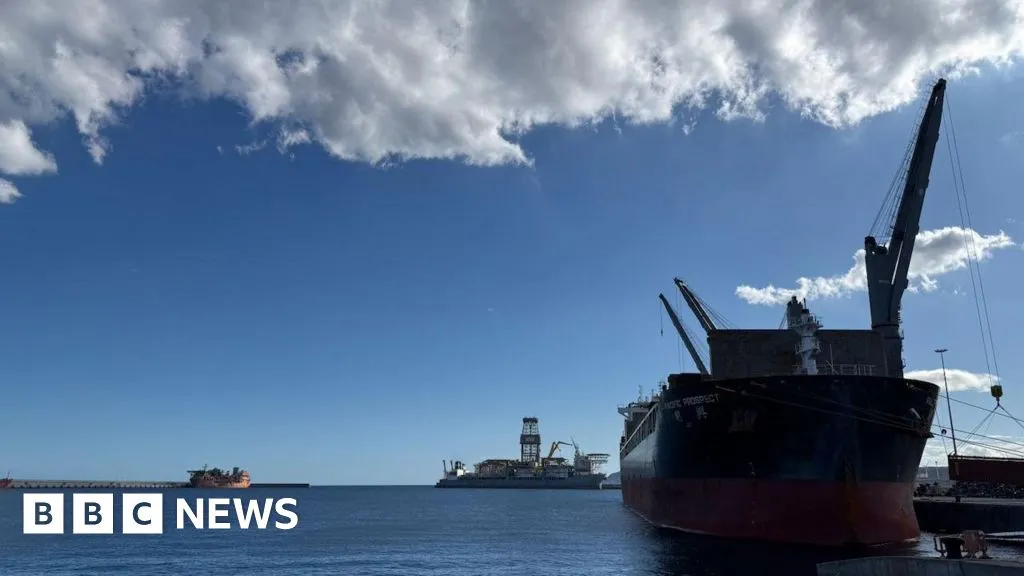
Security measures in the port, an industrial facility in the south of Tenerife, increased notably on Saturday. Spain's military police and disaster response teams have both set up large reception tents and access to the waterfront is restricted.Once the Hondius has been manoeuvred into place, by around 07:00 (06:00 GMT) on Sunday, medical teams will board to check everyone for signs of the virus. Latest reports say nobody else is showing symptoms.People will then be divided into groups by nationality and ferried to the coast in small boats. By then, charter planes should be on the tarmac at the local airport, ready to repatriate them.Earlier on Saturday, the interior minister said the UK, US and multiple EU member states were all sending planes. Medically-equipped aircraft will be on standby, too, should anyone need to be taken into isolation.Otherwise, the Spanish nationals will be flown to Madrid, where they face a mandatory quarantine in the Gomez Ulla military hospital. Complete isolation would be gruelling - the virus has an incubation period of up to nine weeks - and it is not clear how long people in Spain or elsewhere will be quarantined.The head of the World Health Organization (WHO) Tedros Adhanom Ghebreyesus, now in Tenerife to oversee the disembarking, has praised the authorities for their "solid and effective response" to this outbreak.It has been linked to a landfill site in the southernmost tip of Argentina, popular with birdwatchers. The virus is carried there by rodents, and it's rare for it to pass between people, but three cruise passengers have died.So the WHO boss has urged nervous Spaniards to trust those in charge of the evacuation."Your concern is legitimate, because of the experience of Covid: that trauma is still in our minds," he acknowledged. But he added that the risk of wider contagion now was low "because of how the virus works, and because of how the Spanish government has prepared to avoid any problem".Chief intensive care doctor Mar Martin with an intensive care bed at the Candelaria hospitalDozens of intensive care specialists are on stand-by at the Candelaria hospital in Tenerife in case anyone from the Hondius becomes seriously ill during the transfer. A strict isolation facility has one bed fully equipped to deal with infectious diseases, complete with testing kit and a ventilator."We are absolutely ready," chief intensive care doctor Mar Martin told me on the unit, where large numbers of protective suits, masks and gloves are already piled up for staff. "We've never seen [hantavirus] before – but it's a virus, with some complications, just like we manage every day. We are fully trained for that."There was some anger here when people learned the Hondius was being diverted to their island.On Friday, a group of port workers gathered outside the local parliament in noisy protest, concerned that safety measures were not strong enough.Now, there's more clarity – and calm.Grey masks wait in the isolation unit"The virus is dangerous, of course. But they say you need to have very close contact to get it," Jennifer told me, out walking with her child in Tenerife's capital Santa Cruz."If we're careful, we hope it's not too serious."Others were annoyed that Madrid had decided to send the Hondius here - a political concern, rather than a medical one.Some recalled how officials had once made reassuring noises about Covid, too, before the pandemic took hold.But there's no sense of panic here."If they don't come here from the ship, then we're fine," Esteban told me. "If the measures are adequate, then I don't think people here are worried," his partner Isabel agreed.
SRCBBC News - World
LANGEN
LEANCenter
WORDS597
ENT12
SUN · 2026-05-10 · 01:08 GMTBRIEF NSR-2026-0510-74981
NSR-2026-0510-74981News Report·EN·Public Health
Tenerife medics poised for arrival of virus-hit cruise ship
Tenerife is preparing for the arrival of the virus-hit cruise ship Hondius on Sunday. Security measures are heightened at a southern port where medical teams will board to screen passengers.
BBC News - WorldFiled 2026-05-10 · 01:08 GMTLean · CenterRead · 3 min
BBC News - WorldFIG 01
Reading time
3min
Word count
597words
Sources cited
3cited
Entities identified
12entities
Quality score
100%
§ 01
Briefing Summary
AI-generatedNEWSAR · AI
Tenerife is preparing for the arrival of the virus-hit cruise ship Hondius on Sunday. Security measures are heightened at a southern port where medical teams will board to screen passengers. Following checks, passengers will be grouped by nationality and transported ashore by boat, with charter planes from the UK, US, and EU member states ready for repatriation. Spanish nationals will be flown to Madrid for mandatory quarantine. The World Health Organization head is overseeing the operation, praising Spain's response, and urging public trust despite concerns. Intensive care specialists are on standby at Candelaria hospital for any serious cases. The virus, linked to a landfill in Argentina and rarely transmitted between people, has caused three cruise passenger deaths.
Confidence 0.90Sources 3Claims 5Entities 12
§ 02
Article analysis
Model · rule-basedFraming
Public Health
Human Interest
Tone
Measured
AI-assessed
CalmNeutralAlarmist
Factuality
0.80 / 1.00
Factual
LowHigh
Sources cited
3
Well sourced
FewMany
§ 03
Key claims
5 extracted01
Dozens of intensive care specialists are on standby at Candelaria hospital in case anyone from the Hondius becomes seriously ill.
factual
Confidence
1.00
02
The WHO head praised the authorities for their "solid and effective response" to the outbreak.
quoteTedros Adhanom Ghebreyesus (WHO)
Confidence
1.00
03
Medical teams will board the Hondius to check everyone for signs of the virus upon its arrival.
factual
Confidence
1.00
04
Security measures and reception tents have been set up at the port in Tenerife for the arrival of the virus-hit cruise ship Hondius.
factual
Confidence
1.00
05
There was anger and protest from port workers when they learned the Hondius was being diverted to Tenerife.
factual
Confidence
0.90
§ 04
Full report
3 min read · 597 words§ 05
Entities
12 identifiedKey playerOppositionContextPositiveNeutralNegative
Organizations3
§ 06
Keywords & salience
10 termsvirus outbreak
1.00
cruise ship
0.90
tenerife
0.80
medical response
0.80
quarantine
0.70
isolation
0.60
repatriation
0.50
who
0.50
intensive care
0.40
disaster response
0.40
§ 07
Topic connections
Interactive graph No topic relationship data available yet. This graph will appear once topic relationships have been computed.