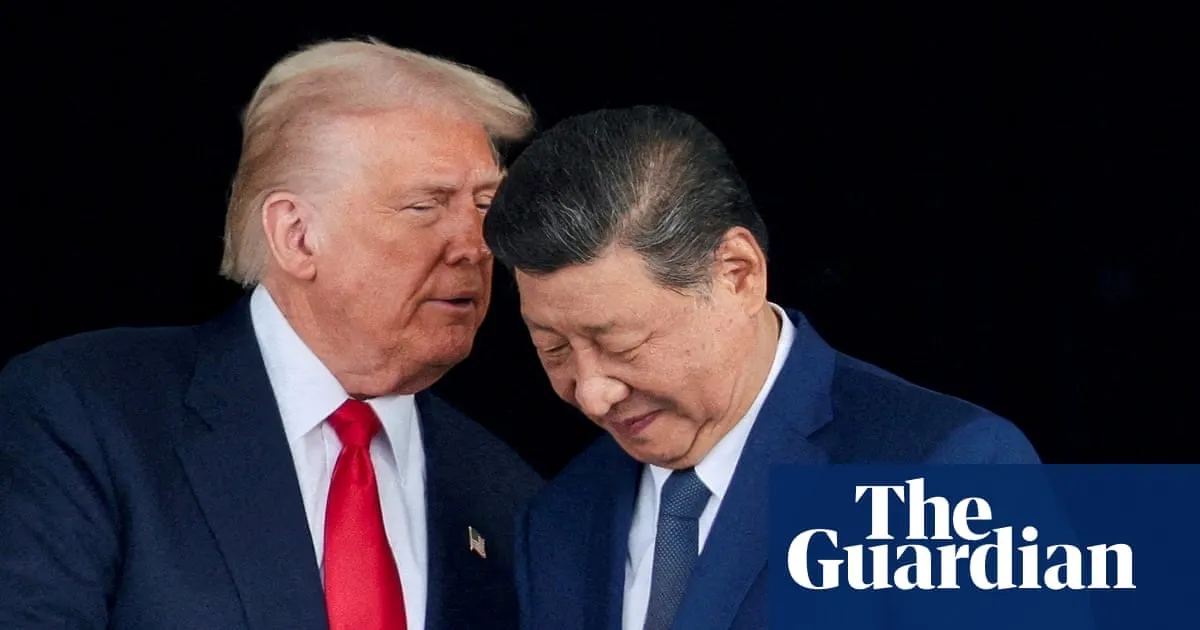
On 20 February, a White House official confirmed that US president Donald Trump would be travelling to Beijing the following month to meet with Chinese leader Xi Jinping. Top of the agenda: the US-China trade war.One week later, Trump approved joint strikes with Israel against Iran, starting a new war in the Middle East. Its ramifications have spread far beyond the region and caused alarm in Beijing. The presidential summit was postponed.Now the highly anticipated meeting between Trump and Xi is expected to take place on 13-15 May in Beijing, and China’s agenda has shifted.Beijing is keen to make sure that the sky-high tariffs that Trump announced last year – which reached as high as 145% before the two sides agreed a truce in October – do not return.But now the more pressing concern is to find a way to reopen the Strait of Hormuz, through which half of China’s crude oil passes. Although China has been more insulated from the energy shock than other Asian countries, thanks to its diversified energy mix and large stockpiles, the risk of a global recession – which the International Monetary Fund has warned is a possible outcome of the Iran war – is a bigger threat to China’s economy. About a fifth of China’s GDP comes from exports. If the rest of the world is no longer able to spend money on goods, China will suffer.“There is no country … whose national interests are advanced by the perpetuation of this conflict,” Ali Wyne, a senior adviser at the International Crisis Group, said in a briefing last week. While “China is much better prepared than many US allies and partners in Asia to weather a short-term disruption to commercial traffic through the Strait of Hormuz … a longer-term disruption becomes more problematic”.The big question hanging over the Trump-Xi summit, then, is what will China do to help to resolve the conflict?Donald Trump and Xi Jinping tour the Forbidden City in 2017. Photograph: Andrew Harnik/APIt was reported last month that China had pushed Iran to the negotiating table with the US in a previous round of ceasefire talks. Last week, Iranian foreign minister Abbas Araghchi met his Chinese counterpart Wang Yi in Beijing. According to the Chinese readout, Wang called for the “comprehensive cessation of hostilities” in the Middle East and said China “supports Iran in safeguarding its national sovereignty and security”.The US is making it increasingly clear that it wants China’s help in striking a deal with Iran. The US treasury secretary, Scott Bessent, has said the administration wanted to see Beijing “step up” pressure on Iran to reopen the waterway.That in itself may influence the dynamic of the meeting between the two strongman leaders.Trump “is in a situation where he is asking the Chinese president to help,” said Dali Yang, a professor of political science at the University of Chicago. That “puts him in a position that he’s not used to”.Influence over Iran may be useful leverage for Beijing in the two other main items on the agenda for the summit: trade and Taiwan.Despite the trade war, China’s trade surplus last year reached a record $1.2tn, with the biggest buyer being the US.The trade war involved so many tit-for-tat policies – from sky-high tariffs to the restriction of rare earth exports by Beijing – that it was almost like the two sides were “sumo wrestling”, said Yang. “The two sides have wrestled to a draw.”Yang, like many analysts, does not expect a major breakthrough on a trade deal. Instead, there could be a broadly worded statement that would “allow each side to claim it’s a productive meeting”. The likeliest outcome may be an extension of the truce that was agreed in South Korea in October.A plastic figure depicting Donald Trump for sale in a store in Beijing. Photograph: Pedro Pardo/AFP/Getty ImagesDa Wei, a professor of international relations at Tsinghua University, said in a recent interview with the German Marshall Fund that such an outcome would be an uneasy compromise for Beijing. “We want stability and predictability. Of course the level of tariff is important, but predictability is more important,” he said. “We don’t want to just review it or postpone it for another year or several months. That would create uncertainty for the business environment.”But Da added that the bigger issue for the summit was the question of arms sales to Taiwan. Last year the US Congress approved an $11bn arms sale package to Taiwan, a self-governing island that Beijing claims as part of its territory. That has reportedly been stalled by the state department ahead of the Trump-Xi summit, but Beijing would like it axed completely.On Friday, after months of wrangling, Taiwan’s legislature approved a $25 billion special defence budget. The budget is around two-thirds of what the government had originally sought, meaning that it will cover US purchases but not domestic weapons production. A state department spokesperson said that further delays in funding domestic capabilities would be “a concession to the Chinese Communist Party”.Beijing knows some matters such as arms sales are subject to congressional oversight rather than being directly controllable by the president. But it may push for greater concessions from Trump on rhetoric. Even a subtle shift such as saying that the US “opposes” Taiwan independence rather than the current wording of “does not support” would be a win for Beijing as it seeks to remould the international outlook according to its worldview, in which Taiwan – a territory never ruled by the Chinese Communist party – is part of China.Wang said on a recent call with the US secretary of state Marco Rubio that Taiwan was “the biggest risk in China-US relations”. China’s foreign minister called on the US to “open up new space for China-US cooperation” over Taiwan.And Beijing sees in the Trump presidency a softer administration than those that came previously – including Trump’s first term in the White House.Trump has relaxed restrictions on the sale of advanced semiconductors to China, shown little support for Taiwan, reportedly ordered the Pentagon to cut references to China being a threat from US defence strategy, and said he expected a “big, fat hug” from Xi in Beijing.China “very much appreciates the respect that President Trump has shown President Xi”, Yang said.Additional research by Yu-chen Li
SRCThe Guardian - World News
LANGEN
LEANCenter-Left
WORDS1 046
ENT12
MON · 2026-05-11 · 23:05 GMTBRIEF NSR-2026-0512-75441
NSR-2026-0512-75441Analysis·EN·Diplomatic
The big questions hanging over the Trump-Xi meeting in China
US President Donald Trump is scheduled to meet with Chinese leader Xi Jinping in Beijing from May 13-15. Originally focused on the US-China trade war and tariffs, the agenda has shifted due to recent US-led strikes against Iran.
Amy Hawkins in BeijingThe Guardian - World NewsFiled 2026-05-11 · 23:05 GMTLean · Center-LeftRead · 5 min
The Guardian - World NewsFIG 01
Reading time
5min
Word count
1 046words
Sources cited
3cited
Entities identified
12entities
Quality score
100%
§ 01
Briefing Summary
AI-generatedNEWSAR · AI
US President Donald Trump is scheduled to meet with Chinese leader Xi Jinping in Beijing from May 13-15. Originally focused on the US-China trade war and tariffs, the agenda has shifted due to recent US-led strikes against Iran. China's primary concern is now the potential disruption to oil shipments through the Strait of Hormuz, which is vital for its energy supply and could trigger a global recession impacting its export-driven economy. The summit's key question is what role China will play in resolving the conflict with Iran, as the US seeks Beijing's assistance in brokering a deal. China has previously engaged with Iran on ceasefire talks and expressed support for Iran's sovereignty.
Confidence 0.90Sources 3Claims 5Entities 12
§ 02
Article analysis
Model · rule-basedFraming
Diplomatic
Economic Impact
Tone
Measured
AI-assessed
CalmNeutralAlarmist
Factuality
0.60 / 1.00
Mixed
LowHigh
Sources cited
3
Well sourced
FewMany
§ 03
Key claims
5 extracted01
Ali Wyne stated that no country benefits from the perpetuation of the conflict in the Middle East.
quoteAli Wyne
Confidence
1.00
02
The US wants China's help in striking a deal with Iran to reopen the strait of Hormuz.
factual
Confidence
1.00
03
China is concerned about the potential return of high tariffs and the impact of the Iran war on global recession risks.
factual
Confidence
1.00
04
The US-China trade war and the conflict in the Middle East were key agenda items for the meeting.
factual
Confidence
1.00
05
US president Donald Trump was scheduled to meet Chinese leader Xi Jinping in Beijing in May.
factual
Confidence
1.00
§ 04
Full report
5 min read · 1 046 words§ 05
Entities
12 identifiedKey playerOppositionContextPositiveNeutralNegative
People4
Organizations2
§ 06
Keywords & salience
8 termstrump-xi meeting
1.00
us-china trade war
0.90
iran conflict
0.80
strait of hormuz
0.70
china's economy
0.60
global recession
0.50
tariffs
0.40
energy shock
0.40
§ 07
Topic connections
Interactive graph Network visualization showing 51 related topics
View Full Graph Person Organization Location Event|Click node to navigate|Edge numbers = shared articles