US President Donald Trump’s landmark visit to China comes as the Iran-war" class="entity-link entity-event" data-entity-id="107864" data-entity-type="event">US-Iran war disrupts global energy supplies, fuels economic uncertainty and adds fresh strain to Washington-Beijing ties. In this story, part of a series examining how rivalry, interdependence and geopolitical crises are reshaping the relationship between the two powers, we examine how artificial intelligence (AI), chip controls and competing technology ecosystems are redefining US-China rivalry.Nvidia CEO Jensen Huang was the undisputed centre of attention at a 1,000-guest banquet in the heart of Beijing in July last year, attended by Chinese government officials, diplomats, businesspeople and industrial leaders.Barely managing a few bites of his dinner, he breezed through a marathon of media interviews and accepted a stream of selfie requests from guests. The rock star treatment even spilled into the hotel lobby when he left, where Huang patiently signed autographs for star-struck fans.
SRCSouth China Morning Post
LANGEN
LEANCenter-Right
WORDS142
ENT8
MON · 2026-05-11 · 22:00 GMTBRIEF NSR-2026-0512-75454
NSR-2026-0512-75454Analysis·EN·Technology
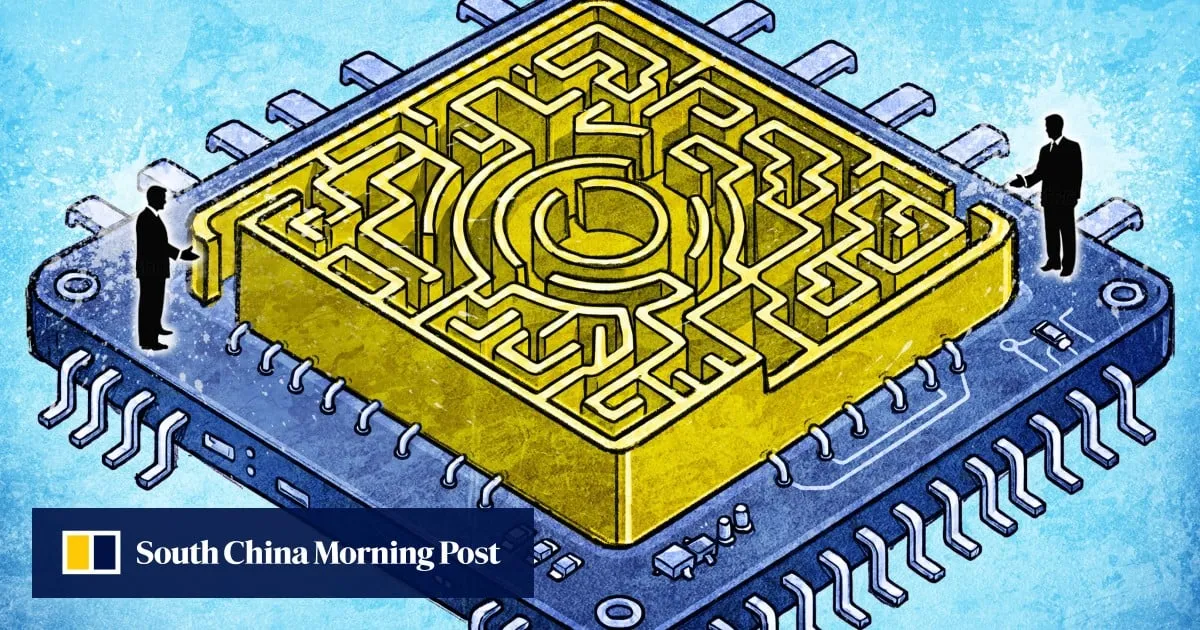
China’s AI ascent leaves Trump a stark choice: escalate or relax chip controls?
The article discusses the intensifying US-China rivalry in the field of artificial intelligence (AI) and semiconductor technology, particularly in the context of Donald Trump's visit to China. It highlights how China's rapid advancement in AI is forcing the US to re-evaluate its chip control policies, presenting Trump with a choice to either escalate or relax these controls.
Ann Cao,Ji SiqiSouth China Morning PostFiled 2026-05-11 · 22:00 GMTLean · Center-RightRead · 1 min
South China Morning PostFIG 01
Reading time
1min
Word count
142words
Sources cited
1cited
Entities identified
8entities
Quality score
100%
§ 01
Briefing Summary
AI-generatedNEWSAR · AI
The article discusses the intensifying US-China rivalry in the field of artificial intelligence (AI) and semiconductor technology, particularly in the context of Donald Trump's visit to China. It highlights how China's rapid advancement in AI is forcing the US to re-evaluate its chip control policies, presenting Trump with a choice to either escalate or relax these controls. The piece uses the example of Nvidia CEO Jensen Huang receiving a celebrity welcome in Beijing, attended by Chinese officials and business leaders, to illustrate the significance of the technology sector in US-China relations. This technological competition, alongside geopolitical crises like the US-Iran war, is reshaping the dynamic between the two global powers.
Confidence 0.85Sources 1Claims 4Entities 8
§ 02
Article analysis
Model · rule-basedFraming
Technology
Diplomatic
Tone
Measured
AI-assessed
CalmNeutralAlarmist
Factuality
0.60 / 1.00
Mixed
LowHigh
Sources cited
1
Limited
FewMany
§ 03
Key claims
4 extracted01
Nvidia CEO Jensen Huang received significant attention at a banquet in Beijing.
quoteNvidia CEO Jensen Huang
Confidence
1.00
02
AI, chip controls, and competing technology ecosystems are redefining US-China rivalry.
factual
Confidence
0.90
03
China's AI ascent presents Donald Trump with a choice regarding US chip controls.
factual
Confidence
0.90
04
The US-Iran war is disrupting global energy supplies and fueling economic uncertainty.
factual
Confidence
0.80
§ 04
Full report
1 min read · 142 words§ 05
Entities
8 identifiedKey playerOppositionContextPositiveNeutralNegative
Organizations1
Locations4
§ 06
Keywords & salience
9 termschip controls
1.00
ai
1.00
us-china rivalry
0.90
technology ecosystems
0.80
geopolitical crises
0.70
economic uncertainty
0.60
donald trump
0.50
nvidia
0.50
global energy supplies
0.40
§ 07
Topic connections
Interactive graph Network visualization showing 51 related topics
View Full Graph Person Organization Location Event|Click node to navigate|Edge numbers = shared articles