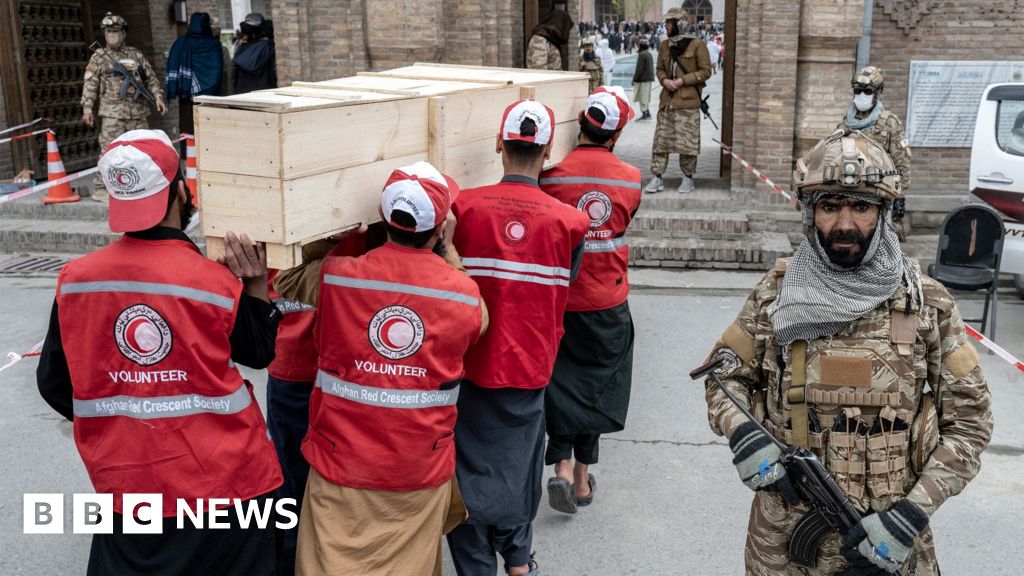
Anadolu via Getty ImagesThe facility had been operating as a drug rehabilitation centre for a decadeFighting between Pakistan and Afghanistan has been going on for months, leaving hundreds dead, most of them from Pakistani airstrikes. Islamabad accuses the Taliban government of sheltering militants who attack Pakistan. Kabul denies doing so.The carnage at the drug rehab centre accounts for most of those killed in the fighting this year. The scale of the death toll is so staggering it has shocked Afghanistan, despite its long familiarity with violent conflict.The UN, which was given access to the site, as well as the BBC's Afghan service teams who were on the ground in the immediate aftermath, confirm the strike hit civilians undergoing treatment. Human Rights Watch called it "an unlawful attack and a possible war crime".But Pakistan disputes it hit a civilian target. In a statement to the BBC it said that "no hospital, no drug rehabilitation centre, and no civilian facility was targeted", adding: "The targets were military and terrorist infrastructure."Masooda is angered by the claim."Pakistan is lying. I have seen it and it wasn't a military camp. There were men admitted there who had come to get healed and return to their families," says Masooda.She is not alone. The BBC has spoken to the families of more than 30 victims – including those of recovering addicts, and employees of the centre - who reject Pakistan's claims.Masooda doesn't know exactly where her brother is buried - he is one of scores placed into the mass grave behind herOmid centre may be located in a former military training compound called Camp Phoenix, which used to be used by the US and NATO forces, but it is far from new.Opened in 2016, after the Americans abandoned the base and five years before the Taliban seized power in 2021, Omid was well-known and had been widely covered by domestic and international news outlets.The BBC had been given access inside the facility in 2023 to speak to recovering addicts."It's literally about a kilometre away from the main UN offices. We have UN agencies, support to the patients of that hospital. So the site was well known to us," said Fiona Frazer, the representative of the UN High Commissioner for Human Rights in Afghanistan.Mirwais – one of an estimated three million Afghans struggling with drug addiction – was one of the newest inpatients.Masooda, who had raised him like a son after the death of their parents, revealed he had been studying to be a pharmacist when he got addicted to 'Tablet-K', the street name of a synthetic drug which, depending on its type, can contain methamphetamine, opioids or MDMA."He was a simple boy who got into a bad habit. He had only been at Omid for 10 days when this happened," Masooda says.The three bombs fell on the facility located on the Kabul-Jalalabad highway at about 20:50 local time on 16 March, one of the doctors on duty at the time told the BBC. He didn't want to be identified because he hadn't been authorised to speak by the Taliban government."One of them hit a hangar-like structure where newly-admitted patients are normally housed," he said."The other two bombs hit containers and wooden blocks that housed patients, as well as food storage units, and offices of the administrative, security and support staff."The UN's Fiona Frazer points out that it also struck "the vocational training areas within the hospital, which were buildings that were mostly made of wood, which then resulted in this very, very large fire".The UN's report into the attack noted that the "leading cause of harm to those killed and injured was shrapnel wounds and burns". It added that "several bodies were unable to be identified because of the nature of their injuries or because they were reduced to dismembered body parts"."I have never seen such a horrific scene in my life," the doctor continued. "I walked amid dead bodies looking for anyone who was alive, looking for people who were screaming for help. The smell of burning flesh was everywhere."In eastern Kabul, Sediq Walizada's phone rang in his home – a relative called to tell him the centre had been bombed. It was the start of an excruciating search for Sediq's brother, 35-year-old Mohammad Anwar Walizada, who had been admitted to Omid just four days before the attack. Like Mirwais, he was struggling with an addiction to Tablet-K, which is increasingly being used in Afghanistan's cities."We moved from one hospital to another. There were so many dead. Their bodies were in pieces and unrecognisable. We were hoping our brother might have escaped," says Sediq, trauma visible on his face.The list of patients admitted to the hospital was destroyed in the fire, according to the UN, making the search for their loved ones extremely difficult for people like Sediq.Every day, Sediq and his other brothers sifted through horrific photos of charred bodies trying to see if they could identify Mohammad Anwar. Four days later, as the world was celebrating Eid, they found one photo of a body that had pieces of clothing and other identifying marks which made them believe it could be their brother."Not knowing whether he was dead or alive was so painful. And then the agony of finding his body severed in half. Still, it is a relief we found our brother. Some families never found their loved ones because the bodies were so burnt," says Sediq, his voice trembling.In a corner of their home is the tricycle cart that Mohammad Anwar sold bottled water from. The father of six children, he was struggling to earn enough to run his home, and had become an addict."He didn't turn to drugs for fun. He turned to it because of helplessness, poverty and hardship," says Sediq.Mohammad Anwar's story mirrors many of those the BBC has been told by grieving families, including Mirwais's."My nephew couldn't find work and poverty forced him into addiction," his uncle, Abdul Wahid, said.The families are also left grappling with why the centre was attacked. "Why did Pakistan do such a thing?" Wahid Sailani, whose brother Ajmal was killed in the strike, asks. "Why did they bomb innocent people?"Pakistan has repeatedly denied those in the centre were innocent. In response to the BBC's questions, the Pakistani military sent a transcript of an interview on Pakistani television channel Geo News TV, in which spokesman Lt Gen Ahmed Sharif Chaudhry claimed "they use these drug addicts as suicide bombers", adding that the centre was "most likely a suicide bomber training facility".Each family we spoke to disputed the allegation."[My late brother] Melad was sick and we took him there for treatment. Everyone knows it was a hospital, not a terrorist centre," Miraj Ali Mohammad told the BBC."I saw the hospital," said Zahidullah Khan, whose brother Rahimullah was killed. "There was nothing there that was military. I even have videos. The people there were addicts."And it was not just the families of drug addicts who spoke out openly.Hedayatullah's brother Emal Abdul Malik was an employee at the centre until he was killed."He worked as an assistant in the hospital kitchen," Hedayatullah said. "They used to cook for all the patients – everyone there was a patient."AFP via Getty ImagesThe Taliban say the death toll in the air strike surpassed 400For the Taliban government in Afghanistan the conflict marks a serious turn in relations with its neighbour. Pakistan's top officials were among the first to visit Afghanistan after the Taliban seized power in 2021. Now the two sides are engaged in a violent conflict, and an almost daily war of words."Targeting innocent civilians is a war crime. International organisations should investigate the incident and prosecute those responsible accordingly," said Hamdullah Fitrat, deputy spokesman of the Taliban government, speaking to the BBC in Kabul about the strike.Pakistan also accuses Afghanistan over the deaths of hundreds of its civilians since last year, alleging the militant groups Tehreek-e-Taliban Pakistan (TTP) and Balochistan Liberation Army (BLA) are behind the attacks, and are being provided refuge by the Taliban government.In a statement to the BBC, Pakistan's military said: "Pakistan, the region, and the wider world continue to face the grave threat of terrorism emanating from territory under the control of the Afghan Taliban regime."
SRCBBC News - World
LANGEN
LEANCenter
WORDS1 371
ENT12
TUE · 2026-05-12 · 07:31 GMTBRIEF NSR-2026-0512-75516
NSR-2026-0512-75516News Report·EN·Human Rights
Pakistan struck a rehab centre and killed 269 Afghans. Their families want to know why
Pakistani airstrikes have killed 269 Afghans at a drug rehabilitation center, marking a significant escalation in ongoing border tensions. Pakistan claims it targeted military and terrorist infrastructure, denying any civilian facility was hit.
BBC News - WorldFiled 2026-05-12 · 07:31 GMTLean · CenterRead · 6 min
BBC News - WorldFIG 01
Reading time
6min
Word count
1 371words
Sources cited
5cited
Entities identified
12entities
Quality score
100%
§ 01
Briefing Summary
AI-generatedNEWSAR · AI
Pakistani airstrikes have killed 269 Afghans at a drug rehabilitation center, marking a significant escalation in ongoing border tensions. Pakistan claims it targeted military and terrorist infrastructure, denying any civilian facility was hit. However, families of victims and the UN confirm the strike impacted civilians undergoing treatment, with Human Rights Watch calling it a potential war crime. The rehabilitation center, known as Omid, had been operating for a decade and was located in a former military compound, but was well-known to international organizations. The incident has caused widespread shock in Afghanistan, and families are seeking answers regarding the attack.
Confidence 0.90Sources 5Claims 5Entities 12
§ 02
Article analysis
Model · rule-basedFraming
Human Rights
Conflict
Tone
Mixed Tone
AI-assessed
CalmNeutralAlarmist
Factuality
0.70 / 1.00
Factual
LowHigh
Sources cited
5
Well sourced
FewMany
§ 03
Key claims
5 extracted01
Human Rights Watch called the attack 'an unlawful attack and a possible war crime'.
quoteHuman Rights Watch
Confidence
1.00
02
The UN and BBC confirm the strike hit civilians undergoing treatment at the rehab centre.
factualUN, BBC
Confidence
0.95
03
Pakistan disputes hitting a civilian target, stating military and terrorist infrastructure were targeted.
factualPakistan (via BBC statement)
Confidence
0.90
04
Pakistan airstrikes hit a drug rehabilitation centre, killing 269 Afghans.
factualAnadolu via Getty Images
Confidence
0.90
05
Families of victims reject Pakistan's claims, stating the centre was for healing, not a military camp.
quoteFamilies of victims (including Masooda)
Confidence
0.85
§ 04
Full report
6 min read · 1 371 words§ 05
Entities
12 identifiedKey playerOppositionContextPositiveNeutralNegative
People1
Organizations7
§ 06
Keywords & salience
9 termsdrug rehabilitation centre
1.00
pakistani airstrikes
0.90
civilian casualties
0.90
war crime
0.80
taliban government
0.70
militant sheltering
0.60
afghanistan conflict
0.50
human rights
0.40
camp phoenix
0.40
§ 07
Topic connections
Interactive graph Network visualization showing 51 related topics
View Full Graph Person Organization Location Event|Click node to navigate|Edge numbers = shared articles