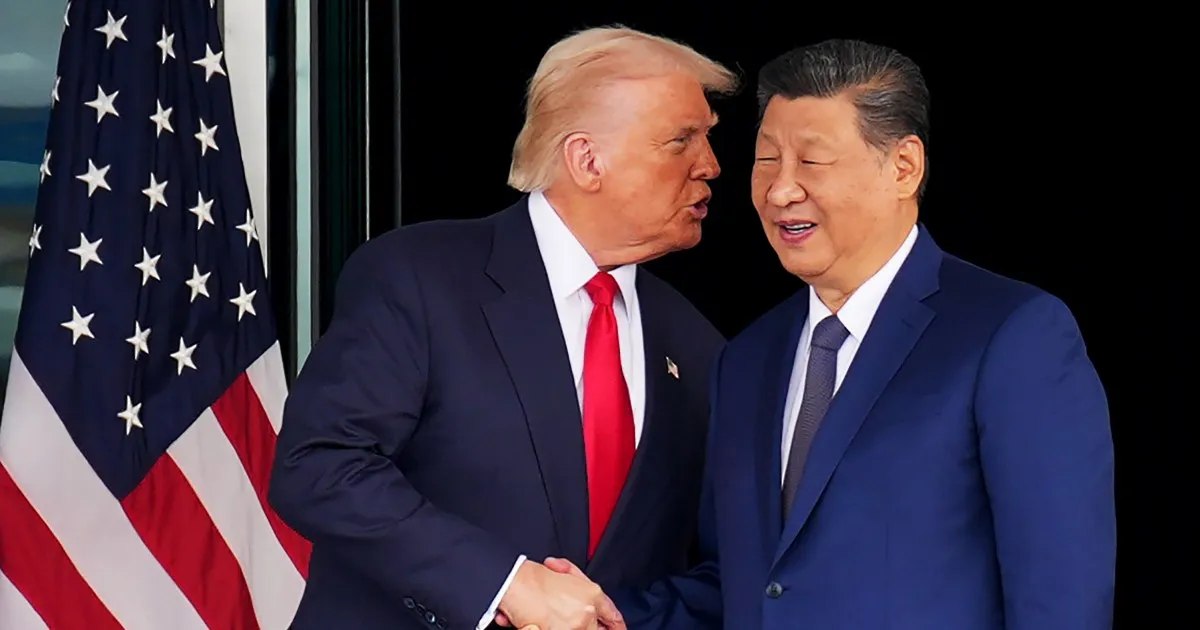
EXPLAINERThe leaders’ upcoming meeting in Beijing has revived the idea of a ‘Group of Two’ between the superpowers.US President Donald Trump and Chinese President Xi Jinping shook hands after a bilateral meeting in Busan, South Korea on October 30, 2025 [File: Andrew Harnik/Getty Images]Published On 12 May 2026US President Donald Trump is set to arrive in Beijing on Wednesday for a two-day summit with China’s President Xi Jinping, marking the two leaders’ first face-to-face talks six months after reaching a trade war truce.The summit, which was delayed from March because of the Iran" class="entity-link entity-event" data-entity-id="38342" data-entity-type="event">US-Israeli war on Iran, comes as Trump needs a foreign policy win amid dissatisfaction at home over the latest Middle East quagmire.Recommended Stories list of 3 itemslist 1 of 3Trump to discuss Iran with Xi Jinping during China visit: Officialslist 2 of 3‘Stupid’: Trump rejects Iran response to US peace proposallist 3 of 3Trump says he will discuss arms sales to Taiwan in meeting with China’s Xiend of listUS-China ties have also been strained by the war, which has damaged Beijing’s economy. Iran’s closure of the Strait of Hormuz and Washington’s competing blockade of Iranian ports have left Chinese ships stranded and severely affected China’s crude oil imports, half of which are shipped from the Middle East.Trump is likely to renew calls for China to join an “international operation” to open the Strait of Hormuz, which Beijing has so far resisted. Xi is expected to look for gains on pressing issues, including trade, rare-earth minerals and a US recognition of China’s rights over self-ruling Taiwan.As Trump threatens to quite NATO over the alliance’s refusal to back the Iran" class="entity-link entity-event" data-entity-id="38342" data-entity-type="event">US-Israeli war on Iran, further distancing the US from its traditional allies, the Trump-Xi summit has revitalised the idea of a Group of Two (G2) – an informal grouping in which the world’s two largest superpowers could steer the world’s collective future.What is a Group of Two – or ‘G2’?The concept of a “G2” between China and the US – similar to the Group of Seven (G7) or Group of 20 (G20) forums gathering the world’s leading industrialised economies – was originally proposed by prominent US economist C Fred Bergsten in 2005.In its original definition, it advocated for a shared responsibility for the world’s two top economies to stabilise global markets and tackle issues of global concern, rather than suggesting a hegemony over others.The concept gained traction during the administration of former US President Barack Obama, who established the Strategic and Economic Dialogue (S&ED) with Chinese President Hu Jintao in 2009 to seek “positive, cooperative, and comprehensive” US-China relations, according to a White House communique at the time.The Obama team believed that strategic engagement with China would be necessary to solve global challenges, including climate change and the transition to clean energy.How likely is a G2 between the US and China?Over the years, the idea that the US and China could be responsible stewards for the collective good has been met with significant scepticism. The idea of a G2 now triggers fears of a departure from a multilateral system towards one in which two superpowers assert their interests over those of other nations.Jing Gu, director of the Centre for Rising Powers and Global Development at the Institute of Development Studies (IDS) in the UK, said the meeting should not be seen as the beginning of a G2, but instead as “strategic reconnaissance”.“Both sides are trying to read the other’s latest bottom line, clarify red lines and test how far pressure can go before stable tension turns into rupture,” Gu told Al Jazeera.“The purpose is not necessarily to end the contest but to understand the terrain, manage the tempo and avoid fighting on unfavourable terms. In that sense, the visit is less about reconciliation than about preserving a controlled tension in which competition can continue without tipping into open collision.”Negotiations on trade, technology, governance and security issues “all sit around this core question: how to keep competition intense but still bounded”, Gu added.Steve Tsang, director of the SOAS China Institute in London, UK, said a trade deal of some sort is likely, “as both want to ensure the meeting [is] a success. But that’s not the same as working as G2, which is unlikely.”“The basic tension is that Trump wants to reassert the US as the most powerful country, and Xi wants the same. They cannot both succeed, even if Xi only wants China to be recognised as pre-eminent rather than as the hegemon,” he added.How friendly are the US and China right now?When Trump and Xi met in South Korea on October 30 and agreed to roll back various trade restrictions after months of negotiations, both sides hailed the meeting as positive.Trump went as far as giving it a “12-out-of-10” rating and touting it as a “G2” meeting, albeit it not resulting in a joint deal or statement that could suggest a formally united front. The characterisation, however, grabbed the headlines as it marked Trump’s recognition of China as a superpower Washington must contend with.Following months of an escalating trade war, Xi also extended an olive branch to Trump when he opened the talks in Busan, describing China’s ambitions as “not incompatible with President Trump’s goal of ‘Making America Great Again'”.As the meeting ended, the leaders shook hands and Xi said their countries should “be partners and friends”, hinting at a partnership reminiscent of the G2 concept. “China and the US can jointly shoulder our responsibility as major countries and work together to accomplish more great and concrete things for the good of our two countries and the whole world,” he said.Below the veneer of cooperation, however, the underlying obstacle to a G2 is that “China is becoming more powerful relative to the US, fuelled in key respects by its rapid emergence as a global technology powerhouse,” John Minnich, a lecturer on US-China relations at the London School of Economics (LSE), told Al Jazeera.While the two superpowers could maintain channels of communication on issues including artificial intelligence (AI) safety, Minnich said the US was unlikely “to quietly accept China as a true technological, economic and military peer”, making “significant cooperation difficult to sustain”.Zhiqun Zhu, director of the China Institute at Bucknell University in the US, said Trump did a “remarkable job” in reversing the previous confrontational approach towards China.“Yet, he is transactional and likes to make deals in the short term. He is not interested in institutionalising his moderate approach to China, which would help create long-term stability and could be a turning point for US-China relations,” Zhu told Al Jazeera.China is also unlikely to be interested in forming a G2 with the US, Zhu said, “because China has always emphasised the authority of the United Nations and has become a defender of the UN-centred international regime in this turbulent world”.China has established itself as a leading proponent of a multipolar world order, Zhu continued, advocating for global affairs to be handled by the international community, rather than a single superpower – or two.How does the rest of the world view all this?According to Gu, at IDS, the formation of a G2 would imply that the rest of the world would accept US–China co-management. “That is doubtful,” the analyst said. “Europe, India, Japan, Brazil, South Africa, the Middle East, ASEAN countries and many developing economies do not want global order to be negotiated over their heads.”Tsang, at the SOAS China Institute, said that if a G2 were to materialise, “the world would be dominated by two self-centred powers only interested in themselves”, while global institutions like the World Trade Organization would be “even less relevant”.The prospect of a G2 raises concerns for allies of the US, who fear that Washington and Beijing could cut them out of important decisions and make deals that work against their interests.Europe is especially worried about a trade deal that cuts it out and accelerates its declining position of strength on the world stage. Transatlantic relations between the EU and the US have been marked by rising tensions on a flurry of issues, including NATO membership, Trump’s claims on Greenland and military assistance to Ukraine since Russia’s invasion in 2022.EU leaders agreed in February on wide-ranging commitments to improve the bloc’s border-free internal market, in a bid to curb its dependency on the US for liquified natural gas (LNG) and on China for critical rare-earth minerals, on which China has a stranglehold and which are vital for the development of technology, defence and a plethora of manufactured goods.French President Emmanuel Macron said at the time that EU leaders shared a sense of “urgency” on this matter due to the superpowers’ attitudes. “We have to accelerate. We are shaken by competition, sometimes by unfair competition and tariffs,” he said.India, Brazil and other major emerging economies within the BRICS grouping of economies also view growing US-China relations as a challenge to their own global superpower aspirations. Recently, New Delhi and Brasilia have been deepening their strategic alliance, agreeing in February to double existing bilateral trade to $30bn by 2030, especially of critical minerals and rare-earth metals.“Any deal involving Chinese investment in the US would direct scarce capital and technology from Global South countries, where Chinese firms have invested heavily in building out clean energy-related manufacturing capacity in recent years, toward the US,” Minnich, at LSE, said.“US-China collusion could also be bad news for Europe, which is caught between and highly vulnerable to coercion from both powers.”While many countries want a stable US-China relationship, ISD senior research fellow Gu said, Europe does not want to “become a rule-taker in a world where Washington and Beijing set the terms of trade, technology, climate finance, AI governance and industrial policy”.“Europe’s anxiety is not only about rivalry; it is also about exclusion,” she said.As for the Global South, “they do not want a world divided into spheres of influence or governed through a bilateral bargain”.“They want options, finance, technology, markets and policy space,” Gu added. “They do not want to be reduced to terrain on which great powers compete.”
SRCAl Jazeera
LANGEN
LEANCenter
WORDS1 667
ENT12
TUE · 2026-05-12 · 14:14 GMTBRIEF NSR-2026-0512-75654
NSR-2026-0512-75654Analysis·EN·Diplomatic
Trump-Xi meeting: Could China, US form a ‘G2’?
US President Donald Trump is scheduled to meet with Chinese President Xi Jinping in Beijing for a two-day summit. This meeting, delayed due to the US-Israeli war on Iran, is Trump's first face-to-face discussion with Xi in six months following a trade war truce.
Federica MarsiAl JazeeraFiled 2026-05-12 · 14:14 GMTLean · CenterRead · 7 min
Al JazeeraFIG 01
Reading time
7min
Word count
1 667words
Sources cited
2cited
Entities identified
12entities
Quality score
100%
§ 01
Briefing Summary
AI-generatedNEWSAR · AI
US President Donald Trump is scheduled to meet with Chinese President Xi Jinping in Beijing for a two-day summit. This meeting, delayed due to the US-Israeli war on Iran, is Trump's first face-to-face discussion with Xi in six months following a trade war truce. The summit occurs amidst strained US-China ties, exacerbated by the war's impact on China's economy and oil imports. Trump is expected to press China to join an operation to reopen the Strait of Hormuz, while Xi will likely seek concessions on trade, rare-earth minerals, and Taiwan. The meeting has also reignited discussions about a "G2," an informal grouping where the two superpowers could jointly address global issues, a concept first proposed in 2005.
Confidence 0.90Sources 2Claims 5Entities 12
§ 02
Article analysis
Model · rule-basedFraming
Diplomatic
Political Strategy
Tone
Measured
AI-assessed
CalmNeutralAlarmist
Factuality
0.60 / 1.00
Mixed
LowHigh
Sources cited
2
Limited
FewMany
§ 03
Key claims
5 extracted01
The idea of a Group of Two (G2) between China and the US was originally proposed by US economist C Fred Bergsten in 2005.
factualC Fred Bergsten
Confidence
1.00
02
US President Donald Trump is set to arrive in Beijing for a two-day summit with China’s President Xi Jinping.
factual
Confidence
1.00
03
Iran’s closure of the Strait of Hormuz and Washington’s competing blockade of Iranian ports have left Chinese ships stranded and severely affected China’s crude oil imports.
factual
Confidence
0.90
04
The summit was delayed from March because of the US-Israeli war on Iran.
factual
Confidence
0.90
05
Trump needs a foreign policy win amid dissatisfaction at home over the latest Middle East quagmire.
factual
Confidence
0.80
§ 04
Full report
7 min read · 1 667 words§ 05
Entities
12 identifiedKey playerOppositionContextPositiveNeutralNegative
Organizations3
Locations6
§ 06
Keywords & salience
8 termsg2
1.00
trump-xi meeting
0.90
us-china relations
0.80
strait of hormuz
0.70
trade war
0.60
taiwan
0.50
rare-earth minerals
0.40
nato
0.40
§ 07
Topic connections
Interactive graph Network visualization showing 51 related topics
View Full Graph Person Organization Location Event|Click node to navigate|Edge numbers = shared articles