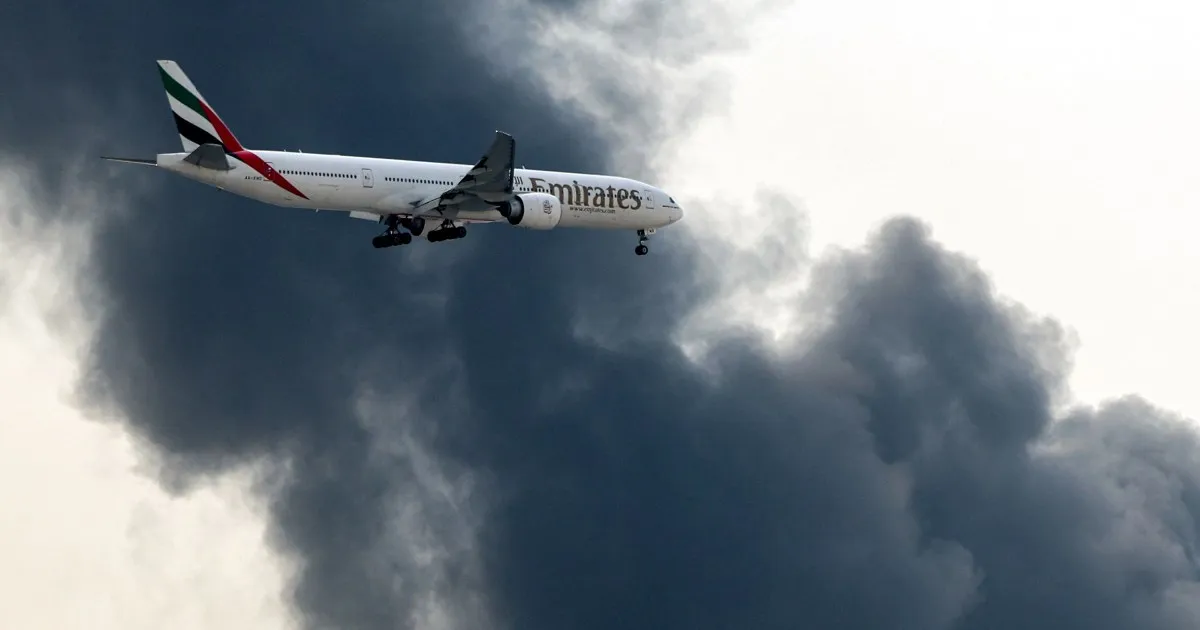
The UAE’s close ties to the US and Israel have placed the Gulf country under Iranian suspicion.An Emirates Boeing 777 aircraft prepares for landing as a smoke plume rises from an ongoing fire at Dubai International Airport in Dubai on March 16, 2026 [File: AFP]Published On 12 May 2026Tehran, Iran – Iranian authorities have increasingly singled out the United Arab Emirates (UAE) in their war messaging, and have warned of stronger strikes against the country if the United States and Israel resume their attacks.“Our label of ‘neighbours’ with the Emirates has for now been lifted, and the label of ‘hostile base’ has been set for the country,” Ali Khezrian, a member of the Iranian parliament’s national security commission, told state television earlier this week.Recommended Stories list of 3 itemslist 1 of 3Kevin Warsh confirmed to US Federal Reserve board in close Senate votelist 2 of 3Israel sent Iron Dome anti-missile batteries and personnel to UAE: US envoylist 3 of 3US faces rising costs with Iran war driving energy prices, inflation higherend of listThe Arab country was also directly referenced in statements issued by the Khatam al-Anbiya Central Headquarters of the Iranian armed forces this month, after Iran and the US traded fire over the Strait of Hormuz, despite a ceasefire announced in April.The joint command, led by generals of the Islamic Revolutionary Guard Corps (IRGC), directly addressed Emirati leaders a week ago, and said they must not turn their country into “the den of Americans and Zionists and their military forces and equipment to betray the world of Islam and Muslims”.It said the UAE’s deepening military, political and intelligence ties with the US and Israel were contributing to regional insecurity, and warned of a “crushing and regret-inducing response” to any more attacks against Iran’s southern islands and ports.The IRGC has also declared that the UAE’s critical port of Fujairah sits on an area of the Strait of Hormuz over which Iran exerts maritime control, therefore subjecting any ship travelling to or from the port to be in Iran’s jurisdiction. The port was struck earlier this month, but Iran denied responsibility.The UAE, for its part, has repeatedly condemned Iranian attacks and said it reserves the right to respond, including through military means.It has also terminated visas for Iranians living there for years, and closed down Iranian businesses, trade routes, currency exchange networks, and institutions.The darkening relations between the two countries have had significant ramifications for Iran, as well, which brought in much of its imports from third markets, including China, through Emirati ports.Iranian authorities have been trying to replace lost sea routes with land routes through Pakistan, Iraq, Turkiye and other neighbours, as a result of the US naval blockade of Iran’s ports, and subsequent skyrocketing food inflation.Why has Iran focused on the UAE?The US military has had a significant presence on the UAE’s soil for years, including in the al-Dhafra airbase located just outside of Abu Dhabi, which holds thousands of US troops and advanced equipment, namely radar and intelligence systems that the IRGC said it targeted during the war.In 2020, the UAE, along with Bahrain and Morocco, signed the Abraham Accords brokered by Washington to normalise relations with Israel.US President Donald Trump has said he wants to expand the deals, which he brokered during his first presidential term, particularly by persuading Saudi Arabia to join. Israel’s genocidal war on Gaza has halted the process for now.Trump has also praised the UAE’s president, Mohammed bin Zayed Al Nahyan, as a smart leader who may want to “go his own way” after he pulled the UAE out of OPEC last month.Since the signing of the Abraham Accords, Israel and the UAE have quickly expanded military and intelligence cooperation, and Israel’s weapons manufacturer Elbit Systems has established a subsidiary in the Gulf country.During the current war, Israel has also sent its Iron Dome missile defence technology – and dozens of troops reportedly required to operate it – to the UAE, something not done anywhere else in the Arab world.In an event in Tel Aviv on Tuesday, US ambassador Mike Huckabee said the deployment of the advanced radars and missile batteries are due to “an extraordinary relationship between the UAE and Israel based on the Abraham Accords”.Anwar Gargash, an adviser to the UAE’s president, said on March 17 that Iranian attacks on its Arab neighbours would serve to strengthen relations between Israel and states that have diplomatic ties with Israel.The country has also said its foreign relations and international defence partnerships are a “purely sovereign matter”, and that Tehran has been attempting to mislead the international community and justify attacking by saying the territory and airspace of Arab countries are used to facilitate attacks on Iran.The UAE also has a long-running dispute with Iran over the islands of Greater Tunb, Lesser Tunb and Abu Musa, which have been controlled by Iran since 1971 and are considered crucial for enforcing control over the Strait of Hormuz.Reem al-Hashimy, the UAE’s minister of state for International cooperation, explained last month why she believed her country had been attacked by Iran during the war.“We represent economic prosperity, welcoming over 200 nationalities and embracing cultural diversity,” she said, adding that Iran has “exhausted its wealth” on its nuclear programme, support for the regional anti-US “axis of resistance”, and projectiles.Did the UAE directly attack Iran?Thanks to its wealth and military agreements with its Western allies, the UAE operates an air force equipped with advanced technologies and warplanes.Just more than a week after the war started on February 28, Israeli media reported that UAE fighter jets directly carried out air strikes against a water desalination facility in Iran’s Qeshm Island. But Ali al-Nuaimi, a senior UAE official, dismissed the report as “fake news”, asserting, “When we do something, we have the courage to announce it.”Tehran blamed the US-Israel coalition, and the IRGC said it launched “precision-guided solid-fuel and liquid-fuel missiles” towards the Juffair base in Bahrain since it believed the US base was used to launch the strike.In early April, a war-focused programme on Iranian state broadcaster IRIB showed an image of the wreckage of what it said was a downed Chinese-made Wing Loong drone. The model has previously been used by the UAE against the Iran-backed Houthis in Yemen, among other places.At the same time, Iranian state media and commentators have increasingly suggested that the UAE may have been involved in strikes on Iranian territory during the war, including attacks that damaged oil facilities on islands in Iran’s southern waters.While Iranian military commanders and politicians have not officially blamed the UAE for any attacks, multiple programmes on state television have pointed the finger towards the UAE.On the morning of April 8, after Trump announced the ceasefire shortly before a deadline he had given to bomb Iran’s power plants, footage and reports from Iranian media indicated attacks on the oil refinery in Lavan, as well as explosions in Siri. Israel and the US said they were not involved.Shortly after, in IRGC Telegram channels and online outlets, an image circulated that purported to show a French-made Mirage 2000-9, operated by the UAE, flying over southern Iran. State-linked media widely reported, without clear attribution, that the UAE’s Mirage fighters carried out the attacks.Iranian state-linked analysts have also pointed out that in a video released by Syria’s President Ahmed al-Sharaa late last month, when he was being escorted by UAE fighter jets, the F-16E warplanes shown had their national markings and tail numbers stripped. They interpreted this as circumstantial evidence showing that the UAE may have been using the jets against Iran and wanted to limit risks in case they were intercepted.
SRCAl Jazeera
LANGEN
LEANCenter
WORDS1 269
ENT10
TUE · 2026-05-12 · 19:37 GMTBRIEF NSR-2026-0512-75729
NSR-2026-0512-75729Analysis·EN·Conflict
Why is Iran increasingly targeting the UAE in its war messaging?
Iran is increasingly targeting the UAE in its war messaging, labeling the Gulf nation a "hostile base" due to its close ties with the US and Israel. This shift in rhetoric, highlighted by statements from Iranian parliament members and the IRGC, follows recent exchanges of fire between Iran and the US.
Maziar MotamediAl JazeeraFiled 2026-05-12 · 19:37 GMTLean · CenterRead · 6 min
Al JazeeraFIG 01
Reading time
6min
Word count
1 269words
Sources cited
3cited
Entities identified
10entities
Quality score
100%
§ 01
Briefing Summary
AI-generatedNEWSAR · AI
Iran is increasingly targeting the UAE in its war messaging, labeling the Gulf nation a "hostile base" due to its close ties with the US and Israel. This shift in rhetoric, highlighted by statements from Iranian parliament members and the IRGC, follows recent exchanges of fire between Iran and the US. Iran warns of stronger strikes against the UAE if the US and Israel resume attacks, accusing Emirati leaders of allowing their country to become a base for American and Zionist forces. The IRGC also claims maritime control over areas near the UAE's Fujairah port. The UAE has condemned Iranian attacks and taken measures against Iranian businesses and individuals.
Confidence 0.90Sources 3Claims 5Entities 10
§ 02
Article analysis
Model · rule-basedFraming
Conflict
Diplomatic
Tone
Mixed Tone
AI-assessed
CalmNeutralAlarmist
Factuality
0.60 / 1.00
Mixed
LowHigh
Sources cited
3
Well sourced
FewMany
§ 03
Key claims
5 extracted01
The UAE has terminated visas for Iranians, closed Iranian businesses, trade routes, and currency exchange networks.
factualarticle
Confidence
0.95
02
An Iranian parliament member stated the UAE's label has been lifted from 'neighbors' to 'hostile base'.
quoteAli Khezrian
Confidence
0.95
03
The IRGC declared the UAE's port of Fujairah is within Iran's maritime control zone, subjecting ships to Iranian jurisdiction.
quoteIRGC
Confidence
0.90
04
Iranian authorities have increasingly singled out the UAE in their war messaging, warning of stronger strikes if the US and Israel resume attacks.
quoteIranian authorities
Confidence
0.90
05
Iran has been trying to replace lost sea routes through Emirati ports with land routes due to the US naval blockade.
factualarticle
Confidence
0.85
§ 04
Full report
6 min read · 1 269 words§ 05
Entities
10 identifiedKey playerOppositionContextPositiveNeutralNegative
Organizations2
§ 06
Keywords & salience
8 termsiran uae relations
1.00
war messaging
0.90
us israel ties
0.80
iranian suspicion
0.70
islamic revolutionary guard corps
0.60
strait of hormuz
0.60
regional insecurity
0.50
military response
0.40
§ 07
Topic connections
Interactive graph Network visualization showing 51 related topics
View Full Graph Person Organization Location Event|Click node to navigate|Edge numbers = shared articles