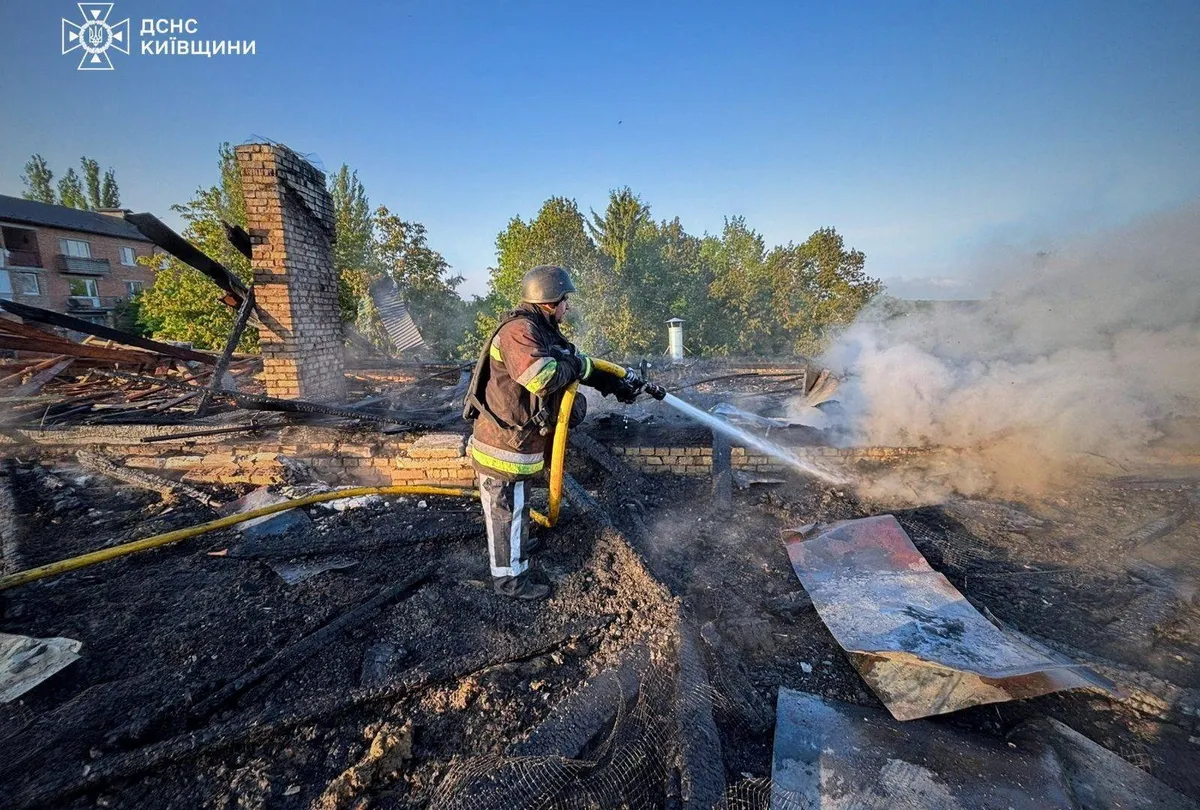
Warring sides resumed fighting after the three-day ceasefire came to an end.A firefighter works at the site of a kindergarten damaged during a Russian drone attack, amid Russia's attack on Ukraine in the Kyiv region Ukraine May 12, 2026 [Reuters]Published On 12 May 2026Ukraine has struck gas facilities in southwest Russia’s Orenburg region, more than 1,500km (932 miles) from the Ukrainian border, according to President Volodymyr Zelenskyy.Zelenskyy said in his daily video address on Tuesday evening that the attack was a retaliation for Russia’s overnight attacks on Ukraine. “Ukraine has said that we will act symmetrically in response to Russia,” he said.Recommended Stories list of 3 itemslist 1 of 3Russia and Ukraine accuse the other of ceasefire violationslist 2 of 3EU, UK sanction Russians over deportations of Ukrainian childrenlist 3 of 3Zelenskyy says Russia fired over 200 drones at Ukraine as truce expiresend of listEvgeny Solntsev, the governor of Orenburg – home to one of the world’s largest gasfields and containing industrial infrastructure considered vital to Russia’s military and economy – claimed that nine Ukrainian drones were repelled over the region.The fragments of the downed drones damaged a residential building, a nearby school and a kindergarten, without causing any injuries, he said.Ukraine’s latest attacks on Russia came hours after Moscow launched a series of overnight attacks on its neighbour, killing six people in the region of Dnipropetrovsk, as the three-day ceasefire brokered by United States President Donald Trump came to an end.The pause in hostilities coincided with Russia’s Victory Day celebrations, marking the Soviet defeat of Nazi Germany in the second world war. Foreign Minister Andrii Sybiha said Kyiv had offered to extend the ceasefire, but Moscow refused.Zelenskyy said Ukraine had been attacked by more than 200 drones, which damaged energy facilities, apartment buildings, a kindergarten and a civilian train. He added that drones had been intercepted across six regions.On Tuesday, Russia tested its new nuclear-capable intercontinental missile, which President Vladimir Putin said would be deployed by the end of the year.Putin described the weapon as the “most powerful” nuclear missile in the world, saying it was capable of travelling more than 35,000 kilometres (21,748 miles).“It has the ability to penetrate all existing and future anti-missile defence systems,” he said in televised comments.Analysts have previously accused Putin of exaggerating Russia’s military capabilities.Peace talksOn Saturday, Putin suggested the war in Ukraine, which began more than four years ago, was nearing its end.The Kremlin reiterated that claim on Tuesday, with spokesperson Dmitry Peskov saying progress made in talks with both the US and Ukraine would soon bring the conflict to a close, while cautioning that it was too early to provide specifics.“This accumulated groundwork in terms of the peace process allows us to say that the completion is indeed approaching,” Peskov told reporters.Zelenskyy, however, disagreed a day earlier and warned that Ukraine was preparing for further attacks. “Russia has no intention of ending this war. And we are, unfortunately, preparing for new attacks,” he said.Kaja Kallas, the European Union’s foreign policy chief, said Putin’s comments were a sign of weakness.“What his statement really shows is that he’s not in a strong position,” she said. “So, I think there’s an opportunity for ending this war.”Talks aimed at ending the conflict have so far failed to achieve a significant breakthrough, stalling in recent months. US President Donald Trump made ending what has become a war of attrition a key pledge during his 2024 election campaign.On Tuesday, as he left the White House for a trip to China, Trump told reporters, “The end of the war in Ukraine, I really think it’s getting very close.”On Monday, the Kyiv Independent newspaper reported that Washington was attempting to negotiate another temporary ceasefire that would include sanctions relief for Russia.Ukrainian officials are reportedly concerned that the proposed agreement does not include security guarantees, which Kyiv views as essential to deterring future aggression from Moscow.
SRCAl Jazeera
LANGEN
LEANCenter
WORDS646
ENT10
TUE · 2026-05-12 · 19:36 GMTBRIEF NSR-2026-0512-75730
NSR-2026-0512-75730News Report·EN·Conflict
Ukraine hits Russia’s distant gas facilities after Moscow’s attacks kill 6
Ukraine has struck gas facilities in Russia's Orenburg region, over 1,500 km from its border, in retaliation for Russian overnight attacks. President Zelenskyy stated this action was a symmetrical response to Russia's aggression.
Al Jazeera StaffAl JazeeraFiled 2026-05-12 · 19:36 GMTLean · CenterRead · 3 min
Al JazeeraFIG 01
Reading time
3min
Word count
646words
Sources cited
5cited
Entities identified
10entities
Quality score
100%
§ 01
Briefing Summary
AI-generatedNEWSAR · AI
Ukraine has struck gas facilities in Russia's Orenburg region, over 1,500 km from its border, in retaliation for Russian overnight attacks. President Zelenskyy stated this action was a symmetrical response to Russia's aggression. The drone attacks on Ukraine killed six people in the Dnipropetrovsk region and damaged energy facilities, residential buildings, and a kindergarten. Russia claimed to have repelled nine Ukrainian drones over Orenburg, with fragments damaging civilian infrastructure. These events occurred as a three-day ceasefire, brokered by President Trump, expired. The conflict resumed following Russia's Victory Day celebrations, with Ukraine alleging Moscow refused a ceasefire extension.
Confidence 0.90Sources 5Claims 5Entities 10
§ 02
Article analysis
Model · rule-basedFraming
Conflict
Political Strategy
Tone
Mixed Tone
AI-assessed
CalmNeutralAlarmist
Factuality
0.70 / 1.00
Factual
LowHigh
Sources cited
5
Well sourced
FewMany
§ 03
Key claims
5 extracted01
Ukraine has struck gas facilities in southwest Russia’s Orenburg region, more than 1,500km from the Ukrainian border.
factualPresident Volodymyr Zelenskyy
Confidence
0.90
02
Ukraine offered to extend the ceasefire, but Moscow refused.
factualAndrii Sybiha
Confidence
0.85
03
Russia launched overnight attacks on Ukraine, killing six people in the region of Dnipropetrovsk.
factualArticle
Confidence
0.85
04
Nine Ukrainian drones were repelled over Orenburg region, with fragments damaging residential buildings, a school, and a kindergarten without injuries.
factualEvgeny Solntsev
Confidence
0.80
05
Russia tested its new nuclear-capable intercontinental missile, described as the 'most powerful' and capable of travelling more than 35,000 km.
factualPresident Vladimir Putin
Confidence
0.75
§ 04
Full report
3 min read · 646 words§ 05
Entities
10 identifiedKey playerOppositionContextPositiveNeutralNegative
People5
Locations4
§ 06
Keywords & salience
10 termsukraine war
1.00
gas facilities
0.90
drone attacks
0.80
retaliation
0.70
ceasefire
0.60
energy facilities
0.50
military
0.50
volodymyr zelenskyy
0.40
vladimir putin
0.40
nuclear missile
0.40
§ 07
Topic connections
Interactive graph Network visualization showing 51 related topics
View Full Graph Person Organization Location Event|Click node to navigate|Edge numbers = shared articles