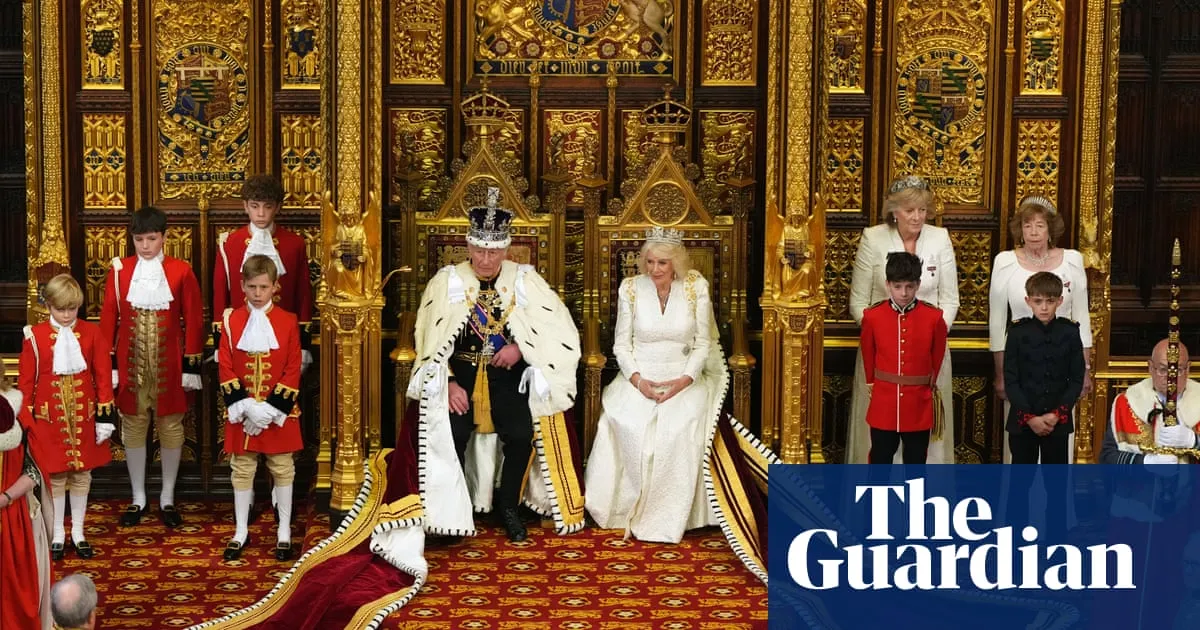
What is the king’s speech?The king’s speech is the centrepiece of the state opening of parliament, the main ceremonial event of the parliamentary calendar, and the only regular occasion when the three constituent parts of parliament – the sovereign, the House of Lords and the House of Commons – meet. It marks the start of the new parliamentary year,Who writes it?Although delivered by the monarch in their constitutional role as the UK head of state, the speech is written by the government to outline its policies and proposed legislation for the new parliamentary session. Formally called the “speech from the throne” because it is delivered from the throne of the House of Lords, the monarch reads it out in a neutral tone. Whatever their private feelings the monarch must not show any preference for any political party or its policies.What is the backdrop to this speech?The event is taking place as the prime minister, Keir Starmer, fights for his future in Downing Street after heavy losses in the 7 May elections. Royal sources reportedly told Politico on Tuesday that the ceremony could prove embarrassing for the king if he had to read out something that may or may not still be the government’s programme by the end of the week.Politico said in one recent discussion that Charles’s senior aide asked top government officials whether the king should go ahead with Wednesday’s ceremony, and was told that it was constitutionally correct for the monarch to open parliament on Wednesday as planned. Buckingham Palace declined to comment on the report. The palace sees state opening as a matter for the government and it is understood that at no time did, nor would, anyone ever suggest state opening might not go ahead.What is the history of the king’s speech?The tradition of a king’s speech has its origins in the medieval parliament, but the speech from the throne as we know it today is said to have evolved in the 17th century when parliament finally established its power over the monarch. The current ceremony dates from the opening of the rebuilt Palace of Westminster in 1852. Much of the modern ritual is said to be a Victorian concoction.What else happens at state opening? The king’s procession from Buckingham Palace to Westminster uses an ornate horse-drawn carriage and is escorted by members of the Household Cavalry. A separate coach carries the royal regalia – the imperial state crown, the cap of maintenance and sword of state – to Westminster. Charles arrives at the Palace of Westminster Sovereign’s Entrance and goes to the robing room.Wearing the imperial state crown and his official robes of state, he then leads the royal procession to the House of Lords. Before the king arrives, the Yeomen of the Guard carry out a ceremonial search of the cellars of the Palace of Westminster for explosives to commemorate Guy Fawkes’s 1605 gunpowder plot. A member of the Commons is “held hostage” in Buckingham Palace while the king is in parliament, to ensure the monarch’s safe return.The House of Lords official known as Black Rod is sent to summon the Commons. The doors to the Commons chamber are shut in their face: a practice dating back to the civil war, symbolising the Commons’ independence from the monarchy. Black Rod strikes the door three times before it is opened. Members of the House of Commons then follow Black Rod and the Commons speaker to the Lords chamber, standing at the opposite end to the throne, known as the Bar of the House, to listen to the speech.What was in the speech?The table below shows all the government bills in the parliamentary session that ended on Tuesday, the first session since Labour came to power. It is, in a sense, an end-of-term report card for Labour’s first two years in charge of the legislature.To become law, proposed legislation has to pass three readings in both Houses of Parliament. There are numerous stages at which amendments may be made and voted upon, chiefly between the second and third readings, during the committee stage. When a bill has passed through a third reading in both houses it is returned to the Commons (where it started) for any amendments made by the Lords to be considered. If MPs do not accept amendments made by peers, or vice versa, the bill can “ping-pong” between the houses until consensus on the exact wording is reached. After that, the bill receives “royal assent” and becomes law.By convention a bill that has not passed by the end of a session is abandoned but it is now possible to carry off important legislation from one session to the next, and it is expected that this will apply to the Representation of the People bill, which would allow voting at 16.
SRCThe Guardian - World News
LANGEN
LEANCenter-Left
WORDS797
ENT9
WED · 2026-05-13 · 11:20 GMTBRIEF NSR-2026-0513-75889
NSR-2026-0513-75889News Report·EN·Political Strategy
What is the king’s speech and what is the state opening of parliament?
The King's Speech, also known as the "speech from the throne," is the central event of the State Opening of Parliament, marking the start of the new parliamentary year. Delivered by the monarch from the House of Lords, it outlines the government's policies and proposed legislation for the upcoming session.
Caroline DaviesThe Guardian - World NewsFiled 2026-05-13 · 11:20 GMTLean · Center-LeftRead · 4 min
The Guardian - World NewsFIG 01
Reading time
4min
Word count
797words
Sources cited
2cited
Entities identified
9entities
Quality score
100%
§ 01
Briefing Summary
AI-generatedNEWSAR · AI
The King's Speech, also known as the "speech from the throne," is the central event of the State Opening of Parliament, marking the start of the new parliamentary year. Delivered by the monarch from the House of Lords, it outlines the government's policies and proposed legislation for the upcoming session. Although read by the King, the speech is written by the government, and the monarch must maintain a neutral tone. This year's ceremony occurs amidst political uncertainty for the Prime Minister. The tradition dates back to medieval times, with the modern ceremony evolving in the 17th century and the current ritual largely established in the Victorian era. The State Opening involves a ceremonial procession and the transport of royal regalia.
Confidence 0.90Sources 2Claims 5Entities 9
§ 02
Article analysis
Model · rule-basedFraming
Political Strategy
Human Interest
Tone
Measured
AI-assessed
CalmNeutralAlarmist
Factuality
0.70 / 1.00
Factual
LowHigh
Sources cited
2
Limited
FewMany
§ 03
Key claims
5 extracted01
The current ceremony dates from the opening of the rebuilt Palace of Westminster in 1852.
factual
Confidence
1.00
02
The tradition of a king's speech has origins in the medieval parliament and evolved in the 17th century.
factual
Confidence
1.00
03
The King's Speech is written by the government to outline its policies and proposed legislation for the new parliamentary session.
factual
Confidence
1.00
04
The King's Speech is the centerpiece of the state opening of parliament, marking the start of the new parliamentary year.
factual
Confidence
1.00
05
Royal sources reportedly told Politico that the ceremony could prove embarrassing for the king.
factualRoyal sources (reported by Politico)
Confidence
0.80
§ 04
Full report
4 min read · 797 words§ 05
Entities
9 identifiedKey playerOppositionContextPositiveNeutralNegative
Organizations3
§ 06
Keywords & salience
10 termsstate opening of parliament
1.00
king's speech
1.00
parliamentary calendar
0.80
monarch
0.70
government policies
0.70
proposed legislation
0.60
house of lords
0.50
house of commons
0.50
constitutional role
0.50
victorian era
0.40
§ 07
Topic connections
Interactive graph No topic relationship data available yet. This graph will appear once topic relationships have been computed.