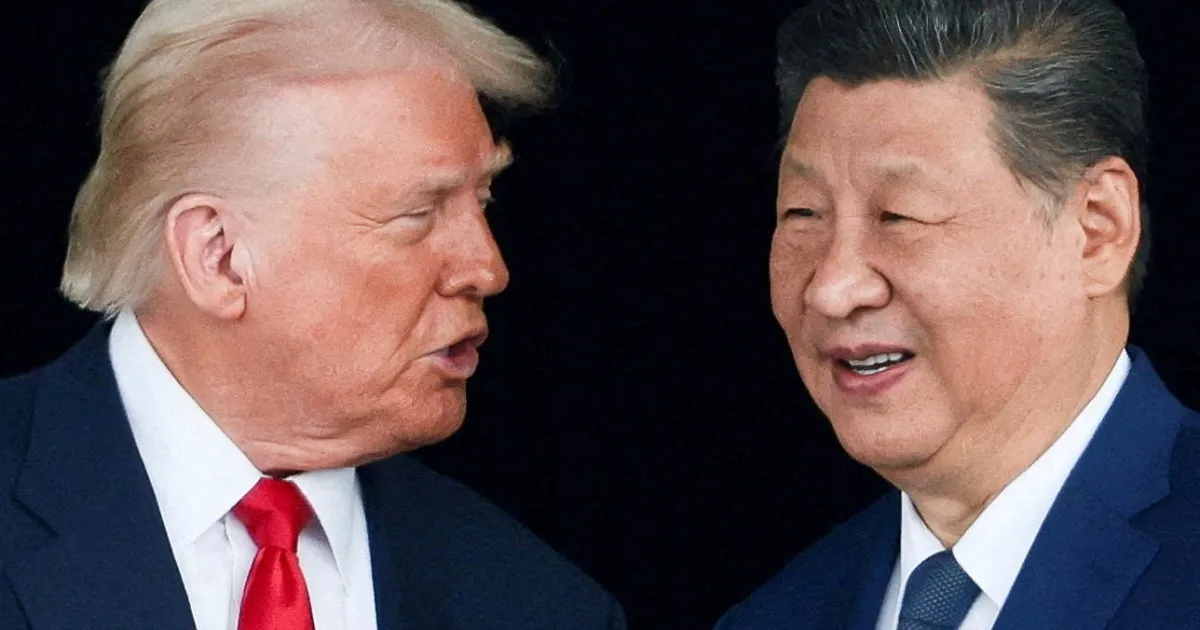
As the Iran-war" class="entity-link entity-event" data-entity-id="38748" data-entity-type="event">Iran war reshapes global power dynamics, Beijing enters the Trump-Xi summit with growing leverage over Washington.Founding director of the China Institute and Mactaggart Research Chair Emeritus at the University of Alberta.Published On 13 May 2026US President Donald Trump and Chinese President Xi Jinping are set to hold talks in Beijing after Trump arrived in China on Wednesday for a two-day state visit, his first trip to the country since returning to office. [Evelyn Hockstein/File Photo/Reuters]In the past few months, the geopolitical chessboard has tilted dramatically, setting the stage for a highly anticipated yet asymmetrical summit between Donald Trump and Xi Jinping, now officially confirmed for May 13-15 following statements from both the White House and China’s Foreign Ministry. Washington has repeatedly signalled the importance it attaches to the meeting, while Beijing has approached it in its characteristically measured fashion, framing the summit less as a breakthrough than as part of the broader need for “communication” and “strategic guidance” between major powers.This subtle diplomatic choreography speaks volumes about the shifting global balance of power. For the first time in decades, it is the United States that finds itself in a position of profound vulnerability, increasingly dependent on China’s cooperation to extricate itself from a self-inflicted disaster.The source of this American predicament is the failure of its recent military adventurism in the Middle East. Having launched an illegal, unprovoked war against Iran alongside Israel, the US military has found itself trapped in a costly and protracted deadlock. In retaliation, Tehran has effectively choked off the Strait of Hormuz, with over a dozen US warships now enforcing a blockade that has rerouted dozens of vessels, sending shockwaves through global energy markets and raising fears of a worldwide economic meltdown. Washington now finds itself scrambling for an exit.In a striking reversal of their usual hawkish rhetoric, top US officials — including Secretary of State Marco Rubio and Treasury Secretary Scott Bessent—have been making increasingly desperate public appeals for China to intervene. They are urging Beijing to use its considerable influence to convince Iran to reopen the vital waterway.What makes this dynamic particularly striking is the contradiction at the heart of US policy. Even as Trump and Rubio appeal for China’s help on the Hormuz crisis, the broader US posture remains confrontational, with ongoing disputes over technology restrictions and other issues continuing to shadow the relationship. The contradiction exposes an administration increasingly driven by desperation.Washington’s narrative conveniently frames China as the party most desperate for a resolution, citing Beijing’s heavy reliance on Middle Eastern energy imports. However, this assessment drastically miscalculates China’s strategic preparedness. Far from being paralysed by the disruption, Beijing has already demonstrated remarkable resilience. Through meticulous stockpiling, diversified supply chains, and robust domestic production, China has coped with the closure exceptionally well, avoiding the kind of immediate economic shock Washington appeared to expect.Consequently, Beijing views the Hormuz standoff as a pivotal stress test it has already passed. Knowing the stakes, China is in no rush to bail out a belligerent Washington. Recent diplomatic engagements have made this increasingly clear. China has maintained close communication with Iran throughout the crisis, with Foreign Minister Wang Yi hosting his Iranian counterpart for talks on the situation. Rather than simply pressuring Iran to reopen Hormuz, Beijing is positioning itself to demand a comprehensive “grand bargain.” Why settle for a minor concession when you can force the US to cease its hostilities against Iran, lift its crippling sanctions, and accept a new multipolar security architecture in the Middle East?Iran has submitted a response to a US proposal to end the war, focused on ceasing hostilities and addressing Strait security, which Trump promptly rejected as “completely unacceptable,” highlighting the continued deadlock Washington hopes Beijing can break.China did not start this fire, but it is now the indispensable power capable of extinguishing it, and strictly on its own terms. Beyond the immediate crisis, Beijing’s ultimate strategic focus remains unwavering: the core issue of Taiwan. This broader assertiveness will undoubtedly carry over into the Trump-Xi summit. While Trump is desperate for tangible deliverables and a successful photo-op to distract from domestic turmoil, Xi can afford to play the long game.Unlike previous administrations that settled for vague diplomatic pleasantries, Beijing is expected to intensify the pressure significantly. China will likely demand that the US explicitly oppose Taiwan independence, moving decisively beyond the current, tepid commitment to merely “not support” secessionist forces.Recognising Trump’s eagerness for a win, the US president may attempt to use Taiwan as a bargaining chip. He could offer concessions on the issue in exchange for Chinese cooperation on reopening the Strait of Hormuz, massive purchases of American agricultural and energy products, or even help brokering peace in other conflicts.However, Beijing is far too disciplined to fall for such short-term traps. Taiwan is a non-negotiable core interest, and any temporary trade-off would be strategically foolish.While Trump may lavish praise on his personal relationship with Xi Jinping and project an image of amicable deal-making, Beijing harbours no illusions about the man across the table. China’s leadership understands that Trump cannot be trusted; any agreement reached today could be discarded tomorrow based on his whims or domestic political calculations. Even as Beijing entertains the prospect of a “grand bargain” and maintains a cordial facade, it refuses to structurally rely on Trump’s commitments.By stabilising its bilateral relationship with the US over the coming months — especially with several high-level meetings scheduled between the two leaders throughout the year — China aims to secure a predictable external environment conducive to its long-term rise.For Beijing, however, the stakes extend far beyond Taiwan alone. A key priority for China will also be securing firm guarantees regarding the trajectory of Japan’s remilitarisation. As Tokyo rapidly expands its military capabilities and grows increasingly vocal about its willingness to intervene in a Taiwan contingency, China will demand that Washington strictly curtail its ally’s ambitions.On a broader geopolitical scale, Beijing is positioning itself as a responsible and stabilising great power, repeatedly calling on the international community to de-escalate the Hormuz crisis and prevent wider economic disruption. In doing so, China is drawing a stark contrast with a United States that is openly launching illegal wars, engaging in what critics describe as state terrorism, including the extrajudicial kidnapping and killing of foreign leaders and their family members.Ultimately, the coming days are critical not only for the future of US-China relations, but for the resolution of the US-Israel war on Iran and the broader structure of the international order. The era of US unilateralism is gasping for air in the Gulf. Armed with strategic patience and increasingly strong leverage over the crisis, China enters the Trump-Xi summit in a commanding position.The views expressed in this article are the author’s own and do not necessarily reflect Al Jazeera’s editorial stance.
SRCAl Jazeera
LANGEN
LEANCenter
WORDS1 130
ENT12
WED · 2026-05-13 · 13:08 GMTBRIEF NSR-2026-0513-75933
NSR-2026-0513-75933Analysis·EN·Diplomatic
Trump needs Xi much more than Xi needs Trump
US President Donald Trump is meeting with Chinese President Xi Jinping in Beijing on May 13-15, 2026. The summit occurs as the US faces a critical situation in the Middle East, where a war against Iran has led to Iran blocking the Strait of Hormuz.
Wenran JiangAl JazeeraFiled 2026-05-13 · 13:08 GMTLean · CenterRead · 5 min
Al JazeeraFIG 01
Reading time
5min
Word count
1 130words
Sources cited
0cited
Entities identified
12entities
Quality score
100%
§ 01
Briefing Summary
AI-generatedNEWSAR · AI
US President Donald Trump is meeting with Chinese President Xi Jinping in Beijing on May 13-15, 2026. The summit occurs as the US faces a critical situation in the Middle East, where a war against Iran has led to Iran blocking the Strait of Hormuz. This blockade has severely impacted global energy markets and created fears of economic meltdown. Consequently, the US is now seeking China's assistance, urging Beijing to use its influence to persuade Iran to reopen the vital waterway. This situation marks a significant shift in global power dynamics, with the US appearing more dependent on China's cooperation than vice versa.
Confidence 0.90Claims 5Entities 12
§ 02
Article analysis
Model · rule-basedFraming
Diplomatic
Conflict
Tone
Mixed Tone
AI-assessed
CalmNeutralAlarmist
Factuality
0.30 / 1.00
Opinion-Heavy
LowHigh
Sources cited
0
No named sources
FewMany
§ 03
Key claims
5 extracted01
Washington's narrative conveniently frames China as the party most desperate for a resolution, citing Beijing’s heavy reliance on Middle Eastern energy imports.
factual
Confidence
0.70
02
The geopolitical chessboard has tilted dramatically, setting the stage for an asymmetrical summit between Donald Trump and Xi Jinping.
factual
Confidence
0.70
03
Top US officials have been making increasingly desperate public appeals for China to intervene and convince Iran to reopen the Strait of Hormuz.
factual
Confidence
0.60
04
Tehran has effectively choked off the Strait of Hormuz, with over a dozen US warships now enforcing a blockade that has rerouted dozens of vessels.
factual
Confidence
0.50
05
The US military has found itself trapped in a costly and protracted deadlock after launching an illegal, unprovoked war against Iran alongside Israel.
factual
Confidence
0.50
§ 04
Full report
5 min read · 1 130 words§ 05
Entities
12 identifiedKey playerOppositionContextPositiveNeutralNegative
People4
Organizations1
Locations5
§ 06
Keywords & salience
10 termstrump-xi summit
1.00
global power dynamics
1.00
iran war
0.90
strait of hormuz
0.90
china leverage
0.80
us vulnerability
0.80
global energy markets
0.70
economic meltdown
0.60
us military
0.50
us policy
0.40
§ 07
Topic connections
Interactive graph Network visualization showing 51 related topics
View Full Graph Person Organization Location Event|Click node to navigate|Edge numbers = shared articles