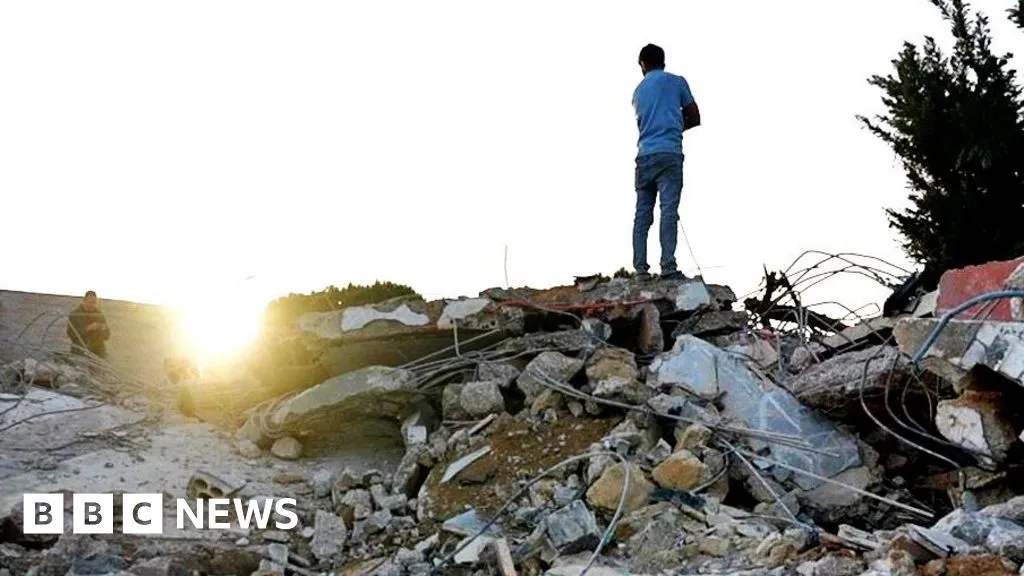
On my drive, I passed the wreckage of a pick-up truck that had been hit by an Israeli air strike a couple of hours earlier. At all times, an Israeli drone flew overhead; occasionally, I could also hear Israeli fighter jets and the sound of explosions in the distance.Life appeared to be on hold. The main street was still decorated for Ramadan, and almost all houses seemed abandoned. The village was quiet, but not in peace. Near the mosque, I met two cousins, Fatmeh and Dunya, both in their 80s. Outside, a banner paid tribute to the late Hezbollah leader, Hassan Nasrallah, killed by Israel in 2024. "We've witnessed many wars. But we've never left," Fatmeh said. "Whatever happens we thought we'd die in our homes rather than leave."More than one million people have been displaced across Lebanon, or one in five of the population, most of them from the south, the eastern Bekaa Valley, and the southern suburbs of Beirut known as Dahieh, areas where Hezbollah holds sway. Many are still living in tents in streets and squares. "They're being humiliated," Dunya told me. I asked the pair how they felt with the constant presence of Israeli drones. "I can't lie, I get a bit afraid," Fatmeh said. "But then my nerves get steady... We're counting on God."Neha Sharma/BBCTowns and villages, like Arab Salim, remain deserted as residents are reluctant to returnDown the road, Hussein Haydar, who was 56, had stayed with his wife, son and one-year-old grandson. "When we hear bombs, we start laughing around him," Haydar told me. "He thinks it's a game when he sees us laughing." A Hezbollah flag had been put on what was left of the façade of his grocery, destroyed after an Israeli air strike hit the building next door last month. Haydar was slightly wounded in the attack. "The community supports Hezbollah because they're defending us," he said. "They're the only ones keeping us on our land."While we met, the Israeli military issued evacuation warnings for three villages nearby, often an indication that an attack is imminent. I left shortly afterwards. The air strikes came about half an hour later.Neha Sharma/BBCIsraeli strikes have damaged or destroyed countless buildings across southern LebanonHezbollah, or Party of God in Arabic, was created in the 1980s during Israel's occupation of Lebanon in the Lebanese civil war. From its beginning, the group has been financed, trained and armed by Iran, and the destruction of Israel remains one of its official goals. The latest escalation in their conflict started when Hezbollah fired rockets into Israel on 2 March, following the killing of the Iranian supreme leader, Ayatollah Ali Khamenei, as the US and Israel launched a war on Iran. Israel responded with widespread air strikes across Lebanon and another invasion of the country's south.On 16 April, US President Donald Trump announced a ceasefire between Israel and Lebanon. Hezbollah, which is designated as a terrorist organisation by countries including the US and the UK, was not officially involved, but indicated it would abide by the deal if it was observed by Israel. The respite was short lived. Within days, Israel resumed its air strikes, mainly in the south, accusing Hezbollah of violations. Hezbollah, then, returned to its attacks on Israel and against Israeli troops in Lebanon.Since the start of the war, at least 2,800 people have been killed in Lebanon, according to the country's health ministry, more than 400 of them after truce came into force. (The ministry does not distinguish combatants from civilians.) Israeli authorities say 18 soldiers and four civilians have been killed in the war.Neha Sharma/BBCIsrael's military occupies about 5% of Lebanon's territory, where Israeli officials say the aim is to create what they describe as a security buffer zoneThe strip of land occupied by Israel in southern Lebanon constitutes around 5% of the country's territory and, in some places, extends 10km (six miles) from the border. There, as it did in Gaza, Israel has flattened entire villages with air strikes and demolitions. Israel's military says the buildings have been used by Hezbollah; human rights groups say the deliberate destruction of civilian infrastructure could be a war crime.The authorities in Israel say the goal is to create what they describe as a security zone along the border, Hezbollah-free, to protect the country's northern communities from the group's rockets and drones and a possible ground invasion. Last year, the Israeli military said Hezbollah had developed a plan called "Conquer the Galilee" that included a large-scale cross-border attack like the one carried out by Hamas on southern Israel on 7 October 2023, which led to Israel's devastating response in Gaza.I visited a checkpoint of the Lebanese military near the occupied town of Khiam (Lebanon's national army is not a party to the conflict). The road had been blocked with a large garbage container and tyres. Half-a-dozen soldiers were positioned a little farther behind, next to an abandoned petrol station. As I walked towards the barrier, one of them stopped me. Israeli troops, he said, were in houses at the top of the hill that overlooked their base and had frequently fired in their direction. He warned me they could fire again if I got closer. I turned back.Neha Sharma/BBCPosters in Tyre remember slain fighters and the late Hezbollah leader, Hassan Nasrallah, killed by Israel in 2024Weakened, Hezbollah is isolated domestically, and the Lebanese President, Joseph Aoun, has vowed to disarm it. Hezbollah's arsenal has long divided this country but the group's leader, Naim Qassem, rejects giving up its weapons. Aoun, a former army chief, says this cannot be done by force, warning of the risks of alienating the Shia community and exacerbating tensions in a country divided by sects.Opponents accuse Hezbollah of dragging Lebanon into unwanted wars and of defending the interests of Iran - the group is part of a regional alliance Tehran calls the "Axis of Resistance". Hezbollah supporters say the group is their only protection against Israel, which they see as an enemy intent on capturing Lebanese land. But even some of them were against the decision to attack Israel after Khamenei's killing. (Open criticism is still rare but, last year, I met some supporters who appeared to be questioning some long-held views.)In Lebanon, however, Hezbollah is more than a militia. It is also a political party represented in parliament and in the government, and a social movement that runs services including schools and hospitals in areas where the state has been absent. For a community historically marginalised, the group is an essential part in their lives and identity.I drove to the coastal city of Tyre, the largest in the south and one of the world's oldest. Hezbollah flags - bright yellow, with a hand holding an assault rifle in the centre - lined the main road. Next to a roundabout, a field had become a makeshift cemetery for fighters. Pictures of men in uniform remembered those who had been killed while the open graves waited for the losses to come.Neha Sharma/BBCLebanon's health ministry says around 400 people have been killed since the ceasefire came into forceIn the city centre, near the Mediterranean waterfront, I met a man called Rida Hijazi as a bulldozer removed broken concrete and twisted metal from collapsed buildings. As a child, Hijazi lived in Tyre under Israeli occupation; at 52, he has seen it being attacked by Israel in the conflicts of 2006, the one that started in 2023, and this year. "These wars have affected us deeply," Hijazi said. "We were people who had money. Now, we've fallen below zero."A massive Israeli bombardment, minutes before the ceasefire was due to start, destroyed his house and business, and killed his brother and a dozen of his neighbours. All civilians, he said. (The Israeli military said it had no comment.) "We've always supported Hezbollah because I grew up in this environment and saw things for myself. They were created to defend the land. Who is Hezbollah? It's me, you, and her," Hijazi told me, pointing to my colleague.Polls suggest most Lebanese want Hezbollah to disarm, but Hijazi told me the group, for now, could not lay down its arms. "As long as Lebanon is under occupation or under threat," he said, "we can't trust anyone."
SRCBBC News - World
LANGEN
LEANCenter
WORDS1 375
ENT12
WED · 2026-05-13 · 23:22 GMTBRIEF NSR-2026-0514-76138
NSR-2026-0514-76138News Report·EN·Human Interest
Hezbollah support endures in south Lebanon as ceasefire fails to stop war with Israel
Despite a ceasefire, conflict persists in southern Lebanon between Hezbollah and Israel, leading to widespread displacement. Many residents, like elderly cousins Fatmeh and Dunya, refuse to leave their homes, even amidst constant Israeli aerial surveillance and shelling.
BBC News - WorldFiled 2026-05-13 · 23:22 GMTLean · CenterRead · 6 min
BBC News - WorldFIG 01
Reading time
6min
Word count
1 375words
Sources cited
3cited
Entities identified
12entities
Quality score
100%
§ 01
Briefing Summary
AI-generatedNEWSAR · AI
Despite a ceasefire, conflict persists in southern Lebanon between Hezbollah and Israel, leading to widespread displacement. Many residents, like elderly cousins Fatmeh and Dunya, refuse to leave their homes, even amidst constant Israeli aerial surveillance and shelling. Hussein Haydar, who remained with his family, stated that the community supports Hezbollah because they believe the group is defending them and enabling them to stay on their land. Hezbollah, founded in the 1980s with Iranian backing, aims to destroy Israel. The article highlights the ongoing destruction of villages and the resilience of some residents who remain, despite the dangers and the significant humanitarian crisis of over a million displaced people.
Confidence 0.90Sources 3Claims 5Entities 12
§ 02
Article analysis
Model · rule-basedFraming
Human Interest
Conflict
Tone
Measured
AI-assessed
CalmNeutralAlarmist
Factuality
0.60 / 1.00
Mixed
LowHigh
Sources cited
3
Well sourced
FewMany
§ 03
Key claims
5 extracted01
The community supports Hezbollah because they are perceived as defending them and keeping them on their land.
quoteHussein Haydar
Confidence
1.00
02
Residents in southern Lebanon express a strong desire to stay in their homes despite the dangers.
quoteFatmeh
Confidence
1.00
03
More than one million people have been displaced across Lebanon, with most from Hezbollah-controlled areas.
statistic
Confidence
0.95
04
Hezbollah, financed and armed by Iran, has the destruction of Israel as an official goal.
factual
Confidence
0.90
05
Hezbollah support endures in south Lebanon despite ongoing conflict with Israel.
factual
Confidence
0.90
§ 04
Full report
6 min read · 1 375 words§ 05
Entities
12 identifiedKey playerOppositionContextPositiveNeutralNegative
People4
Organizations1
Locations6
Events1
§ 06
Keywords & salience
10 termsisrael-hezbollah conflict
1.00
hezbollah support
1.00
south lebanon
0.90
displaced population
0.80
israeli air strikes
0.80
ceasefire failure
0.70
hassan nasrallah
0.60
iranian backing
0.50
evacuation warnings
0.40
lebanese civil war
0.40
§ 07
Topic connections
Interactive graph Network visualization showing 51 related topics
View Full Graph Person Organization Location Event|Click node to navigate|Edge numbers = shared articles