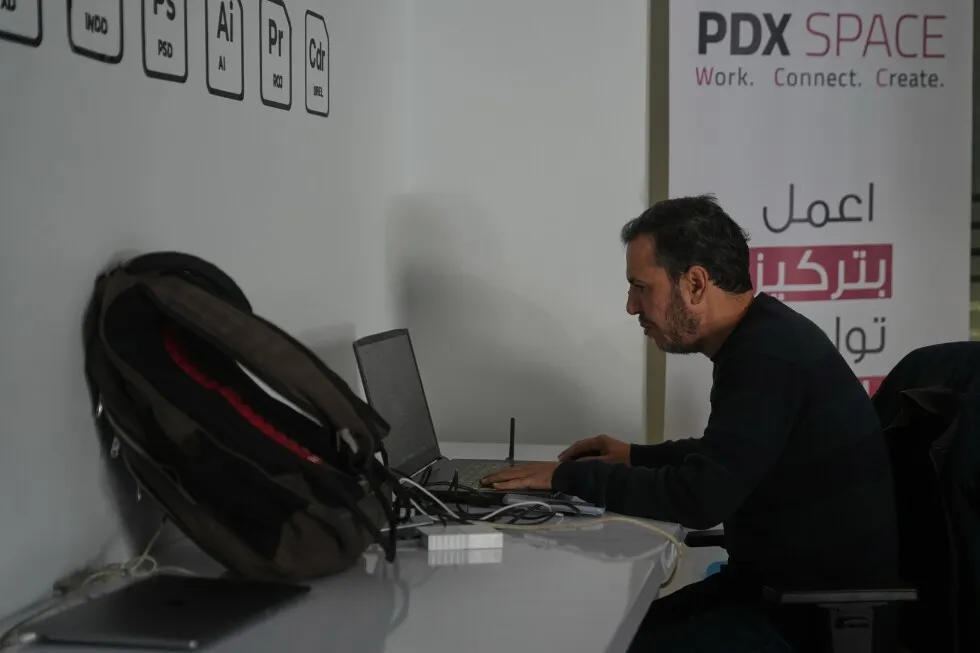
Palestinian programmer Tarik Zaeem, 44, works on his computer at a coworking space in Gaza City, March 8, 2026. (AP Photo/Abdel Kareem Hana) 2026-05-14T04:10:44Z Gaza City, Gaza Strip (AP) — As Israeli drones buzz overhead and ambulance sirens wail in the distance, Tarik Zaeem stays hunched over his laptop, working through lines of code for a Saudi valet parking app, debugging its barcode reader. On weekdays he walks through the bombed-out streets of Gaza City to a coworking space where freelancers charge devices and access stable internet. Remote work provides desperately needed income and a form of escape from the impoverished and largely destroyed Gaza Strip. “When I work, I forget everything and focus on the coding. I stop thinking about my family’s basic needs,” the 44-year-old programmer said of his wife and three children, who fled to Egypt early in the war. “I stop thinking about airstrikes or searching for drinking water. When I’m on my laptop, I shut everything else out.” Zaeem is part of a community of freelancers coding, designing and programming for clients abroad. Platforms connecting them to clients — including Freelancer.com, Upwork and Mostaql — each have thousands of Palestinians from Gaza registered. Like others in Gaza, they have at times struggled to find food , water and shelter , lost friends and relatives, and seen their homes and neighborhoods leveled by Israeli airstrikes. Many stopped working, but others kept going, designing logos for pizza parlors in Canada, building booking apps for Palestinian barber shops and creating websites for businesses in Kuwait and Turkey. After struggling through two years of full-scale war, their work is growing steadier, even as broader recovery and reconstruction efforts remain at a standstill seven months since a shaky ceasefire took hold in October. The digital sector grew up under Israel’s blockade Digital freelancing became popular more than a decade ago in Gaza. Traditional sectors shrank after Hamas seized control of the strip in 2007, as Israel’s intensified blockade devastated agriculture, manufacturing and other industries. High unemployment and a rise in connectivity — more than nine out of 10 households in Gaza had internet before the war — pushed thousands of digitally skilled college graduates to seek income abroad. Foreign donors and NGOs took notice, investing in hackathons, incubators and coding academies. The United Nations Development Program said in 2018 that “freelancing and online jobs are considered to be among the best temporary solutions to the unemployment problem.” (
SRCAssociated Press (AP)
LANGEN
LEANCenter
WORDS408
ENT12
THU · 2026-05-14 · 06:23 GMTBRIEF NSR-2026-0514-76153
NSR-2026-0514-76153News Report·EN·Human Interest
After bombs, blackouts and bank restrictions, Gaza’s digital workers are still coding
Despite ongoing conflict, blackouts, and financial restrictions in Gaza, a community of Palestinian digital workers continues to code and provide freelance services for international clients. Programmers like Tarik Zaeem work from coworking spaces, finding income and a mental escape from the destruction and hardship.
Associated Press (AP)Filed 2026-05-14 · 06:23 GMTLean · CenterRead · 2 min
Associated Press (AP)FIG 01
Reading time
2min
Word count
408words
Sources cited
2cited
Entities identified
12entities
Quality score
100%
§ 01
Briefing Summary
AI-generatedNEWSAR · AI
Despite ongoing conflict, blackouts, and financial restrictions in Gaza, a community of Palestinian digital workers continues to code and provide freelance services for international clients. Programmers like Tarik Zaeem work from coworking spaces, finding income and a mental escape from the destruction and hardship. Thousands of Gazans are registered on global freelancing platforms, designing websites, developing apps, and coding for businesses abroad. This digital sector, which grew under Israel's blockade, has seen its work become steadier even as broader reconstruction efforts lag. These workers are vital for their families' survival and contribute to the global digital economy from a war-torn region.
Confidence 0.90Sources 2Claims 5Entities 12
§ 02
Article analysis
Model · rule-basedFraming
Human Interest
Technology
Tone
Measured
AI-assessed
CalmNeutralAlarmist
Factuality
0.80 / 1.00
Factual
LowHigh
Sources cited
2
Limited
FewMany
§ 03
Key claims
5 extracted01
Digital freelancing became popular in Gaza over a decade ago as traditional sectors shrank due to Israel's blockade.
factual
Confidence
1.00
02
Remote work provides desperately needed income and a form of escape from the impoverished and largely destroyed Gaza Strip.
quoteTarik Zaeem
Confidence
1.00
03
Palestinian programmers in Gaza are working remotely for international clients despite ongoing conflict, blackouts, and bank restrictions.
factual
Confidence
1.00
04
More than nine out of 10 households in Gaza had internet access before the war.
statistic
Confidence
0.90
05
Thousands of Palestinians from Gaza are registered on freelancing platforms like Freelancer.com, Upwork, and Mostaql.
statistic
Confidence
0.90
§ 04
Full report
2 min read · 408 words§ 05
Entities
12 identifiedKey playerOppositionContextPositiveNeutralNegative
Organizations4
§ 06
Keywords & salience
10 termsdigital workers
1.00
gaza
1.00
remote work
0.90
freelancing
0.90
coding
0.80
israeli airstrikes
0.70
war
0.60
internet access
0.50
economic resilience
0.40
digital sector
0.40
§ 07
Topic connections
Interactive graph Network visualization showing 51 related topics
View Full Graph Person Organization Location Event|Click node to navigate|Edge numbers = shared articles