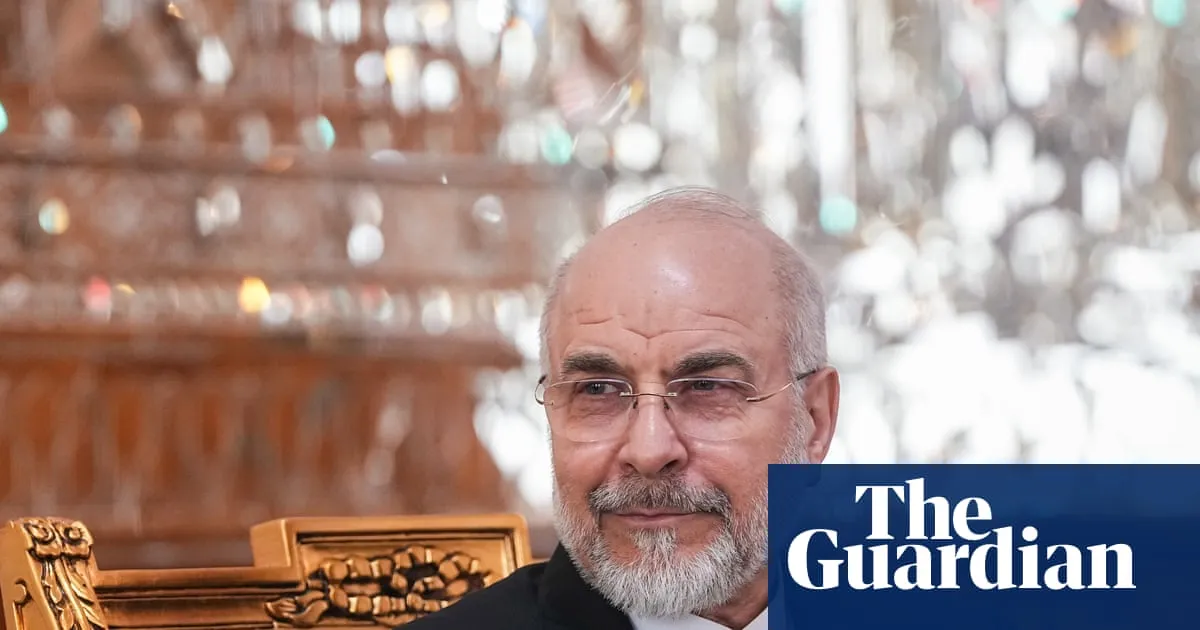
Mohammad Bagher Ghalibaf, the speaker of Iran’s parliament and chief negotiator in peace talks with the US. Photograph: Handout/072019/Iranian Parliament Communication Office/Getty Images View image in fullscreen Mohammad Bagher Ghalibaf, the speaker of Iran’s parliament and chief negotiator in peace talks with the US. Photograph: Handout/072019/Iranian Parliament Communication Office/Getty Images Prominent Australian academic denies links to powerful Iranian politician Prof Abbas Rajabifard of the University of Melbourne says he was listed as a co-author of research with Mohammad Bagher Ghalibaf, Iran’s chief negotiator in recent peace talks, without his knowledge Get our breaking news email, free app or daily news podcast A University of Melbourne academic has denied collaborating on research with the speaker of Iran’s parliament – who has been leading Tehran’s peace negotiations with the US – saying he was named as an author on a journal article without his knowledge. On Monday Australia" class="entity-link entity-organization" data-entity-id="329" data-entity-type="organization">Guardian Australia revealed that Mohammad Bagher Ghalibaf, Iran’s top negotiator, had built extensive ties to Australia over the past decade, including links to a University of Melbourne engineering research centre. In March 2023, Ghalibaf – a former Islamic Revolutionary Guard Corps commander – appeared as co-author of a journal article with a University of Melbourne engineering academic, Prof Abbas Rajabifard, who leads the research centre that employed Ghalibaf’s son Eshagh seven years earlier. On Tuesday, Rajabifard told the Guardian he had “no involvement in the article” and had the journal remove his name from the paper earlier this year. The journal article was published shortly before the foreign affairs minister, Penny Wong, wrote to universities asking them to cease work with Iranian academics and institutions due to concerns about the regime’s human rights record. Rajabifard and Mohammad Ghalibaf – who is also an associate professor in political geography at the University of Tehran – both appeared as authors on the March 2023 journal article titled Explanation of the I.R.I’S Political Economy and Reconstructing of the Social Economy. It was published in the Iran-based Journal of Applied Researchers in Geographical Sciences, with other academics at the University of Tehran also listed as co-authors. For more than two years, Rajabifard’s name remained listed as a co-author of the paper, both on the journal’s website and on a UN database. However, his name has since been removed from the article on the journal’s website. In response to questions, Rajabifard said: “I have never worked or connected or published articles with Mr Ghalibaf or any IRGC members.” He said he was not aware that he was listed as a co-author of the research until January, and “wrote to the journal immediately as a formal notification and request for removal of unauthorised authorship”. “I stated clearly and unambiguously that I had no involvement in that paper,” Rajabifard said. “I did not participate in the study or writing of the manuscript, nor was I consulted or informed at any stage of the research or submission process by the corresponding author or any of the other listed co-authors. “I did not provide consent for my name to be included as a co-author on this publication. As a result, my name was removed from the journal website in February.” In 2016, Rajabifard was a guest at the University of Tehran’s Faculty of Geography, where Ghalibaf is an associate professor. Photos posted to the university’s website show Rajabifard delivering a speech. Asked about the trip, Rajabifard said he “was part of a University of Melbourne delegation that visited Tehran University and a number of other universities” in 2016 and 2017. “I was invited by the Faculty of Geography to deliver a seminar,” Rajabifard said in a statement. “This was my only visit to that Faculty.” Australia has imposed no sanctions on Ghalibaf, his employer (the University of Tehran) or the publisher of the journal, Kharazmi University. In Wong’s 2023 letter to more than 30 Australian university vice-chancellors and presidents, she urged them to stop joint projects with Iran. “In line with the Australian government’s response to the human rights situation in Iran, I urge you to join with the government to put on hold existing cooperation with Iranian entities, including with subnational government entities and universities, and to refrain from any proposed new engagement,” the letter said. Australia" class="entity-link entity-organization" data-entity-id="329" data-entity-type="organization">Guardian Australia understands that in March the federal education minister, Jason Clare, ordered the Department of Education to reiterate to university vice-chancellors the government’s expectations in relation to research collaboration with other countries, including Iran. The Guardian has previously revealed research collaborations between academics at Australian universities and researchers in Iran, including in areas the government defines as critical technologies sensitive to national interests including artificial intelligence and biotechnology. A University of Melbourne spokesperson said they would not comment on individual cases. But the university was “alert to the risks of foreign interference and, in consultation with government, devotes considerable resources to identifying and mitigating these risks”. The spokesperson said “mandatory Foreign Interest Disclosures have been introduced for all staff” in recent years. Eshagh Ghalibaf secured temporary residency in Australia until September 2022 after studying for a master’s of engineering at the University of Melbourne between 2015 and 2018. While studying, he worked as research assistant at the University of Melbourne’s Centre for Spatial Data Infrastructures and Land Administration (CSDILA) between 2016 and 2018, according to a letter from a department administrator tendered during his failed five-year bid for Canadian permanent residency. According to the documents, it amounted to about seven hours of work a week during term times. Eshagh said he received that “casual job offer” from the then “head of the infrastructure engineering department”. “I signed 3 contracts with the university which lasted for 2 years,” he wrote in January 2019 as part of his Canadian permanent residency application, adding that he was also allowed to travel back to Iran to work during university breaks. At the time, the head of the department was Rajabifard, who is also the director of CSDILA. Asked about the job offer, Rajabifard said: “The University of Melbourne’s prevents me from confirming any details relating to past or present University staff, students, prospective students or other individuals.” The University of Melbourne declined to comment on the job offer. A spokesperson for the Department of Foreign Affairs and Trade said the federal government’s position on joint research with Iranian entities had been communicated to the tertiary education sector. “The Australian government has made clear its expectations that universities should not enter into, continue, or facilitate research collaboration with Iranian entities where this would be inconsistent with Australia’s foreign policy, sanctions regime, or national interest,” the spokesperson said. “This includes researcher to researcher engagement, not only formal institutional agreements.” Explore more on these topics Australian foreign policy Iran Australian universities US-Israel war on Iran Australian education news Share Reuse this content
SRCThe Guardian - World News
LANGEN
LEANCenter-Left
WORDS1 129
ENT10
THU · 2026-05-14 · 15:00 GMTBRIEF NSR-2026-0514-76275
NSR-2026-0514-76275News Report·EN·Diplomatic
Prominent Australian academic denies links to powerful Iranian politician
A prominent University of Melbourne academic, Professor Abbas Rajabifard, has denied any involvement in a research paper co-authored with Mohammad Bagher Ghalibaf, the speaker of Iran's parliament and chief negotiator in peace talks with the US. Rajabifard stated he was listed as an author on the March 2023 journal article, titled "Explanation of the I.R.I’S Political Economy and Reconstructing of the Social Economy," without his knowledge.
Adeshola OreThe Guardian - World NewsFiled 2026-05-14 · 15:00 GMTLean · Center-LeftRead · 5 min
The Guardian - World NewsFIG 01
Reading time
5min
Word count
1 129words
Sources cited
2cited
Entities identified
10entities
Quality score
100%
§ 01
Briefing Summary
AI-generatedNEWSAR · AI
A prominent University of Melbourne academic, Professor Abbas Rajabifard, has denied any involvement in a research paper co-authored with Mohammad Bagher Ghalibaf, the speaker of Iran's parliament and chief negotiator in peace talks with the US. Rajabifard stated he was listed as an author on the March 2023 journal article, titled "Explanation of the I.R.I’S Political Economy and Reconstructing of the Social Economy," without his knowledge. The article, published in an Iran-based journal, also listed other academics from the University of Tehran. Rajabifard has since had his name removed from the paper. This revelation comes after reports of Ghalibaf's extensive ties to Australia, including links to the University of Melbourne's engineering research center where Ghalibaf's son was previously employed. The journal article's publication preceded a letter from Australia's foreign affairs minister urging universities to cease collaboration with Iranian academics due to human rights concerns.
Confidence 0.90Sources 2Claims 5Entities 10
§ 02
Article analysis
Model · rule-basedFraming
Diplomatic
Political Strategy
Tone
Measured
AI-assessed
CalmNeutralAlarmist
Factuality
0.80 / 1.00
Factual
LowHigh
Sources cited
2
Limited
FewMany
§ 03
Key claims
5 extracted01
Prof Rajabifard requested the journal remove his name from the article earlier this year, stating he had no involvement.
factualProf Abbas Rajabifard
Confidence
1.00
02
Mohammad Bagher Ghalibaf was listed as a co-author on a journal article with Prof Abbas Rajabifard without Rajabifard's knowledge.
factualProf Abbas Rajabifard
Confidence
1.00
03
University of Melbourne academic Prof Abbas Rajabifard denies collaborating on research with Iran's parliament speaker Mohammad Bagher Ghalibaf.
quoteProf Abbas Rajabifard
Confidence
1.00
04
The journal article was published shortly before Australia's foreign affairs minister asked universities to cease work with Iranian academics.
factual
Confidence
0.90
05
Ghalibaf, Iran's chief negotiator in peace talks with the US, has built extensive ties to Australia over the past decade.
factualGuardian Australia
Confidence
0.90
§ 04
Full report
5 min read · 1 129 words§ 05
Entities
10 identifiedKey playerOppositionContextPositiveNeutralNegative
People3
Organizations4
§ 06
Keywords & salience
8 termsiranian politician
1.00
university of melbourne
0.90
academic research
0.80
peace talks
0.70
journal article
0.60
co-author
0.60
iran's parliament
0.50
human rights record
0.40
§ 07
Topic connections
Interactive graph No topic relationship data available yet. This graph will appear once topic relationships have been computed.