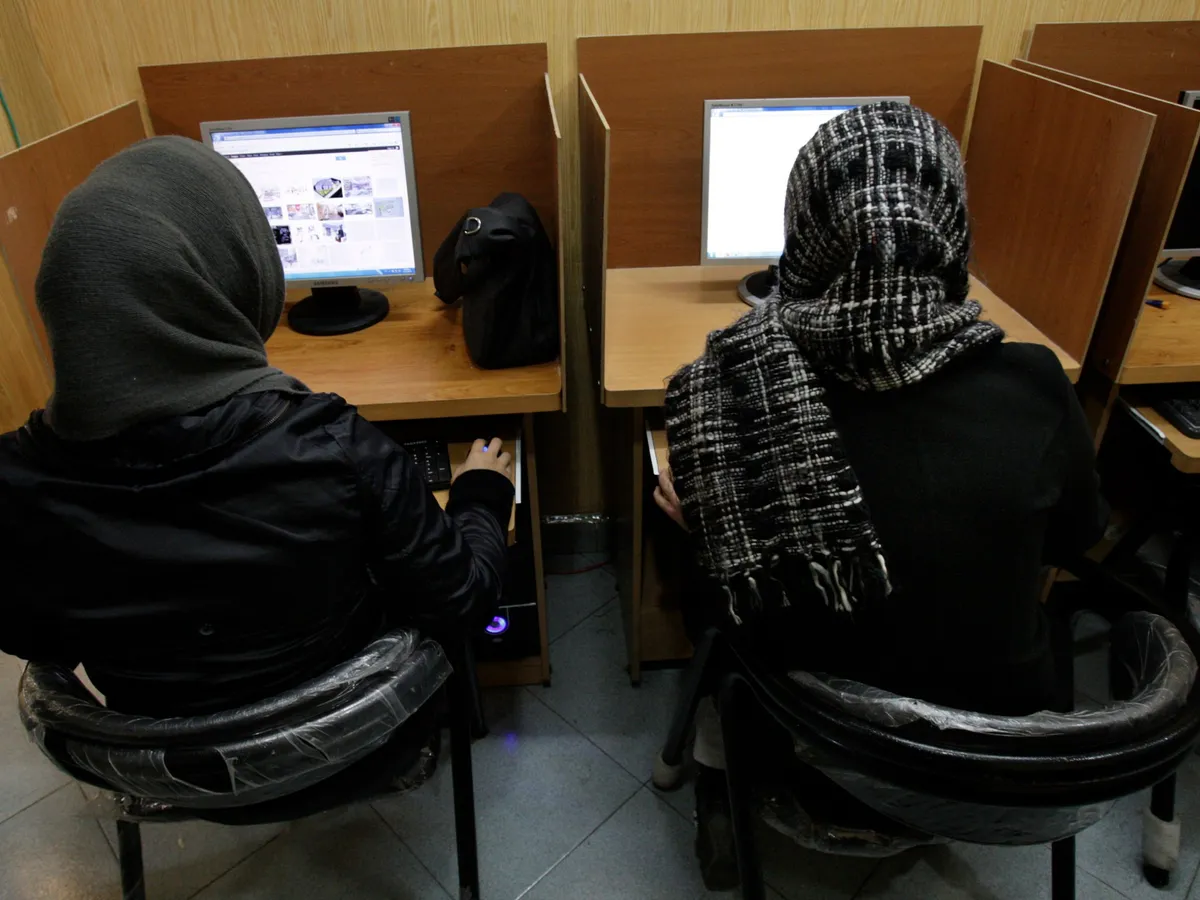
It is unclear how regular internet connections jeopardise national security, but others sold by the government do not.Iranian women use computers at an internet cafe in central Tehran, Iran, Monday, February 13, 2012 [File: Vahid Salemi/AP Photo]Published On 14 May 2026Tehran, Iran – Iran is looking at ways of providing limited connectivity to approved individuals and entities amid a continued state-imposed internet shutdown, with a tiered access model currently being offered that experts have said still undermines the digital rights of Iranians.President Masoud Pezeshkian on Wednesday announced the creation of a new entity to review internet coverage in the country named the Specialised Headquarters for Organising and Guiding Iran’s Cyberspace, with First Vice President Mohammad Reza Aref, a relative moderate, appointed as its head.Pezeshkian said he expects the 74-year-old vice president to “create institutional cohesion and align policies and measures by relevant bodies” and “prevent parallel work and end multiple voices in the management of the country’s cyberspace”, referring to the multiple bodies overseeing communications in Iran.Reza Aref is also expected to devise and enforce a roadmap to “overhaul cyberspace governance”, and perhaps most importantly, to review the efficiency of the secretariat of the Supreme Council of Cyberspace and its subsidiary, the National Cyberspace Center.The council, which Pezeshkian has now said he wants to reform, is a powerful state body established by slain Supreme Leader Ayatollah Ali Khamenei in 2012 to govern the internet landscape in Iran.The council, and its current secretary, Mohammad Amin Aghamiri, have led the charge in heavily restricting Iranians’ access to the internet based on “security considerations”.Pezeshkian’s move to review the government’s internet policy comes 11 weeks into a near-total online blackout affecting 90 million-plus citizens, which followed a similar 20-day outage during deadly nationwide protests in January.Despite the economic pain and mounting public frustration the outage has caused, the new body does not spell out an end to the internet shutdown.Since February 28, when the war with the United States and Israel began, most Iranians have been completely disconnected from the worldwide web, which the government insists is an essential measure to keep Israel’s Mossad spy agency and other harmful actors at bay.It is now the longest nationwide internet shutdown in the world, with users only able to access a slow and patchy intranet, which supports a number of state-approved local applications and content.Virtual private networks (VPNs) and other methods to circumvent filters offer the only pathway to unencumbered internet services, but they can be expensive and often disrupted by Iranian authorities. Security forces are also on the hunt for Starlink satellite internet connections.The Supreme National Security Council, a body that manages Iran’s defence policy, has launched a state-distributed service called “Internet Pro”, but at prices several times higher than regular internet packages.It does provide users with slightly higher-tier internet services than those offered to most of the population, while Telegram, WhatsApp and ChatGPT can be accessed via the platform, but YouTube and almost all other international services remain blocked.The service is stated to be for businesses, university professors, lawyers and other categories of people that the state deems eligible, but some state-linked entities have also been selling access at several times the official price.Chief Justice of Iran Gholam-Hossein Mohseni-Ejei, this week, admitted inconsistencies in the implementation of Internet Pro and described it as a “sledgehammer that descends on public opinion”, but also warned that any infractions of the internet laws must be prosecuted.Government promises situation ‘temporary’Authorities have pledged to restore the internet, but not until the war is concluded, and there is little sign of when that will happen.Iranian government spokesperson Fatemeh Mohajerani lashed out at reporters during a news conference in Tehran on Tuesday, after they pressed her on the internet shutdown.“In a situation where the US president says the ceasefire is on life support, what is your answer?” she said, speaking over reporters.“The country is at war, we must accept that the security of the people is a condition of war,” she added, but said that the internet situation is “temporary”.Amir Rashidi, a digital security expert, believes that tiered internet access is here to stay in Iran, and that it is rooted in longstanding policies approved by the Supreme Council of Cyberspace after deadly nationwide protests in November 2019.That was when the Islamic Republic first imposed a near-total internet shutdown in the country, which lasted about a week, and became a means for the government to tackle unrest.“Until now, the main reason it had not been fully implemented was the lack of political will. That political will now exists, and the policy is moving forward rapidly,” Rashidi told Al Jazeera.Rashidi said the new cyberspace headquarters that Pezeshkian established this week can, at most, provide “a mechanism for better coordination in implementing the policies of the Supreme Council of Cyberspace”, but in reality, there will be little hope of fundamental changes to government policy.‘Against national security’One Tehran-based cybersecurity expert who spoke to Al Jazeera on condition of anonymity said the internet shutdown has ended up harming the country more than defending against cyberattacks and other hostile operations.Even some government officials are voicing concerns about the policy.“The reduction in access to the internet has disrupted the scientific and research communications of the country, and the continuation of the disruption of the internet for the general public will be against national security,” Hossein Simaei Saraf, minister of science, research and technology, said in a speech last week.Saraf bypassed Minister of Information and Communication Technology Sattar Hashemi, as well as the president, when he wrote a letter directly addressed to Aghamiri, the secretary of the Supreme Council of Cyberspace, to ask for the US National Library of Medicine’s authoritative database, PubMed, to be unblocked. It was reopened to Iranians several days later.Hashemi had boasted during a meeting with hardline lawmakers on Tuesday that local messaging apps like Baleh, Eita and others have a combined user base of 100 million people.Many government and judiciary services are offered strictly on these apps, which do not enjoy strong encryption or security protocols.The disconnection of almost all global services has forced many Iranians to rely on local messaging apps, allowing Iranian authorities greater ability to monitor communications between citizens amid control of access to the internet.
SRCAl Jazeera
LANGEN
LEANCenter
WORDS1 036
ENT12
THU · 2026-05-14 · 19:00 GMTBRIEF NSR-2026-0514-76323
NSR-2026-0514-76323News Report·EN·Human Rights
Iran expands tiered internet access amid continued online blackout
Iran is implementing a tiered internet access model amid a prolonged state-imposed shutdown, which began on February 28th following conflict with the United States and Israel. President Masoud Pezeshkian has established a new entity, the Specialised Headquarters for Organising and Guiding Iran’s Cyberspace, to review and potentially reform the country's internet governance.
Maziar MotamediAl JazeeraFiled 2026-05-14 · 19:00 GMTLean · CenterRead · 5 min
Al JazeeraFIG 01
Reading time
5min
Word count
1 036words
Sources cited
3cited
Entities identified
12entities
Quality score
100%
§ 01
Briefing Summary
AI-generatedNEWSAR · AI
Iran is implementing a tiered internet access model amid a prolonged state-imposed shutdown, which began on February 28th following conflict with the United States and Israel. President Masoud Pezeshkian has established a new entity, the Specialised Headquarters for Organising and Guiding Iran’s Cyberspace, to review and potentially reform the country's internet governance. First Vice President Mohammad Reza Aref heads this body, tasked with unifying cyberspace policies and overhauling governance. This move comes after an 11-week near-total internet blackout affecting over 90 million citizens, with the government citing national security concerns and the need to counter foreign intelligence agencies. The new structure does not guarantee an end to the widespread internet restrictions.
Confidence 0.90Sources 3Claims 5Entities 12
§ 02
Article analysis
Model · rule-basedFraming
Human Rights
Political Strategy
Tone
Measured
AI-assessed
CalmNeutralAlarmist
Factuality
0.70 / 1.00
Factual
LowHigh
Sources cited
3
Well sourced
FewMany
§ 03
Key claims
5 extracted01
President Masoud Pezeshkian announced the creation of a new entity to review internet coverage, headed by First Vice President Mohammad Reza Aref.
factual
Confidence
1.00
02
Iran is implementing a tiered internet access model amid a continued state-imposed internet shutdown.
factual
Confidence
1.00
03
The current internet shutdown is the longest nationwide internet shutdown in the world.
factual
Confidence
0.90
04
The government insists the internet shutdown is an essential measure to keep Israel's Mossad spy agency and other harmful actors at bay.
factualIranian government
Confidence
0.90
05
Experts have stated that the tiered access model undermines the digital rights of Iranians.
quoteexperts
Confidence
0.80
§ 04
Full report
5 min read · 1 036 words§ 05
Entities
12 identifiedKey playerOppositionContextPositiveNeutralNegative
People4
Organizations4
§ 06
Keywords & salience
9 termsinternet shutdown
1.00
internet access
1.00
cyberspace governance
0.90
digital rights
0.80
tiered access
0.70
national security
0.60
supreme council of cyberspace
0.50
masoud pezeshkian
0.40
mohammad reza aref
0.40
§ 07
Topic connections
Interactive graph Network visualization showing 51 related topics
View Full Graph Person Organization Location Event|Click node to navigate|Edge numbers = shared articles