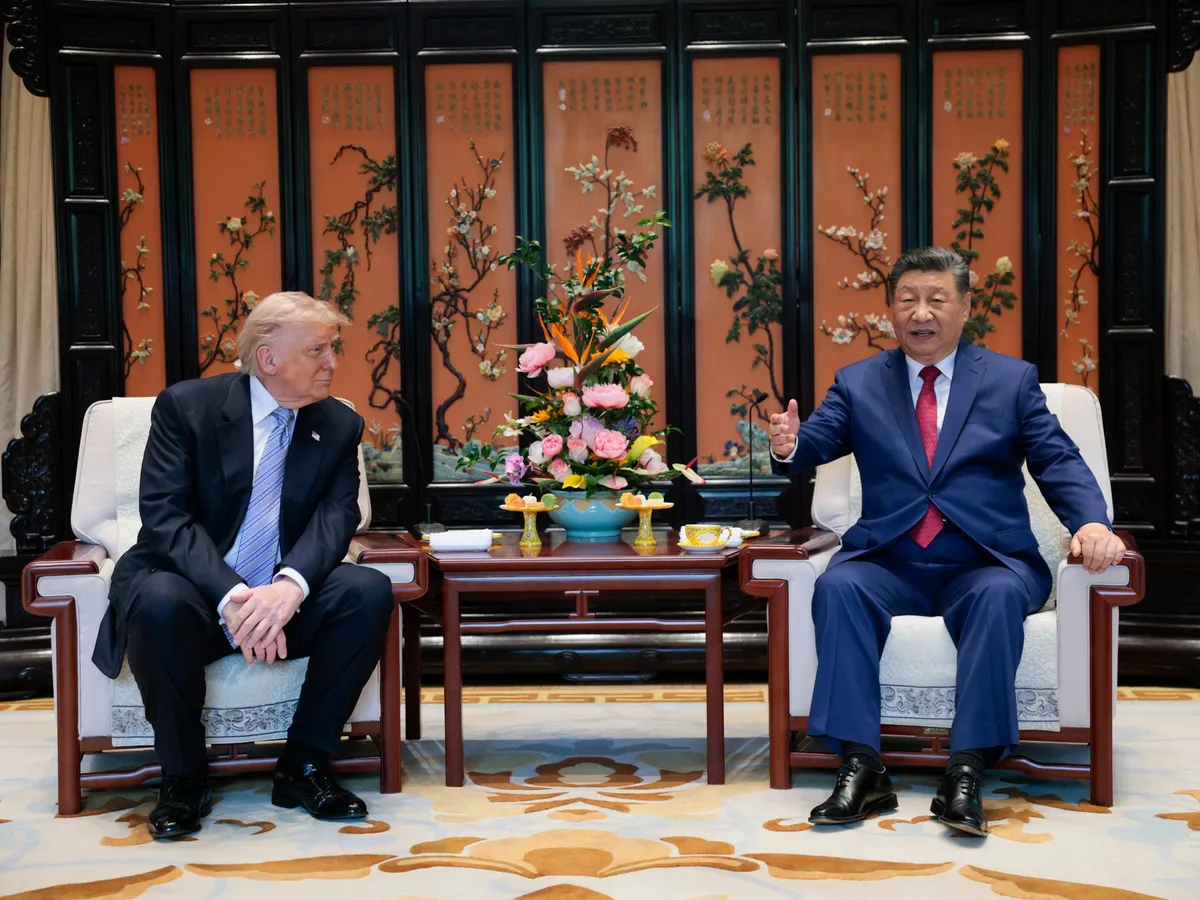
The two leaders did not resolve differences on key issues like Iran and Taiwan, despite push to extend truce.US President Donald Trump and Chinese President Xi Jinping meet on the sidelines of a visit to Zhongnanhai Garden on May 15, 2026 in Beijing, China [Evan Vucci-Pool/Getty Images]Published On 15 May 2026Early signs point to the United States and China moving towards a relationship focused on pragmatic areas of common interest following US President Donald Trump’s trip to China, according to analysts, setting aside the turmoil that marked 2025.Trump was in Beijing for three days this week to meet with Chinese President Xi Jinping, accompanied by a delegation of American CEOs, including the heads of Apple, Nvidia, BlackRock and Goldman Sachs.Recommended Stories list of 4 itemslist 1 of 4Visiting Palestine’s renamed placesThis article will be opened in a new browser windowlist 2 of 4Scientists identify massive new dinosaur following Thailand diglist 3 of 4Nadim Bawalsa & the Palestinian diaspora: From denial to genocidelist 4 of 4US seeks indictment of former Cuban leader Raul Castroend of listThe meeting between the two leaders came just over six months after they agreed to pause the China-trade-war" class="entity-link entity-event" data-entity-id="14708" data-entity-type="event">US-China trade war for a year on the sidelines of a multilateral summit in South Korea. While a frequent critic of China’s economic policies at home, Trump appeared to get along with Xi in person throughout his trip and lavished praise on the Chinese leader.“It’s an honour to be with you, it’s an honour to be your friend, and the relationship between China and the USA is going to be better than ever before,” Trump told Xi on Thursday.The White House readout of the Trump-Xi meeting on Thursday stressed areas of common ground, stating that the leaders had “discussed ways to enhance economic cooperation between our two countries” by “expanding market access for American businesses into China and increasing Chinese investment into our industries”.Notably absent from the statement was any mention of China’s export controls on rare earths, critical materials used across the tech, defence and energy sectors. China controls nearly the entire industry, and it has moved to restrict US access.William Yang, senior Northeast Asia analyst at the Crisis Group, told Al Jazeera that Trump’s remarks showed he would likely try to compartmentalise US-China relations into areas where the two sides can work together without being overshadowed by geopolitical concerns.Xi, while less effusive, also spoke of his desire to move towards a new US-China framework based on “constructive strategic stability”, meaning that the US and China should try to “minimise competition, manage differences and allow stability to be the foundation of the bilateral relationship”, according to Yang.Both leaders appear to have sidestepped other controversial issues, such as the status of Taiwan, a 23 million-person democracy claimed by Beijing but unofficially backed by Washington.Xi told Trump during their meeting that Taiwan was the “most important issue” in the US-China relationship, and that mishandling it could lead to “clashes and even conflicts” between the two sides. Beijing objects to Washington’s ongoing military support of Taiwan and has pressed the US to take a more explicit line on Taiwan’s political status.Although the US does not recognise the government in Taipei, it maintains a deliberately vague policy on China’s territorial claims. Despite the controversy, neither the Chinese nor the US readout mentioned whether Trump discussed Taiwan or the future of arms sales – suggesting he either disagreed with Xi or avoided the topic.Analysts like Yang say it is still too soon to know whether Trump will heed Xi’s remarks by blocking or delaying a $14bn arms deal reportedly in the works for Taiwan. The deal would need Trump’s sign-off to move forward, according to US legislators.Xi was equally circumspect on Iran and the Strait of Hormuz, which has been shuttered since the US and Israel launched a war on Iran on February 28.Trump has previously pushed China to encourage Iran to reopen the strait, through which a fifth of the world’s oil and gas passed each year before the war, because of its close relationship with Tehran. China and Iran signed a 25-year “strategic partnership” in 2021, and Beijing buys 80 to 90 percent of Iran’s oil annually.Trump raised the points again in his meeting with Xi in Beijing, according to the US readout, which said the two leaders “agreed that the Strait of Hormuz must remain open to support the free flow of energy”.“President Xi also made clear China’s opposition to the militarisation of the Strait and any effort to charge a toll for its use, and he expressed interest in purchasing more American oil to reduce China’s dependence on the Strait in the future. Both countries agreed that Iran can never have a nuclear weapon,” the readout said.The Chinese readout of their meeting on Thursday did not include mention of Iran or its nuclear programme.Chucheng Feng, founding partner of Hutong Research based in Beijing, told Al Jazeera that the omissions reflect that Xi and Trump still disagree on key issues, including Iran, but that the overall message from the summit was a desire to move forward.“For Beijing, the most important thing is to find a floor for the relationship, to set up and enhance guardrails so that no surprises or uncontrolled escalations suddenly emerge. For that, item-by-item disagreements are largely secondary,” he said.
SRCAl Jazeera
LANGEN
LEANCenter
WORDS883
ENT12
FRI · 2026-05-15 · 09:46 GMTBRIEF NSR-2026-0515-76470
NSR-2026-0515-76470News Report·EN·Economic Impact
Trump and Xi move towards business-first relationship after Beijing summit
US President Donald Trump met with Chinese President Xi Jinping in Beijing this week, signaling a shift towards a business-focused relationship. The three-day visit, accompanied by American CEOs, followed a six-month pause in the US-China trade war.
Al JazeeraFiled 2026-05-15 · 09:46 GMTLean · CenterRead · 4 min
Al JazeeraFIG 01
Reading time
4min
Word count
883words
Sources cited
1cited
Entities identified
12entities
Quality score
100%
§ 01
Briefing Summary
AI-generatedNEWSAR · AI
US President Donald Trump met with Chinese President Xi Jinping in Beijing this week, signaling a shift towards a business-focused relationship. The three-day visit, accompanied by American CEOs, followed a six-month pause in the US-China trade war. While key differences on issues like Iran and Taiwan remain unresolved, both leaders expressed optimism about improving bilateral ties. The White House readout emphasized enhancing economic cooperation, including expanding market access for US businesses in China and increasing Chinese investment. Analysts suggest Trump aims to compartmentalize US-China relations, focusing on areas of common interest despite ongoing geopolitical concerns.
Confidence 0.90Sources 1Claims 5Entities 12
§ 02
Article analysis
Model · rule-basedFraming
Economic Impact
Diplomatic
Tone
Measured
AI-assessed
CalmNeutralAlarmist
Factuality
0.60 / 1.00
Mixed
LowHigh
Sources cited
1
Limited
FewMany
§ 03
Key claims
5 extracted01
Trump told Xi, 'The relationship between China and the USA is going to be better than ever before.'
quoteDonald Trump
Confidence
1.00
02
The White House readout stressed enhancing economic cooperation by expanding market access for American businesses and increasing Chinese investment.
factualWhite House
Confidence
0.90
03
Trump and Xi did not resolve differences on key issues like Iran and Taiwan, despite a push to extend a truce.
factual
Confidence
0.90
04
Xi spoke of moving towards a new US-China framework based on 'constructive strategic stability'.
quoteXi Jinping
Confidence
0.80
05
US President Donald Trump and Chinese President Xi Jinping are moving towards a relationship focused on pragmatic areas of common interest.
predictionanalysts
Confidence
0.70
§ 04
Full report
4 min read · 883 words§ 05
Entities
12 identifiedKey playerOppositionContextPositiveNeutralNegative
Organizations5
Locations4
§ 06
Keywords & salience
10 termsus-china relations
1.00
business relationship
0.90
economic cooperation
0.80
donald trump
0.70
xi jinping
0.70
trade war
0.60
investment
0.50
market access
0.50
rare earths
0.40
geopolitical concerns
0.40
§ 07
Topic connections
Interactive graph Network visualization showing 51 related topics
View Full Graph Person Organization Location Event|Click node to navigate|Edge numbers = shared articles