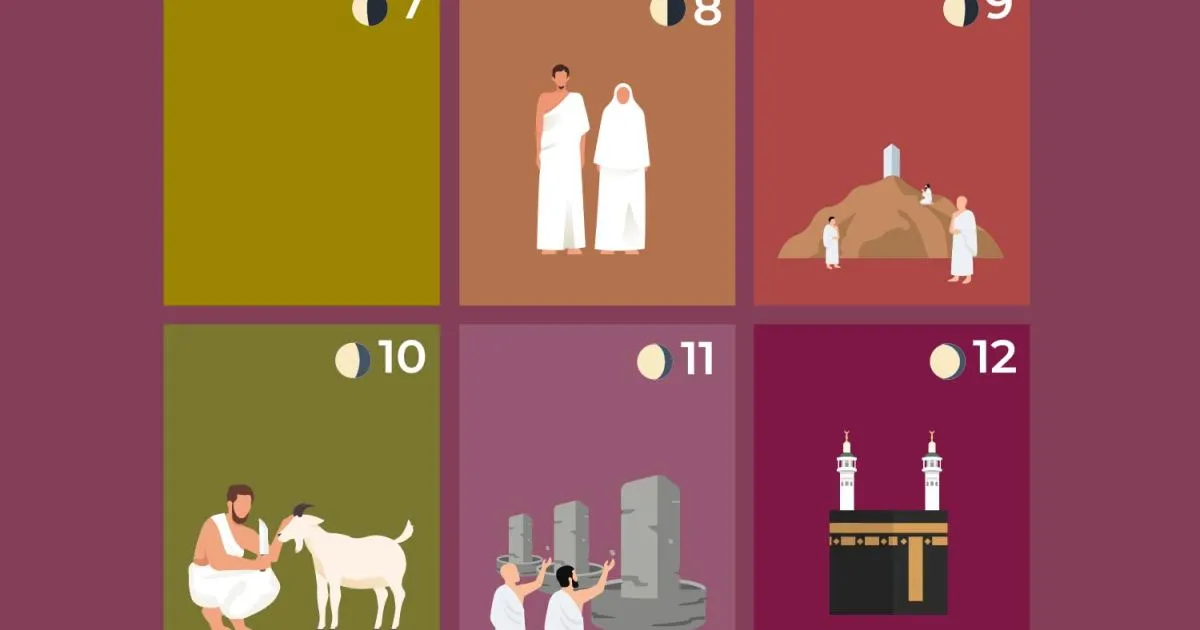
EXPLAINERNearly 2 million Muslims will embark on the annual Hajj pilgrimage to Mecca, which begins on May 25.Published On 18 May 2026Nearly 2 million Muslims are preparing to embark on the annual Hajj pilgrimage to Mecca, which begins on May 25, following the sighting of the crescent moon in Saudi Arabia.The Hajj is the largest annual gathering of Muslims from all over the world and a once-in-a-lifetime journey for many. It is also the fifth pillar of Islam.Recommended Stories list of 4 itemslist 1 of 4The Hajj explained visuallylist 2 of 4The water of Hajj: A simple illustrated guide to Zamzamlist 3 of 4Hajj explained: A journey through the key rites of the Muslim pilgrimagelist 4 of 4‘In the days of old, the world was safe’: West Bank family’s enduring unityend of listIn this visual explainer, we look at how Muslims perform the Hajj, including the key steps, rituals and preparations.What is Hajj?The Hajj is the annual pilgrimage to Mecca, Saudi Arabia. It is the fifth and final pillar of Islam, along with the declaration of faith (shahada), five daily prayers, obligatory charity (zakat), and fasting during the month of Ramadan.The word comes from the Arabic root “h-j-j”, which means “intending a journey” or “to set out for a definitive purpose”.It is obligatory once in a lifetime for all adult Muslims who are physically and financially able to undertake the journey.When is the Hajj performed?The Hajj is performed between the 8th and 12th (or 13th) of Dhul-Hijjah, the 12th and final month of the Islamic calendar.The timing falls roughly 70 days after the end of Ramadan, though this can vary slightly depending on the lunar cycle.In 2026, the Hajj will take place from May 25 to May 27, but many pilgrims arrive in Saudi Arabia weeks before to prepare for the journey.Because the Islamic calendar follows a lunar cycle, with months lasting 29 or 30 days, the Hajj shifts 10 to 12 days earlier each year in the Gregorian calendar.Why do Muslims perform the Hajj?Muslims believe that the Hajj is a direct commandment from God, as outlined in the Quran.Prophet Muhammad’s “farewell pilgrimage” in 632 AD affirmed the steps in the 10th year of the Islamic calendar, and it is mentioned in the Quran nearly a dozen times.The Hajj begins before pilgrims even enter Mecca.The journey is a spiritual one, and it is considered to allow Muslims to seek forgiveness, purify their souls and demonstrate their submission to God.How is the Hajj performed?Muslims perform many rites and rituals during the five days of Hajj, which can be explained in the following steps.Day 1Ihram: Entering the pilgrimageBefore entering Mecca, pilgrims enter a sacred state known as ihram. After making the intention to perform the Hajj, men change into two white garments and women wear modest attire. The basic clothing symbolises equality, humility, and unity before God, where differences of nationality, wealth, and status disappear.Husin bin Nisan, centre, with other worshippers, prepares to wear a special garb called ihram, typically worn during the Hajj pilgrimage, prior to a Hajj rehearsal in Tangerang, Indonesia [File: Achmad Ibrahim/AP Photo]2. Tawaf: Circling the KaabaAfter entering Mecca, pilgrims circle the Kaaba – a cubic building at the Masjid al-Haram (Grand Mosque) that serves as the qibla, the direction Muslims face during prayer – seven times in a counterclockwise direction. This shared rhythm symbolises unity in the worship of the One God.Muslim pilgrims circle the Kaaba, the cubic building at the Grand Mosque, during the annual Hajj pilgrimage in Mecca, Saudi Arabia, on June 11, 2024 [Rafiq Maqbool/AP Photo]3. Sa’i: Walking between Safa and MarwahPilgrims can then perform the sa’i, a ritual of walking seven times between the hills of Safa and Marwa.The ritual retraces the search for water in the desert valley of Mecca by Prophet Abraham’s (Ibrahim) wife, Hagar (Hajar), for their son, Ishmael (Ismail), before the Zamzam well emerged.In Islamic tradition, this well has supplied pristine water in the arid desert for more than 4,000 years and continues to nourish pilgrims to this day.Muslim worshippers walk between the Marwa and Safa hills at the Grand Mosque in Saudi Arabia’s holy city of Mecca [File: Abdel Ghani Bashir/AFP]4. Mina: The tent cityPilgrims then proceed to Mina, about 8km (5 miles) east of the Kaaba, where they will spend the night in prayer and reflection.Mina is famously known as the “city of tents” due to the vast expanse of 100,000 white tents to house the millions of pilgrims.Tents for Muslim pilgrims fill the Mina tent camp during the Hajj, in Mecca, Saudi Arabia, on July 10, 2022 [Amr Nabil/AP Photo]Day 25. Arafat: The central day of HajjOn the second day of the Hajj, pilgrims arrive early at the plains of Mount Arafat, about 15km (9 miles) from Mina. They spend the afternoon in wuquf (standing) from midday to sunset, praying, and repenting.Arafah is the most important ritual of the Hajj and symbolises a preview of the Day of Judgement. Muslims worldwide are encouraged to fast on this day and engage in prayer and reflection.Muslim pilgrims gather on top of the rocky hill known as the Mountain of Mercy, on the Plain of Arafat, during the annual Hajj pilgrimage near the holy city of Mecca, Saudi Arabia, on June 5, 2025 [Amr Nabil/AP Photo]6. Muzdalifah: Sleeping under the open skyAfter sunset, pilgrims travel to Muzdalifah, 9km (5.5 miles) away. There, they perform maghrib and isha prayers before collecting pebbles for the next day’s ritual.Muslim pilgrims rest after arriving at Muzdalifah, before heading to Mina during the annual Hajj pilgrimage, on June 27, 2023 [Sajjad Hussain/AFP]Day 3On this day, Muslims from around the world celebrate the first day of Eid al-Adha, or the celebration of the sacrifice.From the early hours of the morning, pilgrims perform a series of rituals, starting with walking back to Mina.Muslim pilgrims walk on their way to cast stones at pillars in the symbolic stoning of the devil, the last rite of the annual Hajj, in Mina, near the holy city of Mecca, Saudi Arabia, on June 6, 2025 [Amr Nabil/AP Photo]7. Stoning of the pillarsPilgrims enter Mina, where they throw seven pebbles at the largest of three stone pillars. This ritual represents the stoning of the devil, which symbolises the rejection of Satan’s temptations.Muslim pilgrims cast stones at pillars in the symbolic stoning of the devil, the last rite of the annual Hajj, in Mina near the holy city of Mecca, Saudi Arabia, on June 6, 2025 [Amr Nabil/AP Photo]8. Sacrifice during Eid al-AdhaPilgrims, or agents on their behalf, offer an animal sacrifice in remembrance of Abraham’s willingness to sacrifice his son in obedience to God.9. Cutting or shaving hairMen shave or trim their heads, and women cut a small portion of their hair. This symbolises spiritual renewal.Muslim pilgrims have their heads shaved by barbers upon leaving Muzdalifah, after throwing pebbles as part of the symbolic al-Aqabah (stoning of the devil ritual) at the Jamarat Bridge during the Hajj pilgrimage in Mina, near Saudi Arabia’s holy city of Mecca on August 11, 2019 [Fethi Belaid/AFP]10. Main tawafPilgrims return to Mecca to perform tawaf, circling the Kaaba, followed by sa’i, walking seven times between the hills of Safa and Marwa.Muslim pilgrims walk around the Kaaba, the cubic building at the Grand Mosque, during the annual Hajj pilgrimage, in the Muslim holy city of Mecca, Saudi Arabia, on June 4, 2025 [Amr Nabil/AP Photo]Days 4 and 5Pilgrims return to Mina and perform rami (stoning) of all three stone pillars on each day. Pilgrims who remain for an extra day repeat the stoning ritual at all three pillars once more.Before leaving Mecca, pilgrims perform a final tawaf around the Kaaba, known as the tawaf al-wada or a “farewell tawaf”, signifying a spiritual farewell to the holy sanctuary.How do Muslims mark the end of Hajj?Muslims mark the end of the Hajj with Eid al-Adha, celebrated on the 10th of Dhul-Hijjah and lasting up to three days in many countries.The day begins with a special prayer shortly after sunrise, as Muslims gather in mosques or open areas, wearing their finest clothes. The rest of the day is spent sharing meals, exchanging gifts, and visiting family and friends. The greeting “Eid Mubarak”, meaning “Blessed Eid,” is commonly exchanged.Eid al-Adha also involves the ritual of animal sacrifice, known as Qurbani. Muslims who are able to do so sacrifice a sheep, goat, cow or camel, and the meat is divided into three parts: one for the family, one for relatives and friends, and one for those in need.
SRCAl Jazeera
LANGEN
LEANCenter
WORDS1 417
ENT10
MON · 2026-05-18 · 05:12 GMTBRIEF NSR-2026-0518-77098
NSR-2026-0518-77098News Report·EN·Human Interest
When are Hajj and Eid al-Adha 2026? A visual guide to the Muslim pilgrimage
Nearly 2 million Muslims are preparing for the annual Hajj pilgrimage to Mecca, Saudi Arabia, which begins on May 25, 2026. The Hajj, the fifth pillar of Islam, is a once-in-a-lifetime journey for physically and financially able adult Muslims.
Alia ChughtaiAl JazeeraFiled 2026-05-18 · 05:12 GMTLean · CenterRead · 6 min
Al JazeeraFIG 01
Reading time
6min
Word count
1 417words
Sources cited
0cited
Entities identified
10entities
Quality score
100%
§ 01
Briefing Summary
AI-generatedNEWSAR · AI
Nearly 2 million Muslims are preparing for the annual Hajj pilgrimage to Mecca, Saudi Arabia, which begins on May 25, 2026. The Hajj, the fifth pillar of Islam, is a once-in-a-lifetime journey for physically and financially able adult Muslims. Performed between the 8th and 12th of Dhul-Hijjah, the final month of the Islamic calendar, the Hajj involves several key rituals. These include entering a sacred state of ihram, circling the Kaaba seven times (Tawaf), walking between the hills of Safa and Marwah (Sa'i), spending a night in prayer at Mina, and the central ritual of standing in prayer and repentance at Mount Arafat. Muslims perform the Hajj to seek forgiveness, purify their souls, and demonstrate submission to God.
Confidence 0.90Claims 5Entities 10
§ 02
Article analysis
Model · rule-basedFraming
Human Interest
Social Justice
Tone
Measured
AI-assessed
CalmNeutralAlarmist
Factuality
0.80 / 1.00
Factual
LowHigh
Sources cited
0
No named sources
FewMany
§ 03
Key claims
5 extracted01
The Hajj is performed between the 8th and 12th (or 13th) of Dhul-Hijjah, the 12th and final month of the Islamic calendar.
factual
Confidence
1.00
02
The Hajj is the fifth pillar of Islam.
factual
Confidence
1.00
03
The Hajj is the largest annual gathering of Muslims from all over the world and a once-in-a-lifetime journey for many.
factual
Confidence
1.00
04
The Hajj pilgrimage to Mecca begins on May 25, 2026.
factual
Confidence
1.00
05
Nearly 2 million Muslims will embark on the annual Hajj pilgrimage to Mecca.
statistic
Confidence
1.00
§ 04
Full report
6 min read · 1 417 words§ 05
Entities
10 identifiedKey playerOppositionContextPositiveNeutralNegative
§ 06
Keywords & salience
9 termsmuslim pilgrimage
1.00
hajj
1.00
islam
0.90
mecca
0.80
eid al-adha
0.70
islamic calendar
0.60
saudi arabia
0.50
prophet muhammad
0.40
quran
0.40
§ 07
Topic connections
Interactive graph No topic relationship data available yet. This graph will appear once topic relationships have been computed.