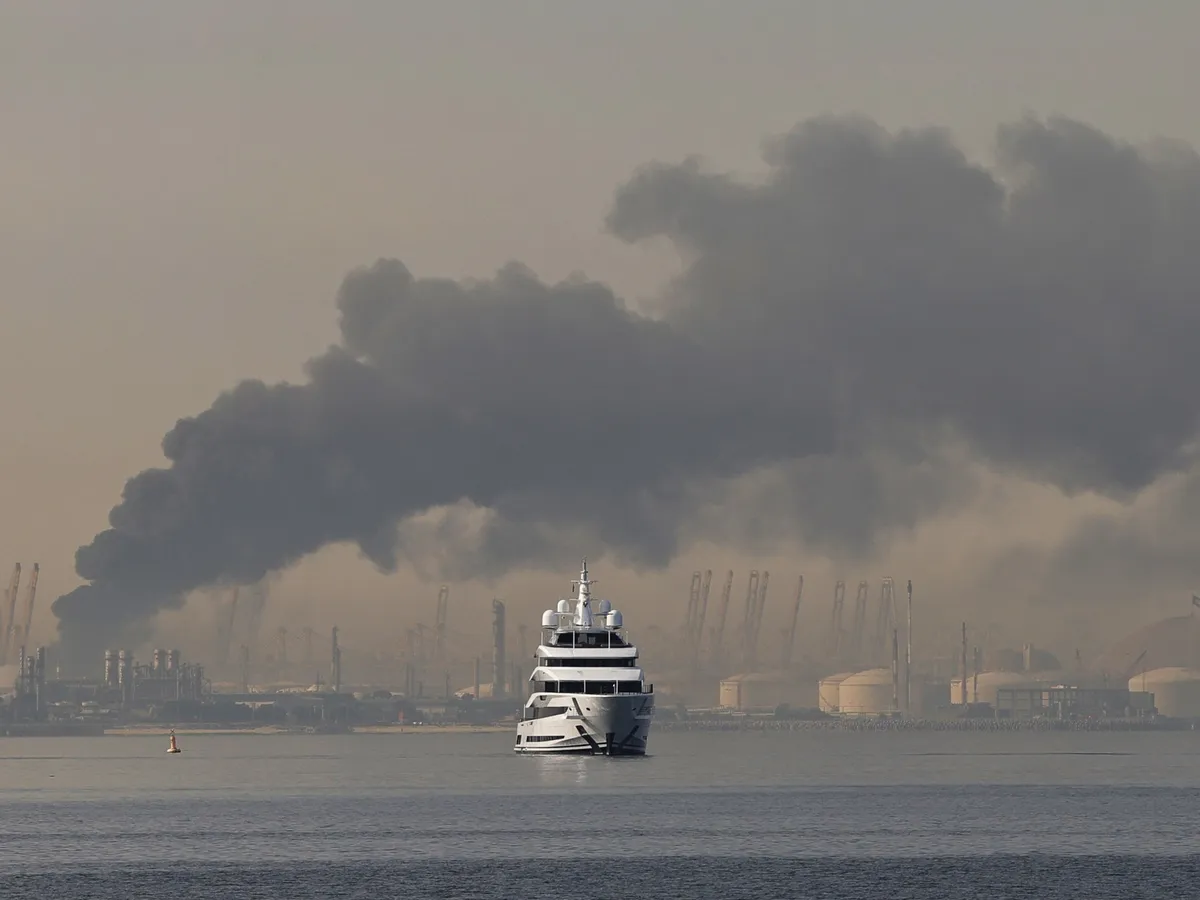
It has to choose stability or permanent war.Published On 18 May 2026A yacht sails past a plume of smoke rising from the port of Jebel Ali following a reported Dubai-on-march-1-2026" class="entity-link entity-event" data-entity-id="129243" data-entity-type="event">Iranian strike in Dubai on March 1, 2026 [AFP]One of the most dangerous ideas in today’s Middle East is the claim that Gulf States must choose between Iran and Israel. This framing is politically simple, but strategically misleading.It assumes that Gulf security can be reduced to alignment with one regional actor against another. The Gulf’s central interest is neither to defend Iran nor to serve Israel’s regional agenda. Its real interest is to prevent the region from becoming a battlefield.For Gulf States, escalation is a direct threat. Any confrontation involving Iran, Israel and the United States immediately affects Gulf airspace, shipping lanes, energy infrastructure, investment confidence and domestic stability.The Gulf cannot observe from a distance; it automatically incurs costs from the conflict. Therefore, the real choice is not between Iran or Israel. It is between stability or permanent war.A false choiceRecent events have demonstrated that even if the Gulf does not initiate confrontation, it still becomes an arena of it. In June when Israel attacked Iran, the conflict spilled over. In September, an Israeli air strike targeted Doha. This was not a separate episode but a continuation of the same campaign.This matters because Qatar has built much of its foreign policy around mediation, dialogue, de-escalation and the preservation of channels with other regional actors. Yet even this posture did not shield it from the consequences of confrontation.The second conflict in 2026 widened the battlefield to the rest of the Gulf. This made it clear that the whole region is at risk when conflict erupts.Even before the latest escalation, the Gulf States already had experience with Iran-linked missile threats, proxy networks, ideological pressure, maritime insecurity and the use of instability as leverage. Iran’s regional influence, combined with its ability to threaten the Strait of Hormuz, makes it a central concern for Gulf security.But recognising Iran as a threat does not mean accepting war as a strategy. The Gulf has an interest in containing Iranian pressure but also in preventing a wider war that would damage its infrastructure, economy and development. Its policy must, therefore, combine firmness with communication: oppose coercion but keep channels open to prevent miscalculation.Gulf States may share some concerns with Israel regarding Iran, but shared concern does not mean identical interests. Israel has its own security doctrine, domestic pressures, military calculations and regional ambitions. These do not reflect Gulf priorities.Israel may see escalation as a way to restore deterrence or weaken its adversaries. For the Gulf, however, escalation produces immediate costs: disrupted maritime routes, higher insurance costs, exposed energy facilities, cyber-risks and political pressure across Gulf societies. A conflict that may appear manageable from Tel Aviv can be far more dangerous when experienced from the Gulf.Automatic alignment with Israel against Iran is strategically risky. It reduces the Gulf to a support base for another actor’s security agenda and ignores the Palestinian question, which remains central to the legitimacy of any regional order and stability.Diplomacy and strategic autonomyWhen faced with repeated escalation, Saudi Arabia, the United Arab Emirates, Qatar, Kuwait, Oman and Bahrain have pursued distinct foreign policy tracks, sometimes complementary, sometimes divergent. Qatar’s mediation posture has differed sharply from the UAE’s harder line on Iran. Oman has maintained quiet channels with Tehran that others have not.Yet the Gulf countries have a clear common interest in regional security and stability.Freedom of navigation is central to it. For the Gulf, maritime security is not an abstract legal principle or a Western slogan. It is a national necessity. The Strait of Hormuz, the Gulf of Oman, Bab al-Mandeb and other passages are lifelines for energy exports, food imports, industrial production and global trade.Any attempt to weaponise these routes threatens the entire Gulf system: oil and gas flows, economic diversification, supply chains, investor confidence and the credibility of Gulf States as stable global hubs.However, maritime security cannot be protected by military power alone. The Gulf needs crisis communication, early-warning systems, intelligence sharing, regional maritime coordination, cyber-resilience and diplomatic mechanisms that reduce miscalculation.The Strait of Hormuz illustrates a larger point: Geography makes isolation impossible. Iran cannot be removed, Israel cannot be ignored, the US remains central to Gulf defence, China is economically significant and Europe has energy and maritime interests. This environment requires a layered strategy that combines deterrence with diplomacy.Mediation and backchannels are practical tools for preventing incidents from becoming wars. In a region where one missile, one naval encounter or one misread signal can trigger escalation, communication becomes strategic insurance.The Gulf’s answer should be strategic autonomy, not passive neutrality. This means resisting Iranian coercion without becoming an extension of Israeli escalation, partnering with the US without outsourcing every security decision, engaging China economically without accepting dependency and preserving channels without compromising sovereignty.Air defence, maritime surveillance, cyberprotection, food security, energy infrastructure and crisis diplomacy must become shared priorities. The Gulf cannot rely indefinitely on external actors to define its security future.In the end, the Gulf needs to choose whether it wants to become a theatre for permanent war or an architect of regional stability.Working towards stability is not a soft slogan. It is a strategic doctrine. It protects sovereignty, maritime lifelines, economic development and regional resilience. The Gulf’s strongest position is not to choose between Iran and Israel. It is to choose itself: its security, sovereignty, economic future and role as a centre of balance in a region too often pushed towards perpetual war.The views expressed in this article are the author’s own and do not necessarily reflect Al Jazeera’s editorial stance.
SRCAl Jazeera
LANGEN
LEANCenter
WORDS939
ENT12
MON · 2026-05-18 · 12:49 GMTBRIEF NSR-2026-0518-77213
NSR-2026-0518-77213Analysis·EN·Political Strategy
The Gulf does not have to choose Iran or Israel
Gulf states face a critical choice between regional stability or perpetual conflict, not between aligning with Iran or Israel. Escalation involving Iran, Israel, and the US directly impacts Gulf airspace, shipping, energy infrastructure, and domestic stability, making the region an unavoidable arena for conflict.
Abdulla Banndar Al-EtaibiAl JazeeraFiled 2026-05-18 · 12:49 GMTLean · CenterRead · 4 min
Al JazeeraFIG 01
Reading time
4min
Word count
939words
Sources cited
0cited
Entities identified
12entities
Quality score
100%
§ 01
Briefing Summary
AI-generatedNEWSAR · AI
Gulf states face a critical choice between regional stability or perpetual conflict, not between aligning with Iran or Israel. Escalation involving Iran, Israel, and the US directly impacts Gulf airspace, shipping, energy infrastructure, and domestic stability, making the region an unavoidable arena for conflict. Recent events, including Iranian strikes in Dubai and Israeli attacks on Doha, demonstrate that even neutral stances do not shield Gulf nations from the consequences of regional confrontation. While Gulf states share some concerns with Israel regarding Iran, their interests diverge, and automatic alignment with Israel is strategically risky. The Gulf's priority is to contain Iranian pressure while preventing wider war through a policy of firmness combined with open communication and diplomacy to ensure maritime security and regional stability.
Confidence 0.90Claims 5Entities 12
§ 02
Article analysis
Model · rule-basedFraming
Political Strategy
Conflict
Tone
Mixed Tone
AI-assessed
CalmNeutralAlarmist
Factuality
0.30 / 1.00
Opinion-Heavy
LowHigh
Sources cited
0
No named sources
FewMany
§ 03
Key claims
5 extracted01
Recognizing Iran as a threat does not necessitate accepting war as a strategy; policy must combine firmness with communication.
factual
Confidence
0.90
02
Escalation involving Iran, Israel, and the US immediately affects Gulf airspace, shipping lanes, energy infrastructure, investment confidence, and domestic stability.
factual
Confidence
0.90
03
Gulf states' central interest is to prevent the region from becoming a battlefield, not to defend Iran or serve Israel's agenda.
factual
Confidence
0.90
04
The idea that Gulf states must choose between Iran and Israel is a politically simple but strategically misleading framing.
factual
Confidence
0.90
05
Even if Gulf states do not initiate confrontation, they become an arena for it, as demonstrated by recent events where conflict spilled over.
factual
Confidence
0.80
§ 04
Full report
4 min read · 939 words§ 05
Entities
12 identifiedKey playerOppositionContextPositiveNeutralNegative
Locations9
§ 06
Keywords & salience
10 termsregional stability
1.00
gulf security
1.00
iran israel conflict
0.90
permanent war
0.80
escalation
0.70
gulf states
0.60
israel
0.50
iran
0.50
strait of hormuz
0.40
maritime insecurity
0.40
§ 07
Topic connections
Interactive graph No topic relationship data available yet. This graph will appear once topic relationships have been computed.