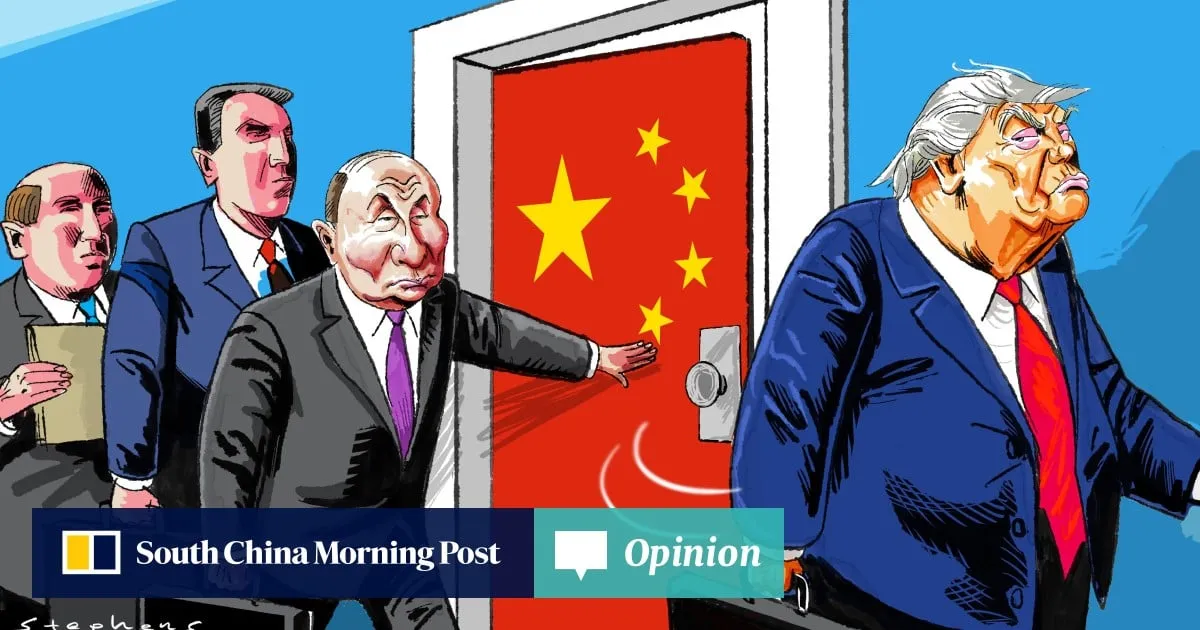
When Russian President Vladimir Putin arrives in Beijing this week, just days after US President Donald Trump departed, following his summit with President Xi Jinping, the choreography will not be merely diplomatic. It will be show of “civilisational theatre”.For years, analysts framed China as a power caught awkwardly between a revanchist Russia and an increasingly hostile United States. That interpretation now looks obsolete. Beijing is no longer balancing between rival poles; it is positioning itself as the axis around which those poles must rotate.Putin’s visit, immediately following Trump’s, is no coincidence. Moscow urgently needs clarity on what transpired behind the doors of Zhongnanhai and the Great Hall of the People. Any recalibration in China-US relations – on tariffs, semiconductors, sanctions, rare earths, Taiwan or Ukraine – alters Russia’s strategic environment.
SRCSouth China Morning Post
LANGEN
LEANCenter-Right
WORDS130
ENT12
MON · 2026-05-18 · 21:30 GMTBRIEF NSR-2026-0518-77323
NSR-2026-0518-77323Analysis·EN·Political Strategy
How China is becoming the gravitational centre of global diplomacy
Russian President Vladimir Putin's upcoming visit to Beijing, immediately following US President Donald Trump's summit with President Xi Jinping, signifies a shift in global diplomacy. Analysts previously viewed China as balancing between Russia and the US, but this interpretation is now considered outdated.
Adriel KasontaSouth China Morning PostFiled 2026-05-18 · 21:30 GMTLean · Center-RightRead · 1 min
South China Morning PostFIG 01
Reading time
1min
Word count
130words
Sources cited
1cited
Entities identified
12entities
Quality score
100%
§ 01
Briefing Summary
AI-generatedNEWSAR · AI
Russian President Vladimir Putin's upcoming visit to Beijing, immediately following US President Donald Trump's summit with President Xi Jinping, signifies a shift in global diplomacy. Analysts previously viewed China as balancing between Russia and the US, but this interpretation is now considered outdated. Beijing is actively positioning itself as a central player, with other global powers needing to align with its influence. Putin's visit is driven by Russia's need to understand the outcomes of China-US discussions, as any changes in their relationship, particularly concerning trade, technology, and geopolitical issues like Taiwan and Ukraine, directly impact Russia's strategic position.
Confidence 0.85Sources 1Claims 5Entities 12
§ 02
Article analysis
Model · rule-basedFraming
Political Strategy
Diplomatic
Tone
Mixed Tone
AI-assessed
CalmNeutralAlarmist
Factuality
0.40 / 1.00
Mixed
LowHigh
Sources cited
1
Limited
FewMany
§ 03
Key claims
5 extracted01
Any recalibration in China-US relations alters Russia’s strategic environment.
factual
Confidence
0.95
02
Russian President Vladimir Putin's visit to Beijing, immediately following US President Donald Trump's, is not a coincidence.
factual
Confidence
0.90
03
Moscow urgently needs clarity on what transpired during President Xi Jinping's meetings with President Donald Trump.
factual
Confidence
0.85
04
China is positioning itself as the axis around which global poles must rotate, rather than balancing between them.
factual
Confidence
0.80
05
Analysts previously framed China as a power caught between Russia and the US, an interpretation now considered obsolete.
factualanalysts
Confidence
0.70
§ 04
Full report
1 min read · 130 words§ 05
Entities
12 identifiedKey playerOppositionContextPositiveNeutralNegative
People3
Locations7
Topics1
§ 06
Keywords & salience
10 termsglobal diplomacy
1.00
china
1.00
russia
0.90
united states
0.90
donald trump
0.70
xi jinping
0.70
vladimir putin
0.70
strategic environment
0.60
china-us relations
0.50
civilisational theatre
0.40
§ 07
Topic connections
Interactive graph Network visualization showing 51 related topics
View Full Graph Person Organization Location Event|Click node to navigate|Edge numbers = shared articles