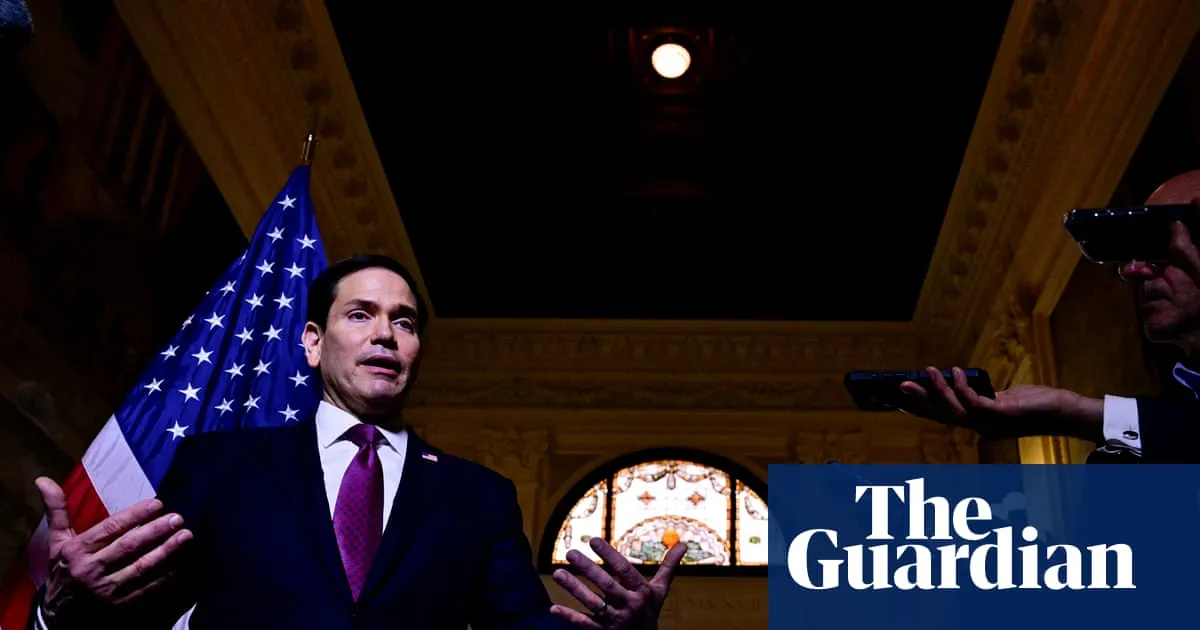
The US secretary of state, Marco Rubio, said on Tuesday that the World Health Organization (WHO) was “a little late” in identifying the deadly Ebola outbreak in the the Democratic Republic of the Congo and Uganda.On Tuesday, Rubio told reporters: “The lead is obviously going to be CDC [Centers for Disease Control] and the World Health Organization, which was a little late to identify this thing unfortunately.”His comments follow Donald Trump’s decision to withdraw the US from the WHO, a move which experts described as “sowing the seeds of the next pandemic”. Trump made the move in one of his first acts on returning to office last year. The US’s departure also led to the loss of nearly a quarter of the WHO’s workforce – about 2,000 jobs – from a total staff of about 9,400.Rubio said that the US, which has committed about $13m in assistance after sweeping aid cuts last year, was hoping to open about 50 clinics to treat Ebola in the DRC.“It’s a little tough to get to because it’s in a rural area … and [a] hard-to-get-to place in a war-torn country, unfortunately,” Rubio said. “We’re going to lean into that pretty heavy.”The WHO said earlier on Tuesday that it was concerned about the “scale and speed” of the Ebola outbreak that has killed an estimated 131 people in the DRC.Gigi Gronvall, an immunologist and associate professor at the Johns Hopkins Bloomberg School of Public Health, rejected Rubio’s criticism of the WHO.“Blaming the WHO is misplaced, because they are operating with limited resources in a difficult setting with many security challenges. But it’s also cold comfort for all the people who have gotten Ebola and died. And this should concern Americans as well. It’s highly worrisome given that public health resources in the US have been slashed and even a couple of cases in the US would be challenging with our current workforce,” Gronvall said.She added: “It is a strategic mistake – and a national security vulnerability – that we are worse off now to handle infectious disease threats than at the start of COVID-19. hantavirus [and] Ebola are terrible, serious diseases but they are not as transmissible as some other infectious disease threats we could face. Instead of dismantling everything, we need to invest in the vaccines, diagnostic testing, and public health and hospital responses we would need to protect Americans.”On Sunday, the WHO announced that the Ebola outbreak in the DRC and Uganda was a “public health emergency of international concern”, saying: “Neighboring countries sharing land borders with the Democratic Republic of the Congo are considered at high risk for further spread due to population mobility, trade and travel linkages, and ongoing epidemiological uncertainty.“The event requires international coordination and cooperation to understand the extent of the outbreak, to coordinate surveillance, prevention and response efforts, to scale up and strengthen operations and ensure ability to implement control measures,” the WHO added.The organization also noted that countries not bordering the DRC and Uganda should avoid closing borders or restricting travel and trade during disease outbreaks, arguing that such measures are driven more by fear than science. Restrictions can force people and goods through unmonitored crossings, potentially increasing the spread of disease, they said.WHO authorities also cautioned that travel bans can damage local economies and disrupt emergency response efforts.The Guardian has approached the WHO for comment.The WHO’s warnings come as US health agencies continue to face sweeping layoffs during Trump’s second term. Earlier this week, the Department of Health and Human Services announced plans to eliminate dozens of positions across agencies including the Agency for Healthcare Research and Quality, the Centers for Disease Control and Prevention, and the National Institutes of Health, among others.The cuts follow the announcement by the health secretary, Robert F Kennedy Jr, last year that he intended to reduce the department’s 82,000-person workforce by 10,000 jobs.The latest layoffs also arrive amid mounting concerns over the US’s preparedness for the next pandemic.While experts say the recent hantavirus outbreak is unlikely to spark a global health crisis, it has underscored the erosion of public health infrastructure in the US. Public health experts have also warned that deep political divisions and rampant misinformation could undermine Americans’ willingness to follow future health guidance.Echoing Gronvall, Jennifer Nuzzo, an epidemiology professor and director of the Pandemic Center at Brown School of Public Health, said: “The CDC first learned of the outbreak when it was publicly confirmed, despite the fact that there’d been rumors of an outbreak for weeks. This represents a notable change for the US government, which has historically played a key role in responding to rumored outbreaks in places like DRC and, if the rumors are confirmed to be true, helping to stop the outbreak.“It feels like the US government is on the sidelines this time,” she added.Melody Schreiber contributed reporting
SRCThe Guardian - World News
LANGEN
LEANCenter-Left
WORDS805
ENT12
TUE · 2026-05-19 · 18:44 GMTBRIEF NSR-2026-0519-77618
NSR-2026-0519-77618News Report·EN·Public Health
Rubio criticizes WHO’s Ebola response as US continues sweeping public health cuts
US Secretary of State Marco Rubio criticized the World Health Organization (WHO) for being "a little late" in identifying the Ebola outbreak in the Democratic Republic of the Congo and Uganda. This criticism comes as the US continues public health cuts, including planned layoffs across agencies like the CDC and NIH.
Maya Yang and agencyThe Guardian - World NewsFiled 2026-05-19 · 18:44 GMTLean · Center-LeftRead · 4 min
The Guardian - World NewsFIG 01
Reading time
4min
Word count
805words
Sources cited
2cited
Entities identified
12entities
Quality score
100%
§ 01
Briefing Summary
AI-generatedNEWSAR · AI
US Secretary of State Marco Rubio criticized the World Health Organization (WHO) for being "a little late" in identifying the Ebola outbreak in the Democratic Republic of the Congo and Uganda. This criticism comes as the US continues public health cuts, including planned layoffs across agencies like the CDC and NIH. Despite these cuts, the US has committed $13 million in aid and plans to open Ebola treatment clinics in the DRC. Experts, however, argue that blaming the WHO is misplaced given its limited resources and difficult operating environment, and that US public health infrastructure is weakened, making it less prepared for future threats. The WHO declared the Ebola outbreak a "public health emergency of international concern," urging international coordination.
Confidence 0.90Sources 2Claims 5Entities 12
§ 02
Article analysis
Model · rule-basedFraming
Public Health
Diplomatic
Tone
Measured
AI-assessed
CalmNeutralAlarmist
Factuality
0.70 / 1.00
Factual
LowHigh
Sources cited
2
Limited
FewMany
§ 03
Key claims
5 extracted01
Gronvall stated the US is worse off handling infectious disease threats now than at the start of Covid-19.
quoteGigi Gronvall
Confidence
1.00
02
Gigi Gronvall believes blaming the WHO is misplaced due to limited resources and difficult settings.
quoteGigi Gronvall
Confidence
1.00
03
The WHO declared the Ebola outbreak in the DRC and Uganda a "public health emergency of international concern."
quoteWHO
Confidence
1.00
04
Marco Rubio stated the WHO was "a little late" to identify the Ebola outbreak in the DRC and Uganda.
quoteMarco Rubio
Confidence
1.00
05
The US withdrew from the WHO, leading to the loss of approximately 2,000 WHO jobs.
factual
Confidence
0.90
§ 04
Full report
4 min read · 805 words§ 05
Entities
12 identifiedKey playerOppositionContextPositiveNeutralNegative
People3
Organizations3
Locations3
Topics1
§ 06
Keywords & salience
8 termswho
1.00
ebola response
1.00
public health cuts
0.90
us withdrawal from who
0.80
infectious disease threats
0.70
cdc
0.60
national security vulnerability
0.50
pandemic preparedness
0.40
§ 07
Topic connections
Interactive graph Network visualization showing 51 related topics
View Full Graph Person Organization Location Event|Click node to navigate|Edge numbers = shared articles