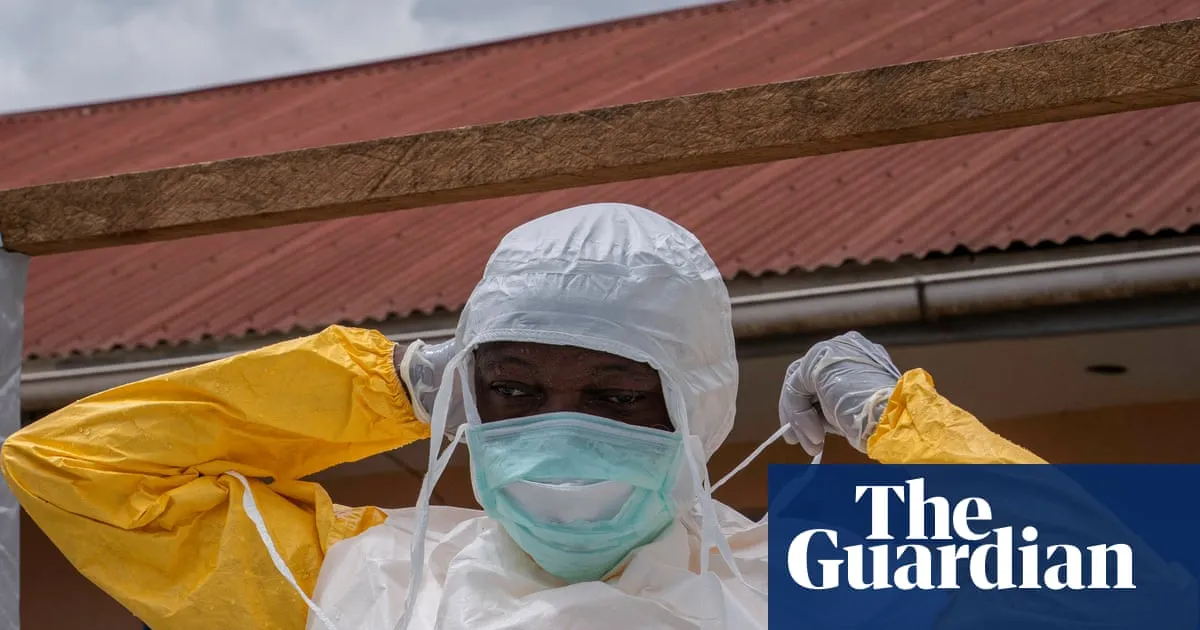
Central Africa’s Ebola outbreak could spread to be similar in scale to the worst outbreak in history, West Africa’s 2014-2016 outbreak that killed more than 11,000 people, according to a new analysis by US health officials.The US Centers for Disease Control and Prevention (CDC) on Friday published a range of scenarios generated by computer models, from 10,000 cases to more than 20,000. In the West Africa outbreak, more than 28,000 cases were reported.The analysis from the CDC said cases could grow to 20,000 or more, depending on how quickly infected people are isolated to slow the spread.Incident manager for the CDC’s Ebola response, Dr Satish Pillai, said without strong public health interventions, “the modelling work suggests an outbreak of that scale is possible”.Jennifer Nuzzo, director of Brown University’s Pandemic Center in the United States, said the modelling “affirms what we have worried about since the beginning: this outbreak is following dangerous trajectory” if more is not done to stop its spread.But she cautioned it can be extremely difficult to predict how outbreaks will progress. “I wouldn’t read too much into the specific numbers. It’s really hard to make an accurate projection when you have limited data,” she said.The Africa Centers for Disease Control and Prevention said Friday there have been about 400 confirmed cases, including 63 deaths. Experts say there are probably other cases that haven’t been diagnosed or reported.The viruses that cause Ebola are spread through contact with body fluid such as vomit, blood and semen. There are no specific treatments or vaccines for the Bundibugyo virus at the heart of the current outbreak. The disease is often fatal.The World Health Organization declared the outbreak a global health emergency in May. Some experts believe infections may have been occurring in February, but health officials initially tested for a different kind of Ebola virus.The outbreak response has been complicated by an armed conflict between Congo’s government and the Rwanda-backed M23 rebel group, as well as attacks by the Islamic State-affiliated group the Allied Democratic Force. The violence has caused massive displacement of people living in the conflict areas, officials say.CDC’s modelling report attempts to project how things might play out, based on different factors – including how many infections and deaths have already happened, and how quickly responders can identify and isolate infected people before they can spread the infection to others.Pillai said the actual isolation rate is unknown but is considered to be “on the lower end of the scenarios” that CDC modelled.Higher isolation rates, of 50% or 70%, could result in the number of cases being more like 10,000, CDC officials said. But if the actual number of deaths were greater in late May than now recognised, that could make the outcomes worse, CDC officials said.Some CDC modelling during the large Ebola outbreak in West Africa proved to be way off. The CDC issued modelled numbers in 2014, when the epidemic was spiralling out of control and international health officials were quickly trying to build a response.It estimated that in a worse-case scenario where nothing was done, as many as 1.4 million people might become infected. That turned out to be more than 50 times higher than what happened.
SRCThe Guardian - World News
LANGEN
LEANCenter-Left
WORDS531
ENT12
SAT · 2026-06-06 · 04:21 GMTBRIEF NSR-2026-0606-82160
NSR-2026-0606-82160News Report·EN·Public Health
Ebola spread in central Africa could match 2014 record outbreak, US health officials say
US health officials from the CDC have developed computer models suggesting that the current Ebola outbreak in central Africa could potentially reach the scale of the 2014-2016 West Africa epidemic, which saw over 28,000 cases. The CDC's analysis presents scenarios ranging from 10,000 to over 20,000 cases, depending on the speed of isolating infected individuals.
The Associated PressThe Guardian - World NewsFiled 2026-06-06 · 04:21 GMTLean · Center-LeftRead · 3 min
The Guardian - World NewsFIG 01
Reading time
3min
Word count
531words
Sources cited
4cited
Entities identified
12entities
Quality score
100%
§ 01
Briefing Summary
AI-generatedNEWSAR · AI
US health officials from the CDC have developed computer models suggesting that the current Ebola outbreak in central Africa could potentially reach the scale of the 2014-2016 West Africa epidemic, which saw over 28,000 cases. The CDC's analysis presents scenarios ranging from 10,000 to over 20,000 cases, depending on the speed of isolating infected individuals. Experts emphasize that while the modeling indicates a "dangerous trajectory" without strong interventions, outbreak predictions are inherently difficult due to limited data. The Africa CDC has reported approximately 400 confirmed cases and 63 deaths, though undiagnosed cases are likely. The outbreak, caused by the Bundibugyo virus, is complicated by ongoing armed conflict and displacement in the region.
Confidence 0.90Sources 4Claims 5Entities 12
§ 02
Article analysis
Model · rule-basedFraming
Public Health
Conflict
Tone
Mixed Tone
AI-assessed
CalmNeutralAlarmist
Factuality
0.70 / 1.00
Factual
LowHigh
Sources cited
4
Well sourced
FewMany
§ 03
Key claims
5 extracted01
There are no specific treatments or vaccines for the Bundibugyo virus causing the current outbreak.
factualarticle
Confidence
1.00
02
Outbreak response is complicated by armed conflict and attacks by militant groups.
factualofficials
Confidence
0.90
03
The current outbreak has about 400 confirmed cases, including 63 deaths.
statisticAfrica Centers for Disease Control and Prevention
Confidence
0.90
04
CDC computer models project 10,000 to over 20,000 cases depending on isolation speed.
statisticUS Centers for Disease Control and Prevention (CDC)
Confidence
0.80
05
Central Africa's Ebola outbreak could spread to be similar in scale to the 2014-2016 west Africa outbreak.
predictionUS health officials
Confidence
0.70
§ 04
Full report
3 min read · 531 words§ 05
Entities
12 identifiedKey playerOppositionContextPositiveNeutralNegative
Organizations4
Locations4
Events1
§ 06
Keywords & salience
9 termsebola outbreak
1.00
public health interventions
0.90
us health officials
0.80
computer models
0.70
disease spread
0.70
2014 record outbreak
0.60
armed conflict
0.50
bundibugyo virus
0.50
global health emergency
0.40
§ 07
Topic connections
Interactive graph Network visualization showing 51 related topics
View Full Graph Person Organization Location Event|Click node to navigate|Edge numbers = shared articles