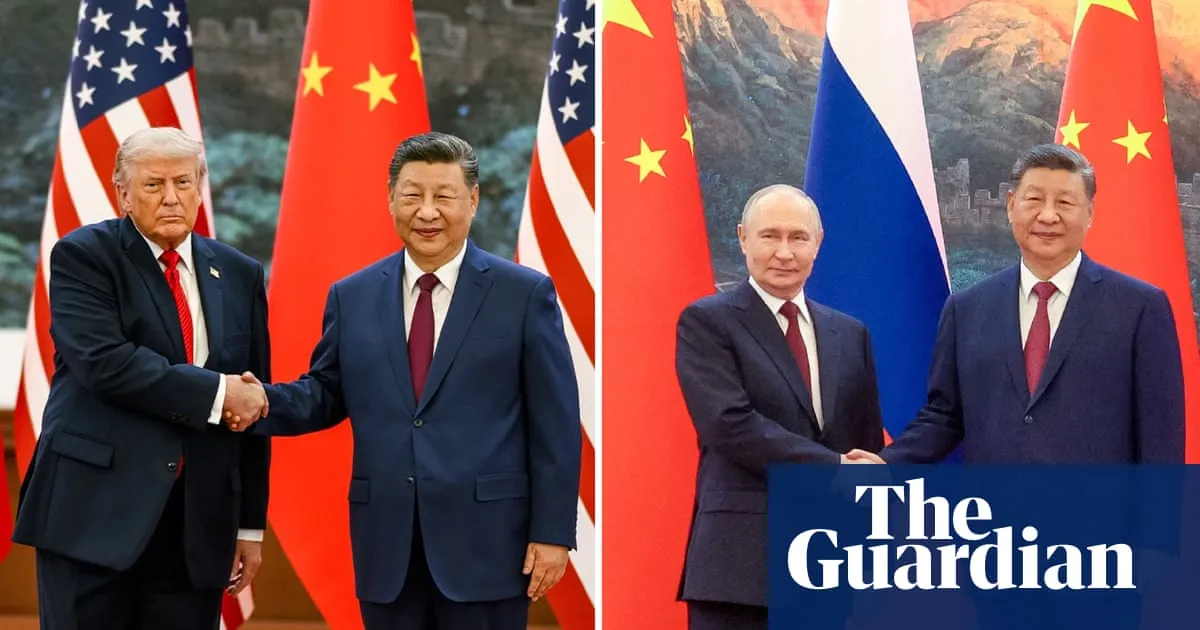
Days after Donald Trump was greeted in Beijing with a military band, an honour guard and dozens of youths waving American and Chinese flags, Vladimir Putin arrived in China to an almost identical spectacle.The choreography of the two welcomes appeared deliberately mirrored, designed to showcase Beijing’s ability to host leaders from Washington and Moscow with equal grandeur.But China also made sure the differences were noticed. Trump was met at the airport by China’s vice-president, a largely ceremonial role outside the Communist Party’s real power structure, while Putin was welcomed by a sitting member of the politburo, the party’s top decision-making body, a subtle signal that China sees Moscow as a trusted partner of an emerging non-western world order led by Beijing.The Kremlin appeared sensitive to the comparisons. Its spokesperson, Dmitry Peskov, dismissed suggestions that the two visits were being measured against each another, insisting they should not be viewed through the prism of rivalry. The senior Kremlin aide Yuri Ushakov stressed that Putin’s visit to meet Xi Jinping had been planned long before Trump’s trip to Beijing.Trump and Putin were both presented with an honour guard outside the Great Hall of the People. Composite: Evan Vucci/Reuters/Getty ImagesEven if Moscow insisted the two visits should not be compared, the message in Russia’s state press was clear. The Russian newspaper Argumenty i Fakty wrote that Putin was being received in Beijing “as an ally and reliable partner” while Trump had been treated as “a rival and competitor from whom anything can be expected”.Behind the lavish ceremonies, both visits produced relatively modest results. While Trump and Xi projected an image of cooperation, their summit yielded few concrete breakthroughs, with little progress on key disputes over Nvidia chip exports and tariffs.For Moscow, the stakes were arguably higher. Putin arrived in Beijing facing what may be the most difficult period of his long rule. His strongman image at home is beginning to fray as Russia’s economy struggles under the pressure of war and sanctions, while Russian forces have made little meaningful progress on the battlefield in Ukraine this year.Russia’s mounting economic troubles are deepening its reliance on China, transforming what the Kremlin portrays as a partnership of equals into an increasingly asymmetric relationship. But the war between the US and Iran has given Russia a new opening. With instability in the Gulf threatening global energy supplies and the strait of Hormuz in effect closed, Moscow has sought to present itself to Beijing as a more reliable long-term supplier of oil and gas.A large screen in a shopping area in Beijing shows news footage of Xi meeting Trump and then Putin. Photographs: Tingshu Wang/Reuters/Greg Baker/AFP/Getty ImagesBefore the summit, Russian officials said they hoped for concrete progress on energy cooperation, particularly on the long-delayed Power of Siberia 2 gas pipeline, which would redirect gas from fields that once supplied Europe towards China instead.Joseph Webster, a senior fellow at the Atlantic Council, said: “Ukraine’s attacks on Russian western energy infrastructure have further incentivised Moscow to look east, while the US-Iran war has heightened Beijing’s energy security anxieties.”But on the day there was no specific announcement on Power of Siberia 2. Xi and Putin instead pledged in vague terms to deepen cooperation across a broad range of sectors, with Xi saying the two countries would “give full play to resources interconnection”.Peskov later acknowledged that the timeline for the project’s implementation had still not been determined.Group meetings attended by Trump and by Putin. Photographs: Mark Schiefelbein/AP/XinhuaThe biggest winner from the summits may have been Xi himself. China’s leader has long sought to project himself as a global statesman capable of dealing with rival powers. No previous Chinese leader has hosted back-to-back state visits in the same month from a sitting US president and a sitting Russian president.Xi will cherish the image of China as a power capable of challenging the US economically while highlighting Beijing’s growing role as the lifeline of an increasingly dependent Russia.During Trump’s visit, Xi was keen to remind his American counterpart that Beijing still retained a powerful strategic ally in Russia. As he hosted Trump inside Zhongnanhai, the Communist leadership compound rarely opened to foreign guests, Xi emphasised the exclusivity of the setting. Asked whether foreign leaders were often invited there, Xi shook his head. “Very rarely,” he said, adding with a chuckle: “For example, Putin has been here.”Speaking later alongside Putin, Xi said relations between China and Russia were “rightfully regarded as a model for a new type of relations between major powers”.Notably absent from public discussions during either summit was any serious attempt at a breakthrough on the two wars currently dominating global politics.Trump said he had rejected a proposal from Xi for China to help broker peace between the US and Iran, keeping the strait of Hormuz shut.Before Putin’s visit, the Financial Times reported that Xi had privately suggested to Trump that Putin could ultimately come to regret the war in Ukraine. China’s foreign ministry, as well as Trump, rejected the report.Vladimir Putin and Xi Jinping deliver a joint press statement in the Great Hall of the People. Photograph: Pool/Getty ImagesXi appeared keen to project a united front with Moscow, which has shown no signs of compromise to end the full-scale invasion of Ukraine. In a joint statement, China and Russia reiterated their call for the “elimination of the root causes” of the war in Ukraine – language that closely mirrors the Kremlin’s narrative blaming the west for the conflict.Still, Russia’s growing difficulties in Ukraine will not be lost on Beijing, which has closely monitored the war as an opportunity to study the successes and failures of both sides.William Yang, a senior analyst for the International Crisis Group, said Xi may be seeking a clearer understanding of Putin’s thinking on the war in Ukraine, which has increasingly complicated Beijing’s relations with western countries at a time when China is trying to stabilise trade ties with Europe and the US.China, which holds enormous sway over Russia’s economy, has played little meaningful role in trying to end the war in Ukraine, content to tolerate the conflict so long as it can preserve its trade and diplomatic ties with Moscow while extracting increasingly favourable terms from its weakened partner.
SRCThe Guardian - World News
LANGEN
LEANCenter-Left
WORDS1 033
ENT12
WED · 2026-05-20 · 13:44 GMTBRIEF NSR-2026-0520-77829
NSR-2026-0520-77829Analysis·EN·Political Strategy
Same but different: how Xi and China welcomed Trump and Putin
China recently hosted back-to-back state visits by Donald Trump and Vladimir Putin, with outwardly similar grand receptions. However, China subtly highlighted differences, welcoming Putin with a higher-ranking official than Trump, signaling Moscow as a trusted partner in a non-Western order.
Pjotr Sauer, and Amy Hawkins in BeijingThe Guardian - World NewsFiled 2026-05-20 · 13:44 GMTLean · Center-LeftRead · 5 min
The Guardian - World NewsFIG 01
Reading time
5min
Word count
1 033words
Sources cited
3cited
Entities identified
12entities
Quality score
100%
§ 01
Briefing Summary
AI-generatedNEWSAR · AI
China recently hosted back-to-back state visits by Donald Trump and Vladimir Putin, with outwardly similar grand receptions. However, China subtly highlighted differences, welcoming Putin with a higher-ranking official than Trump, signaling Moscow as a trusted partner in a non-Western order. Russian officials downplayed comparisons, but state media portrayed Putin as an ally while Trump was seen as a rival. Both visits yielded modest concrete results, though Russia's economic struggles increase its reliance on China. Xi Jinping benefited from projecting himself as a global statesman, showcasing China's ability to engage with both rival powers and a dependent Russia.
Confidence 0.90Sources 3Claims 5Entities 12
§ 02
Article analysis
Model · rule-basedFraming
Political Strategy
Diplomatic
Tone
Measured
AI-assessed
CalmNeutralAlarmist
Factuality
0.70 / 1.00
Factual
LowHigh
Sources cited
3
Well sourced
FewMany
§ 03
Key claims
5 extracted01
Russian state press portrayed Putin's reception as an 'ally and reliable partner' while Trump was seen as a 'rival and competitor'.
quoteArgumenty i Fakty
Confidence
0.95
02
China deliberately mirrored the welcomes for Trump and Putin to showcase its hosting capabilities.
factual
Confidence
0.90
03
Both Trump's and Putin's visits yielded modest results with few concrete breakthroughs.
factual
Confidence
0.85
04
Russia's reliance on China is deepening due to economic troubles and sanctions, making the relationship increasingly asymmetric.
factual
Confidence
0.80
05
China subtly signaled Moscow as a trusted partner in an emerging non-western order by having a politburo member greet Putin, unlike Trump's reception.
factual
Confidence
0.80
§ 04
Full report
5 min read · 1 033 words§ 05
Entities
12 identifiedKey playerOppositionContextPositiveNeutralNegative
People5
Organizations3
§ 06
Keywords & salience
10 termschina foreign policy
0.90
us-china relations
0.80
russia-china partnership
0.80
geopolitical strategy
0.70
non-western world order
0.60
donald trump
0.50
vladimir putin
0.50
xi jinping
0.50
ukraine war
0.40
economic sanctions
0.40
§ 07
Topic connections
Interactive graph Network visualization showing 51 related topics
View Full Graph Person Organization Location Event|Click node to navigate|Edge numbers = shared articles