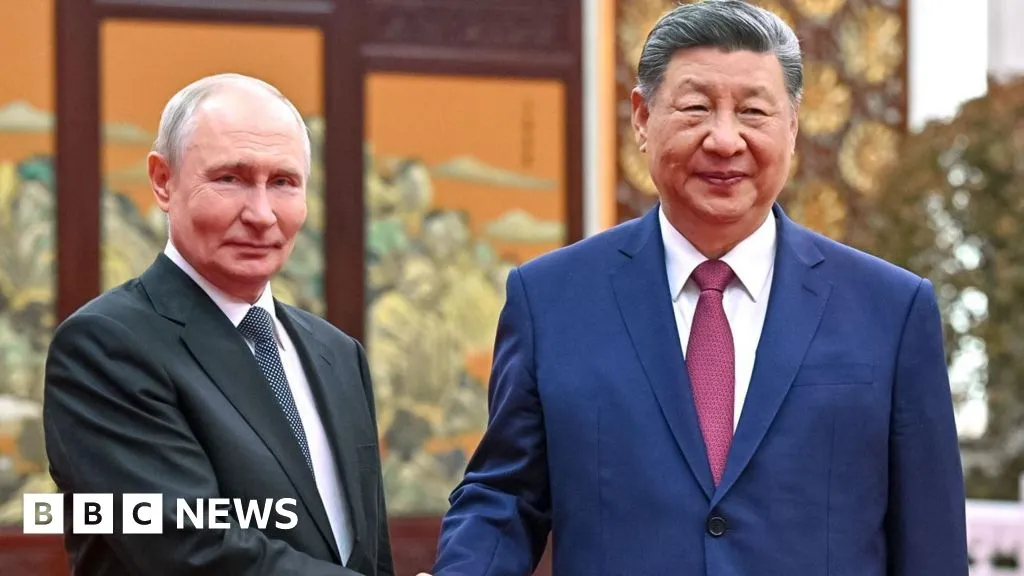
In their public statements they spoke of "strategic co-operation" between their nations, about "partnership", "mutual respect", "friendship" and "trust."Together they railed against the "irresponsible" nuclear policy of the United States and condemned Donald Trump's plan for a Golden Dome missile defence shield.On the eve of the visit the Russian government newspaper had published two big photos on its front page: one of a lonely-looking Trump climbing the steps of Air Force One at the end of his China trip last week; and beside it an old image of Putin and Xi walking together.The visual messaging was unmistakable: Russia and China are shoulder-to- shoulder on the world stage.But this is not a world of love songs, romance and bromance.This is geopolitics.And in the world of geopolitics relationships are rarely based on love and affection. It's often self-interest.At the Xi-Putin summit it became clear that there are limits to the love.
SRCBBC News - World
LANGEN
LEANCenter
WORDS149
ENT9
WED · 2026-05-20 · 16:34 GMTBRIEF NSR-2026-0520-77884
NSR-2026-0520-77884Analysis·EN·Political Strategy
Rosenberg: Putin enjoys Xi's Chinese welcome but heads home without pipeline deal
During a summit in China, Russian President Vladimir Putin and Chinese President Xi Jinping presented a united front, emphasizing "strategic co-operation," "partnership," and "friendship." Both leaders publicly criticized the United States' nuclear policy and a missile defense plan. Visual messaging from Russian state media highlighted the perceived alliance between the two nations.
BBC News - WorldFiled 2026-05-20 · 16:34 GMTLean · CenterRead · 1 min
BBC News - WorldFIG 01
Reading time
1min
Word count
149words
Sources cited
0cited
Entities identified
9entities
Quality score
100%
§ 01
Briefing Summary
AI-generatedNEWSAR · AI
During a summit in China, Russian President Vladimir Putin and Chinese President Xi Jinping presented a united front, emphasizing "strategic co-operation," "partnership," and "friendship." Both leaders publicly criticized the United States' nuclear policy and a missile defense plan. Visual messaging from Russian state media highlighted the perceived alliance between the two nations. However, the article indicates that despite the strong public statements, the relationship is driven by geopolitics and self-interest, suggesting limitations to their cooperation. Putin departed without a pipeline deal, underscoring that the partnership, while outwardly strong, is not based on sentiment but on strategic considerations.
Confidence 0.85Claims 5Entities 9
§ 02
Article analysis
Model · rule-basedFraming
Political Strategy
Diplomatic
Tone
Mixed Tone
AI-assessed
CalmNeutralAlarmist
Factuality
0.40 / 1.00
Mixed
LowHigh
Sources cited
0
No named sources
FewMany
§ 03
Key claims
5 extracted01
Both leaders criticized the United States' "irresponsible" nuclear policy and Donald Trump's missile defense plan.
quotepublic statements
Confidence
1.00
02
Putin and Xi spoke of "strategic co-operation," "partnership," "mutual respect," "friendship" and "trust" in public statements.
quotepublic statements
Confidence
1.00
03
Putin returned from China without a pipeline deal.
factualarticle's own claim
Confidence
0.90
04
Russian government newspaper published photos of Trump and Putin/Xi to visually convey Russia and China are aligned.
factualarticle's own claim
Confidence
0.90
05
Geopolitical relationships are often based on self-interest rather than affection.
factualarticle's own claim
Confidence
0.70
§ 04
Full report
1 min read · 149 words§ 05
Entities
9 identifiedKey playerOppositionContextPositiveNeutralNegative
People3
§ 06
Keywords & salience
8 termsgeopolitics
1.00
strategic co-operation
0.90
xi-putin summit
0.80
russia-china relations
0.80
self-interest
0.70
nuclear policy
0.60
missile defence shield
0.50
pipeline deal
0.40
§ 07
Topic connections
Interactive graph Network visualization showing 51 related topics
View Full Graph Person Organization Location Event|Click node to navigate|Edge numbers = shared articles