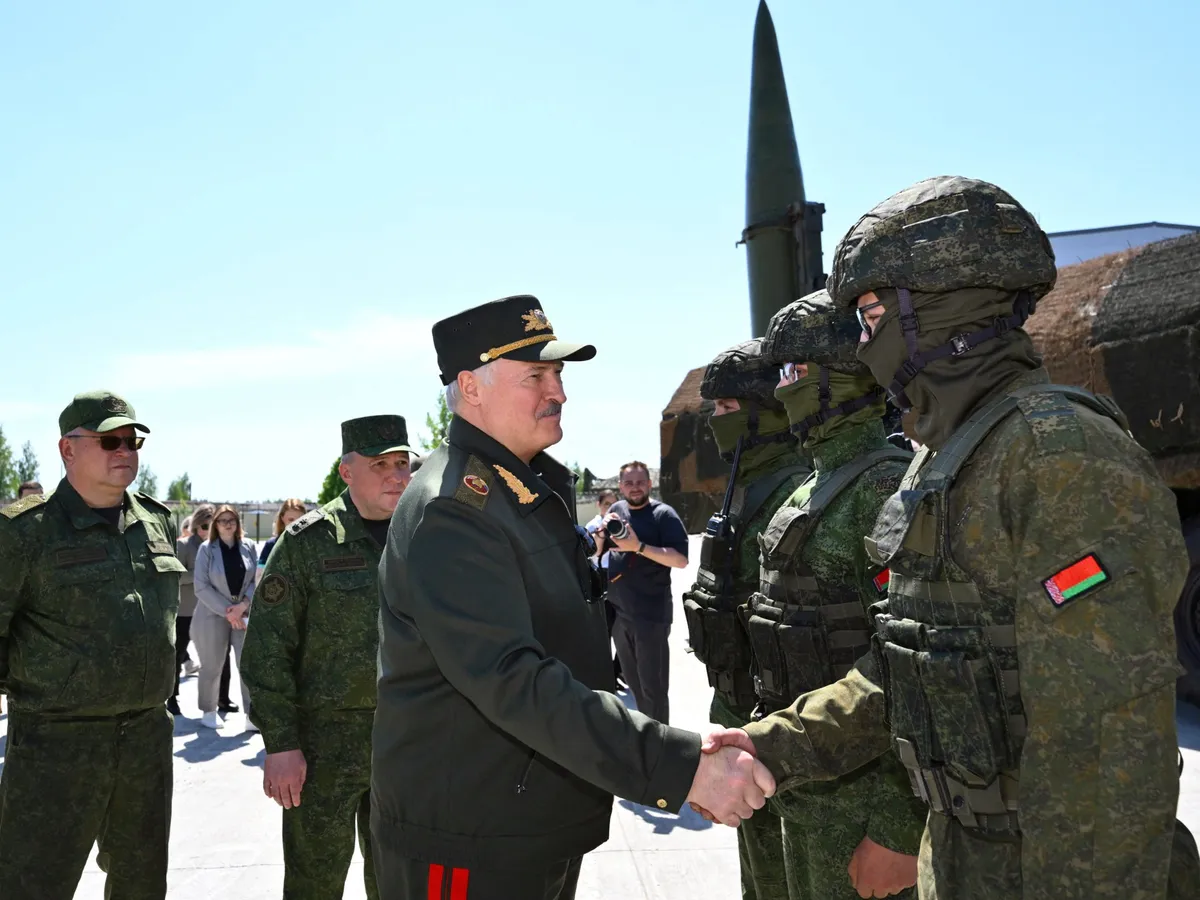
Russia’s ally participated in joint drills for the first time. Analysts say it was a risky move for Minsk.Published On 22 May 2026Kyiv, Ukraine – Earlier this week, Belarusian President Alexander Lukashenko for the first time took part in the “rehearsal” of Russia’s use of tactical and strategic nuclear weapons.Between Tuesday and Thursday, he and his Russian counterpart Vladimir Putin presided over joint military drills that covered the area from Eastern Europe to the Pacific and involved hundreds of Russian missile launchers, warplanes, warships and nuclear submarines.Recommended Stories list of 4 itemslist 1 of 4Zelenskyy vows response after Russian strike kills 24 in Kyivlist 2 of 4Belarus dismisses concerns as it launches joint nuclear drills with Russialist 3 of 4Russia rehearses ‘use of nuclear forces’ in drills with Belaruslist 4 of 4Putin and Lukashenko monitor joint Russia-Belarus nuclear exercisesend of list“We threaten absolutely no one,” said Lukashenko, a 71-year-old former collective farm director who has helmed his ex-Soviet nation since 1994. “But we have such weapons, and we’re ready in every possible way to defend our common fatherland from [the western Belarusian city of] Brest to [Russia’s Pacific port of] Vladivostok.”But Lukashenko, who is often labelled as “Europe’s last dictator”, does not keep all his political eggs in one basket.He has, for years, been politically backed by Moscow. Belarus enjoys economic preferences and cheap hydrocarbons, but Lukashenko managed to resist Putin’s attempts to merge Belarus with Russia as part of “union state” deals dating back to the 1990s. And in recent months, ties between Belarus and the United States have warmed.So, what’s behind Belarus’s involvement in Russia’s nuclear war games?A nuclear scare“It’s important to further boost the level of readiness of strategic and tactical nuclear forces,” Putin said on Thursday.Both Moscow and Minsk will “take into account the experience of the special military operation,” he said, referring to Russia’s four-year-old war in Ukraine.He and Lukashenko ordered the launch of the intercontinental, hypersonic Yars missile capable of carrying three independently targetable nuclear missiles.In less than 20 minutes, the missile flew 5,750km (3,573 miles) from the Plesetsk Cosmodrome in the northwestern Arkhangelsk region to the Pacific Kamchatka Peninsula.The drills got many worried.“The events develop suddenly, seemingly without any external reasons,” Nikolay Mitrokhin, a researcher with Germany’s Bremen University who has penned hundreds of detailed analyses of the Russia-Ukraine war, told Al Jazeera.“Something big is taking place, something that will be significant for international politics in general, and for mass media, including the very supply of nuclear arms,” he said.As part of the drills, Moscow supplied Minsk with modified Su-25 fighter jets and the Iskander-M ballistic missiles with a range of up to 500km (310 miles) – and nuclear weapons that are reportedly stored at the Asipovichi military range, less than 200km (124 miles) north of the Ukrainian border.Russian President Vladimir Putin observes the joint war games at the Kremlin in Moscow, Russia, on May 21, 2026 [Sputnik/Mikhail Metzel/Pool via Reuters]Days after Russia began its full-scale invasion of Ukraine in February 2022, Lukashenko conducted a “referendum” to amend the Belarusian constitution and allow the presence of nuclear weapons on its territory.In June 2023, Putin announced the deployment of tactical, short-range nuclear arms to Belarus, claiming that he mirrors what Washington had been doing for decades by placing its nukes at military bases in NATO member states in Europe. He also said Moscow would upgrade Belarusian strategic bombers to allow them to carry nuclear bombs.Tactical nuclear weapons are not regulated by treaties between the two major nuclear powers, the US and Russia. Because of their small size, they are harder to track down and monitor.NATO Secretary-General Mark Rutte said on Wednesday that if Moscow uses nuclear weapons against Ukraine, the alliance’s response would be “devastating”.On Friday, Rutte is heading a summit of foreign ministers of NATO member states in Sweden’s Helsingborg.The venue is symbolic – Sweden joined the alliance after Moscow’s full-scale invasion – and the Russia-Belarus drills are obviously timed to the summit.A new Ukrainian front?Moscow and Minsk claimed this week’s drills were triggered by an unspecified “threat of aggression”.But Ukrainian President Volodymyr Zelenskyy said on May 15 that Russia is dragging Belarus into “new acts of aggression”.Six days later, Zelenskyy warned that the drills may be part of Moscow’s preparations to launch a new offensive against northern Ukraine and Kyiv after Russian troops failed to capture sizeable areas in eastern and southern Ukraine this year.However, the current concentration of Russian forces in Belarus is “insufficient” for a new offensive, according to the head of the Kyiv-based Penta think tank.“Attacking Ukraine with Belarusian forces alone may end very badly for Lukashenko,” Volodymyr Fesenko told Al Jazeera. “For him, involving Belarus in the war is too big a risk.”Service members mount a missile on a Russian Iskander-M missile launcher during nuclear forces exercises at an unidentified location in Belarus, in this still image taken from handout footage released on May 21, 2026 [Russian Defence Ministry/Handout via Reuters]In early 2022, Minsk allowed Moscow to cross the Belarusian-Ukrainian border that stretches across Europe’s densest forests and swamps for 1,084km (674 miles) as a springboard to invade northern Ukraine and the Kyiv region.Parts of the border lie within the Alienation Zone around the shut-down Chornobyl nuclear plant, the site of the largest nuclear disaster in history, and some Russian troops were reportedly heavily irradiated.The offensive and the “takeover of Kyiv in three days” that the Kremlin had anticipated failed, and weeks later, Putin ordered the withdrawal of troops.But Russian troops continued to launch missiles and drones from Belarus.‘Sabre-rattling’However, despite the threatening rhetoric and impressive video footage of the drills, they’re nothing but bluff aimed at threatening the West, some observers say.They are also an unorthodox way to restart direct diplomatic contacts between Minsk and Kyiv.“I’d say it’s sabre-rattling. And not even with sabres but with threats,” Igar Tyskevych, a Belarus-born political analyst based in Kyiv, told Al Jazeera.By issuing warnings and alarming the West, Zelenskyy “deliberately upped the ante to create a separate track for negotiations,” he said.As a result, Lukashenko “sent a personal signal that he’s ready for this track,” he said.Lukashenko made it clear on Thursday – and signalled his readiness to hold talks with Zelenskyy.“We’re not going to get sucked into the war in Ukraine. There’s no need for it, neither civil nor military,” Lukashenko was quoted by the state-run Belta news agency as saying.“If [Zelenskyy] wants to discuss something, seek advice, or anything else, he’s welcome,” he said. “I’m ready to meet him anywhere in Ukraine or Belarus.”This readiness also signals Minsk’s economic woes.Belarus, a United Kingdom-sized nation of 10 million, is an amber-preserved Soviet relic.Its state-controlled economy is export-oriented, depending heavily on the export of potassium fertiliser, gasoline made from discounted Russian crude, foodstuffs and timber.Ukraine stopped buying Belarusian goods altogether, and the European Union reduced imports by more than two-thirds as part of sanctions slapped on Lukashenko for his support of Russia’s war.
SRCAl Jazeera
LANGEN
LEANCenter
WORDS1 152
ENT12
FRI · 2026-05-22 · 11:06 GMTBRIEF NSR-2026-0522-78405
NSR-2026-0522-78405Analysis·EN·National Security
‘Something big taking place’: Why has Russia sent more nukes to Belarus?
Russia and its ally Belarus recently conducted joint military drills involving tactical and strategic nuclear weapons, with Belarusian President Alexander Lukashenko participating for the first time. These exercises, which spanned from Eastern Europe to the Pacific, included missile launches and the deployment of modified Russian military equipment to Belarus.
Mansur MirovalevAl JazeeraFiled 2026-05-22 · 11:06 GMTLean · CenterRead · 5 min
Al JazeeraFIG 01
Reading time
5min
Word count
1 152words
Sources cited
2cited
Entities identified
12entities
Quality score
100%
§ 01
Briefing Summary
AI-generatedNEWSAR · AI
Russia and its ally Belarus recently conducted joint military drills involving tactical and strategic nuclear weapons, with Belarusian President Alexander Lukashenko participating for the first time. These exercises, which spanned from Eastern Europe to the Pacific, included missile launches and the deployment of modified Russian military equipment to Belarus. Analysts suggest this move is a risky step for Minsk, potentially aimed at bolstering readiness and responding to perceived threats. The drills, which saw Russia supply Belarus with nuclear-capable missiles and aircraft, have raised concerns for Ukraine, with President Zelenskyy warning of potential new offensives. NATO has stated its response would be "devastating" if Russia uses nuclear weapons.
Confidence 0.90Sources 2Claims 5Entities 12
§ 02
Article analysis
Model · rule-basedFraming
National Security
Political Strategy
Tone
Sensational
AI-assessed
CalmNeutralAlarmist
Factuality
0.60 / 1.00
Mixed
LowHigh
Sources cited
2
Limited
FewMany
§ 03
Key claims
5 extracted01
Lukashenko claims Belarus threatens no one but is ready to defend its common fatherland.
quoteAlexander Lukashenko
Confidence
1.00
02
Researcher Nikolay Mitrokhin stated that 'Something big is taking place, something that will be significant for international politics in general, and for mass media, including the very supply of nuclear arms.'
quoteNikolay Mitrokhin
Confidence
1.00
03
Putin stated that Moscow and Minsk will take into account the experience of the special military operation in Ukraine.
quoteVladimir Putin
Confidence
1.00
04
Belarusian President Alexander Lukashenko participated in the rehearsal of Russia’s use of tactical and strategic nuclear weapons for the first time.
factualarticle
Confidence
0.90
05
Russia supplied Minsk with modified Su-25 fighter jets and Iskander-M ballistic missiles capable of carrying nuclear weapons as part of the drills.
factualarticle
Confidence
0.85
§ 04
Full report
5 min read · 1 152 words§ 05
Entities
12 identifiedKey playerOppositionContextPositiveNeutralNegative
Locations9
§ 06
Keywords & salience
10 termsnuclear weapons
1.00
russia belarus drills
0.90
tactical nuclear weapons
0.80
strategic nuclear forces
0.80
military drills
0.70
vladimir putin
0.60
alexander lukashenko
0.60
war in ukraine
0.50
readiness
0.40
missile launchers
0.40
§ 07
Topic connections
Interactive graph Network visualization showing 51 related topics
View Full Graph Person Organization Location Event|Click node to navigate|Edge numbers = shared articles