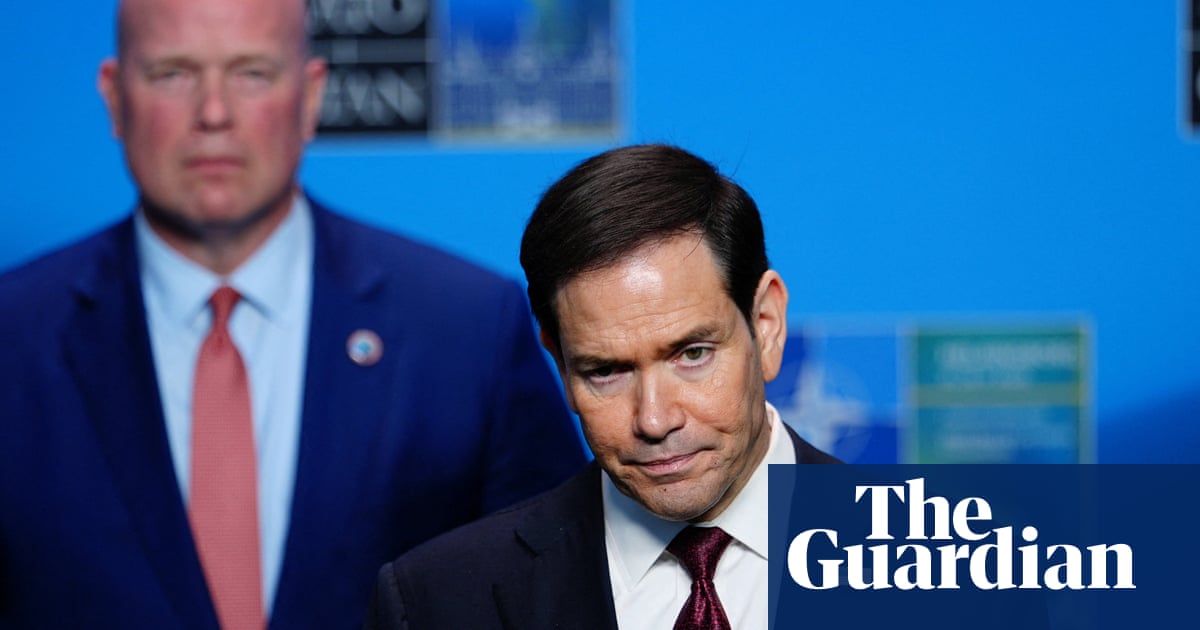
Donald Trump is disappointed that NATO allies refused to become more actively involved in attacking Iran, the US secretary of state has said, setting up what could become a fraught summit of the alliance in July.Marco Rubio, meeting with foreign ministers of the military alliance, emphasised that he expected the rift would be discussed at the July meeting in Ankara, making the summit “one of the more important” in NATO’s 77-year history.“The president’s views – frankly, disappointment – at some of our NATO allies and their response to our operations in the Middle East, they are well documented,” Rubio said as he arrived for the start of the meeting in Helsingborg.“That will have to be addressed. That won’t be solved or addressed today. That’s something for the leaders level to discuss,” he said, amid fresh US demands for help in forcing open the Strait of Hormuz if peace talks with Iran fail to progress.After the meeting, Rubio said he discussed the possibility with his counterparts of NATO countries helping militarily. “We have to have a plan B for if someone is shooting, then how do you reopen the straits?” Rubio said. “I don’t know if that would be a NATO mission necessarily, but it would certainly be NATO countries that can contribute to it.”The UK and France have offered to lead a multinational air and naval force to maintain security for merchant shipping in the Strait of Hormuz once the US and Iran have reached a peace deal, or there is a well-established ceasefire.US troop numbers in Europe are also expected to drop from 80,000 after a review reflecting wider commitments, Rubio emphasised, although the exact cut remains unclear amid contradictory statements from the White House.“I think it’s well understood in the alliance that the United States’ troop presence in Europe is going to be adjusted,” Rubio said after the foreign ministers’ meeting, stressing that the US had been talking to European NATO members about it.“I’m not saying they’re going to be thrilled about it, but they certainly are aware of it, and you know, we have obligations in the Indo-Pacific, we have obligations in the Middle East, we have obligations in the western hemisphere,” he added.At the beginning of the month, the US said it would withdraw 5,000 troops from Germany, as Trump reacted angrily to comments from the chancellor, Friedrich Merz, who had said Iran was humiliating the US in the peace talks.Last week, the Pentagon added that it would halt the rotation of 4,000 more into Poland, only for Trump to apparently reverse that on Thursday night on social media, in a hasty announcement that appeared to catch the Pentagon by surprise.Trump posted: “Based on the successful Election of the now President of Poland, Karol Nawrocki, who I was proud to Endorse, and our relationship with him, I am pleased to announce that the United States will be sending an additional 5,000 Troops to Poland.”Other NATO allies admitted erratic White House policy changes left them struggling to keep up. Maria Malmer Stenergard, Sweden’s foreign minister, admitted the situation was “confusing indeed, and not always easy to navigate”.The US secretary of state said after the meeting that while he had “long been an advocate for NATO”, one of the arguments he had made was that US “bases in the region” had provided the country’s military with “logistical options that we wouldn’t otherwise have”.“When some of those bases are denied to you during a conflict that we’re involved in, then you question whether that value is still there,” a topic Rubio said would be discussed at Ankara.No other NATO member joined in the 38-day attack on Iran or has so far proved prepared to force open the Strait of Hormuz, closed by an Iranian blockade, though some countries did provide a degree of assistance.Spain refused to allow US bases in the country or its airspace to be used for the attack on Iran, while France only allowed air tankers and other support aircraft to be used from the Istres air base in the south.The UK permitted the US air force to bomb Iranian missile launchers and any other military assets obstructing the strait from Fairford in Gloucestershire, the furthest any European country was willing to go in enabling US bombing.Earlier this year, Trump also demanded Greenland from Denmark, another NATO member, though he dropped the proposal after international lobbying and an agreement to create an Arctic air patrol mission to deter any Russian military activity.
SRCThe Guardian - World News
LANGEN
LEANCenter-Left
WORDS746
ENT12
FRI · 2026-05-22 · 16:29 GMTBRIEF NSR-2026-0522-78484
NSR-2026-0522-78484News Report·EN·Diplomatic
Marco Rubio: Trump ‘disappointment’ with Nato will be discussed at summit
US Secretary of State Marco Rubio stated that President Trump is disappointed with NATO allies' limited involvement in operations in the Middle East, particularly their refusal to actively participate in attacking Iran or forcing open the Strait of Hormuz. This disappointment will be a key topic at the upcoming NATO summit in Ankara in July, which Rubio described as highly important.
Dan SabbaghThe Guardian - World NewsFiled 2026-05-22 · 16:29 GMTLean · Center-LeftRead · 3 min
The Guardian - World NewsFIG 01
Reading time
3min
Word count
746words
Sources cited
3cited
Entities identified
12entities
Quality score
100%
§ 01
Briefing Summary
AI-generatedNEWSAR · AI
US Secretary of State Marco Rubio stated that President Trump is disappointed with NATO allies' limited involvement in operations in the Middle East, particularly their refusal to actively participate in attacking Iran or forcing open the Strait of Hormuz. This disappointment will be a key topic at the upcoming NATO summit in Ankara in July, which Rubio described as highly important. The US is also seeking NATO countries' military assistance for the Strait of Hormuz if peace talks with Iran fail. Additionally, the US plans to adjust its troop presence in Europe due to broader commitments, a move that has caused confusion among allies due to erratic White House policy changes.
Confidence 0.90Sources 3Claims 5Entities 12
§ 02
Article analysis
Model · rule-basedFraming
Diplomatic
National Security
Tone
Measured
AI-assessed
CalmNeutralAlarmist
Factuality
0.70 / 1.00
Factual
LowHigh
Sources cited
3
Well sourced
FewMany
§ 03
Key claims
5 extracted01
Trump announced on social media that the US will send an additional 5,000 troops to Poland.
quoteDonald Trump
Confidence
0.95
02
Marco Rubio expects Trump's disappointment with Nato allies to be discussed at the July summit in Ankara.
quoteMarco Rubio
Confidence
0.95
03
The US will withdraw 5,000 troops from Germany.
factualarticle
Confidence
0.90
04
Donald Trump is disappointed that Nato allies refused to become more actively involved in attacking Iran.
quoteUS secretary of state
Confidence
0.90
05
The US plans to adjust its troop presence in Europe due to wider commitments in other regions.
quoteMarco Rubio
Confidence
0.85
§ 04
Full report
3 min read · 746 words§ 05
Entities
12 identifiedKey playerOppositionContextPositiveNeutralNegative
Organizations1
§ 06
Keywords & salience
10 termsnato allies
1.00
trump disappointment
0.90
strait of hormuz
0.80
nato summit
0.80
middle east operations
0.70
iran peace talks
0.60
us troop presence
0.60
military assistance
0.50
marco rubio
0.50
indo-pacific obligations
0.40
§ 07
Topic connections
Interactive graph Network visualization showing 51 related topics
View Full Graph Person Organization Location Event|Click node to navigate|Edge numbers = shared articles