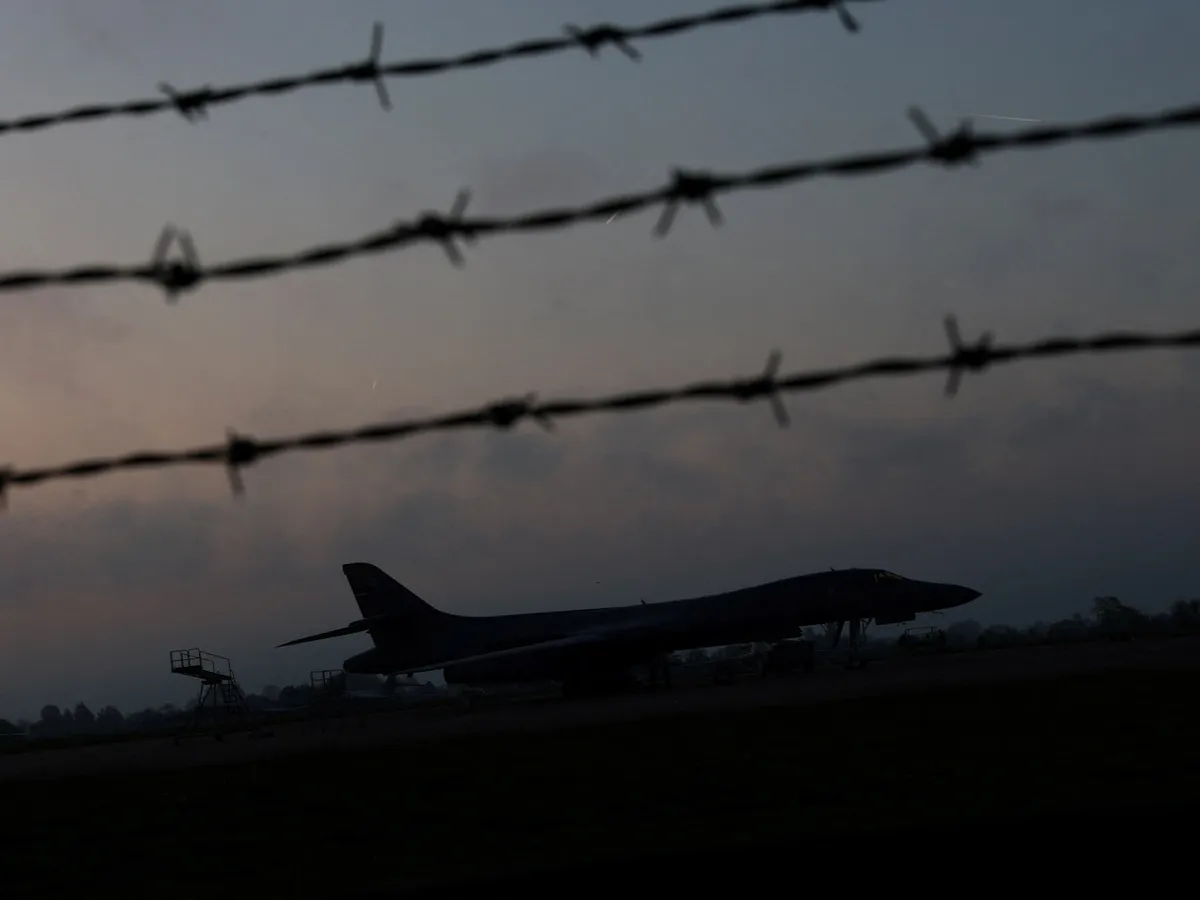
While US officials publicly project confidence in weapons stockpiles, analysts say dwindling munitions may be shaping Washington’s calculations over whether to resume the war on Iran.A B‑1B Lancer military aircraft parked on the tarmac at RAF Fairford airbase, which hosts United States Air Force (USAF) personnel, amid a ceasefire between the US and Iran, in Fairford, UK [File: Hannah McKay/Reuters]Published On 23 May 2026On Thursday, the acting United States Navy secretary, Hung Cao, was asked by a Senate committee about $14bn in weapons sales to Taiwan that Congress has approved but that President Donald Trump needs to sign off on.“Right now we’re doing a pause,” said Cao, “in order to make sure we have the munitions we need for Epic Fury – which we have plenty.”Recommended Stories list of 4 itemslist 1 of 4US-Iran diplomacy picks up: What’s the latest?list 2 of 4Trump shifts between diplomacy and threats in Iran standofflist 3 of 4US Senate pushes back against Trump’s $1.8bn ‘anti-weaponisation’ fundlist 4 of 4US pausing $14bn arms sale to Taiwan due to Iran war, navy chief saysend of listEpic Fury is the name of the US military operation that the Trump administration launched on February 28 against Iran. Trump’s Secretary of State Marco Rubio has since stated that Epic Fury was over, so Cao’s comments on needing munitions for the operation appeared to contradict the US’s top diplomat.But the Navy secretary’s comments on needing munitions for the Iran war also hit at another contradiction between the administration’s claims and the facts.While Cao was adamant that the pause in supplies to Taiwan was not due to a critical shortage of weapons – echoing other officials in the Trump administration – there’s growing evidence that the US is running through its munitions and missiles in the war on Iran much faster than they can be replenished.That strain was captured by Cao’s own comments. “We’re just making sure we have everything, then the foreign military sales will continue when the administration deems necessary,” he told senators.On Thursday, The Washington Post revealed that the US used more of its advanced missile-defence interceptors to defend Israel than even Israel itself during the 40 days of the Iran war, before the ceasefire came into effect on April 8.The report found that the US launched more than 200 Terminal High Altitude Area Defenses (THAAD) interceptors – which equate to about half its total inventory – and more than 100 Standard Missile-3 and Standard Missile-6 interceptors. By contrast, Israel fired fewer than 100 Arrow interceptors and about 90 David’s Sling interceptors.While US officials publicly project confidence in their stockpiles, analysts say the diminishing munitions could be factoring in Washington’s calculations in resuming its war on Tehran.Risk lies in future warsFollowing The Washington Post’s report, the Pentagon and Israel both defended their joint strategy of interceptor deployments, with the US defence body downplaying concerns of dwindling weapons.Ballistic missile interceptors are “just one tool” in the US air defence network, and both Israel and the US “equitably” shouldered the burden of Operation Epic Fury, Sean Parnell, the Pentagon’s chief spokesman, told the US outlet.Even as early as the first week of the war, Trump shrugged off concerns about US stocks of some critical missiles running low.But in late April, when the ceasefire had reduced the daily use of missiles and interceptors, the Center for Strategic and International Studies (CSIS), a Washington, DC think tank, warned that US forces had heavily used seven critical ammunitions, and for four of them expended more than half of the pre-war inventory. They included the THAAD interceptors, Patriot missiles and the SM-3 and SM-6 ship-based surface-to-air missiles used to intercept ballistic missiles.By April 21, the CSIS report said, the US had also used up more than 1,000 of its estimated 3,100 Tomahawk missiles.“Rebuilding to pre-war levels for the seven munitions will take from one to four years as missiles in the pipeline are delivered,” the report stated.To be sure, Felix Arteaga, a defence and security fellow at Madrid’s Elcano Royal Institute, said that unless a conflict with China erupts over Taiwan from today, the US is largely prepared – for now.“They will have prepared because they have made calculations for planning – alternative planning, contingency planning, [and] emergency planning,” Arteaga told Al Jazeera.But Omar Ashour, a professor of security and military studies at the Doha Institute for Graduate Studies in Qatar, said that while the Iran war did not empty the US arsenal of weapons, it burned through some of the most important and strategically valuable layers of this arsenal.“It’s not tactical exhaustion, it’s just a strategic inventory shock if you wish, because that depletion will affect other theatres [of war],” Ashour told Al Jazeera.He added that while expenditure on weapons like Tomahawks was serious, the missile defence depletion was a sharper strategic problem for the US.While CSIS said the US had enough missiles to continue fighting the Iran war in “any plausible scenario”, the risk “which will persist for many years, lies in future wars”, it said.The weapons factor in Washington’s Iran war calculationsWhile Trump has insisted he has called off military attacks in the past few weeks on Iran at the request of US allies in the Gulf, Ashour said dwindling munitions are indeed part of his calculation on this decision.“Stockpiles are now part of the escalation calculus,” said Ashour.“The US can restart striking, but every renewed wave has an opportunity cost … The question is no longer ‘Can we strike?’, but, ‘What strategic magazine are we consuming to strike and how would that affect the other theatres [of war]?’”The Washington Post also reported that Israel’s persistent pressure to restart the war has “irritated some US officials, particularly given the strain that renewed fighting would impose on the Pentagon’s munitions supply”.A CSIS report in April found that Iran’s missiles and drones during the war destroyed US military equipment worth between $2.3bn and $2.8bn, an additional factor in its diminished supply.And despite Trump’s claims that Iran’s missile arsenal has been “mostly decimated”, US intelligence assessments indicate Tehran still retains about 70 percent of its pre-war stockpile.So while the Iran war did not prove that the US is weak, it proved that Iran is resilient, Ashour said.“[Iran is] capable of multi-domain resistance and capable of withstanding 21,000 strikes and … sustained decapitation without collapsing. Not many states, not many regimes can claim that.”The US does not have an ‘unlimited magazine depth’According to the April CSIS report on US munitions, building stockpiles of weapons for future wars will take years. Even rebuilding to pre-war levels for the seven critical munitions the report cited “will take from one to four years as missiles in the pipeline are delivered”.Long lead times, supply chain bottlenecks, workforce constraints and material availability are challenges impacting manufacturing at speed, wrote Albert Vidal Ribe, an analyst at the International Institute for Strategic Studies.This is creating challenges not only for the US, but also for its Gulf allies, many of which relied on US-made and US-supplied defence systems to fend off retaliatory Iranian attacks, Arteaga said.While confidence in those systems remains high because they largely proved effective, Gulf states also understand that dwindling US munition stockpiles could leave them more vulnerable if the war resumes, he added.Trump’s second administration has attempted to expand production, but growth has been slower than hoped for due to the earlier COVID-19 pandemic-related supply-chain issues, and higher inflation and energy costs staving off extra investment, according to Ribe.
SRCAl Jazeera
LANGEN
LEANCenter
WORDS1 240
ENT12
SAT · 2026-05-23 · 09:22 GMTBRIEF NSR-2026-0523-78618
NSR-2026-0523-78618News Report·EN·National Security
Missiles to munitions: Does the US risk running out of key weapons?
US officials express confidence in weapons stockpiles, but analysts suggest dwindling munitions are influencing decisions regarding a potential resumption of the war on Iran. The acting US Navy secretary indicated a pause in a $14 billion arms sale to Taiwan, citing the need to ensure sufficient munitions for "Epic Fury," the US military operation against Iran.
Urooba JamalAl JazeeraFiled 2026-05-23 · 09:22 GMTLean · CenterRead · 5 min
Al JazeeraFIG 01
Reading time
5min
Word count
1 240words
Sources cited
3cited
Entities identified
12entities
Quality score
100%
§ 01
Briefing Summary
AI-generatedNEWSAR · AI
US officials express confidence in weapons stockpiles, but analysts suggest dwindling munitions are influencing decisions regarding a potential resumption of the war on Iran. The acting US Navy secretary indicated a pause in a $14 billion arms sale to Taiwan, citing the need to ensure sufficient munitions for "Epic Fury," the US military operation against Iran. Reports reveal the US expended a significant portion of its advanced missile-defense interceptors, including THAAD and Standard Missile interceptors, to defend Israel during the Iran war. A think tank warned that the US had heavily used seven critical ammunitions, with replenishment taking one to four years. While some experts believe the US is prepared for immediate conflicts, others argue the depletion of strategically valuable weapons could impact other potential theaters of war.
Confidence 0.90Sources 3Claims 5Entities 12
§ 02
Article analysis
Model · rule-basedFraming
National Security
Political Strategy
Tone
Mixed Tone
AI-assessed
CalmNeutralAlarmist
Factuality
0.60 / 1.00
Mixed
LowHigh
Sources cited
3
Well sourced
FewMany
§ 03
Key claims
5 extracted01
Acting US Navy Secretary Hung Cao stated that a pause in weapons sales to Taiwan was to ensure munitions for 'Epic Fury', which he claimed the US has 'plenty' of.
quoteHung Cao
Confidence
1.00
02
The US launched more than 200 THAAD interceptors, about half its total inventory, and over 100 SM-3 and SM-6 interceptors during the Iran war.
statisticThe Washington Post
Confidence
0.90
03
The US used more advanced missile-defense interceptors to defend Israel than Israel itself during the 40 days of the Iran war.
factualThe Washington Post
Confidence
0.90
04
US officials publicly project confidence in weapons stockpiles, but analysts say dwindling munitions may be shaping Washington’s calculations over whether to resume the war on Iran.
factualarticle
Confidence
0.80
05
The US is running through its munitions and missiles in the war on Iran much faster than they can be replenished.
factualarticle
Confidence
0.70
§ 04
Full report
5 min read · 1 240 words§ 05
Entities
12 identifiedKey playerOppositionContextPositiveNeutralNegative
Events1
§ 06
Keywords & salience
9 termsmunitions stockpiles
1.00
us weapons
0.90
iran war
0.80
missile defense
0.70
weapons sales
0.60
military operation
0.50
taiwan
0.50
thaad interceptors
0.40
us navy
0.40
§ 07
Topic connections
Interactive graph Network visualization showing 51 related topics
View Full Graph Person Organization Location Event|Click node to navigate|Edge numbers = shared articles