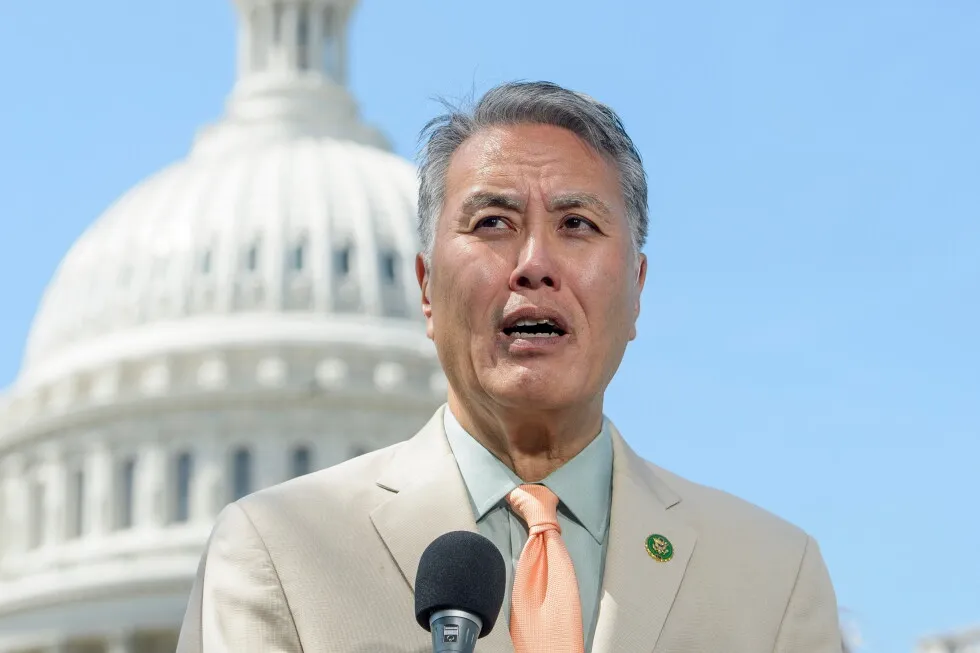
This congressman’s family was swept up in WWII Japanese detention. He sees a repeat in today’s raids 1 of 2 | Rep. Mark Takano, D-Calif., speaks during a news conference on the Equality Act at the Capitol, April 29, 2025, in Washington. (AP Photo/Rod Lamkey, Jr., File) 2 of 2 | This undated photo provided by Rep. Mark Takano, D-Calif., on April 9, 2026, shows from back left, the congressman’s grandmother Kazue Takano, grandfather Isao Takano, aunt Carol Takahashi, from front left, uncle Kenny Takano and father William Takano in Washington state. (Office of Rep. Mark Takano via AP) 1 of 2 | Rep. Mark Takano, D-Calif., speaks during a news conference on the Equality Act at the Capitol, April 29, 2025, in Washington. (AP Photo/Rod Lamkey, Jr., File) 1 of 2 Rep. Mark Takano, D-Calif., speaks during a news conference on the Equality Act at the Capitol, April 29, 2025, in Washington. (AP Photo/Rod Lamkey, Jr., File) Add AP News on Google Add AP News as your preferred source to see more of our stories on Google. Share 2 of 2 | This undated photo provided by Rep. Mark Takano, D-Calif., on April 9, 2026, shows from back left, the congressman’s grandmother Kazue Takano, grandfather Isao Takano, aunt Carol Takahashi, from front left, uncle Kenny Takano and father William Takano in Washington state. (Office of Rep. Mark Takano via AP) 2 of 2 This undated photo provided by Rep. Mark Takano, D-Calif., on April 9, 2026, shows from back left, the congressman’s grandmother Kazue Takano, grandfather Isao Takano, aunt Carol Takahashi, from front left, uncle Kenny Takano and father William Takano in Washington state. (Office of Rep. Mark Takano via AP) Add AP News on Google Add AP News as your preferred source to see more of our stories on Google. Share Updated [hour]:[minute] [AMPM] [timezone], [monthFull] [day], [year] Washington (AP) — The congressman returned home last Fourth of July to startling stories in Southern California as Immigration patrols swept through communities and one constituent told him about starting to carry a passport as proof of the right to be in the country.Rep. Mark Takano, whose American-born parents were both incarcerated as young children with their families during the forced relocation of Japanese Americans during World War II, could not help but see the parallels between that chapter of American history and this one.“I do feel like there’s a similarity of circumstance of my own 2-year-old father and my 1-year-old mother being labeled as enemy aliens and they’re considered a danger to national security,” he told The Associated Press in an interview.“They’re put into these incarceration camps,” he said. “Similar arguments have been made by this administration — that immigrants pose a grave danger to our country and it’s for the security of our country that we’re doing this.” Echoes of history in Trump’s Immigration sweepsPresident Donald Trump’s campaign promise of the largest mass deportation operation in U.S. history is at an inflection point. Americans are seeing what it looks like to round up, detain and deport thousands of people, particularly in the aftermath of the deaths this year of Renee Good and Alex Pretti, U.S. citizens protesting the actions in Minneapolis.The White House changed the leadership at the Department of Homeland Security as it reframes its approach. New Secretary Markwayne Mullin promised to keep the department off the front pages. But Trump is also under mounting pressure from conservative groups not to let up on the goal of deporting 1 million people a year. The president’s Republican allies in Congress are fueling the Immigration and deportation actions with billions of dollars in special funds. Takano, the ranking Democrat on the House Veterans’ Affairs Committee, has drawn from his own family history — and the country’s eventual redress to Japanese Americans who were detained — to challenge Trump’s approach.“We look back on that era of history as a shameful one, as a time when our political leaders failed the Constitution, failed the American people,” he said. One family’s story among many A former high school history teacher before being elected to Congress in 2012, Takano grew up in Southern California and came to understand the family stories.His grandfather Isao Takano arrived in the U.S. from Hiroshima and married Kazue Takahashi, a U.S.-born citizen. Together they settled in Bellevue, Washington, and launched a business growing tomatoes, strawberries and chrysanthemums for the marketplace in Seattle.When the U.S. entered the war after the Japanese attack on Pearl Harbor, they were among some 120,000 people of Japanese ancestry, immigrants and those born in the U.S., forcibly relocated. His father, William, was 2 years old when his family was sent in 1942 to the incarceration camp at Tule Lake in California. His mother, Nancy Tsugiye Sakamoto, born in California to American-born parents, was a year old when she was relocated to the detention facility in Heart Mountain, Wyoming. Then, as now, he said, people are being swept up in the anti-immigrant detentions. “Will Americans generations from now visit Alligator Alcatraz and think to themselves, How could our government do this?” Takano said during a House floor speech, referring to the Trump-era Immigration detention facility in Florida. “These future generations of Americans will look to us, the Congress, to see what we did to try to stop it.” A Reagan-era law is seen as model for redressTakano remembers his father taking him to see the land the family once owned. He learned about his great uncles who served in the Army’s 442nd Regimental Combat Team of Japanese American soldiers; one was killed in action in Italy. He recalls his own father later collected donations for the national redress campaign.In 1988 Congress passed the Civil Liberties Act, which sought to apologize for the “grave injustice” that had been done and provide $20,000 to each person detained. Republican President Ronald Reagan signed it into law.Takano’s parents were among those who received a letter of apology from the federal government, he said, and a payment. Talks are underway among some in Congress, he said, for a similar redress to the people who have had their car windows smashed in, their homes raided and livelihoods upended as part of Trump’s Immigration enforcement operations.“Remarkably the country did come to realize the mistake,” he said. “I believe we’re living through one of those eras of mistakes and I believe we can come out of this moment stronger.”
SRCAssociated Press (AP)
LANGEN
LEANCenter
WORDS1 066
ENT12
SAT · 2026-05-23 · 12:53 GMTBRIEF NSR-2026-0523-78661
NSR-2026-0523-78661News Report·EN·Human Interest
This congressman’s family was swept up in WWII Japanese detention. He sees a repeat in today’s raids
Rep. Mark Takano, D-Calif., sees parallels between current immigration raids and the World War II detention of Japanese Americans, a historical event that impacted his own family.
By
LISA MASCAROAssociated Press (AP)Filed 2026-05-23 · 12:53 GMTLean · CenterRead · 5 min
Associated Press (AP)FIG 01
Reading time
5min
Word count
1 066words
Sources cited
1cited
Entities identified
12entities
Quality score
100%
§ 01
Briefing Summary
AI-generatedNEWSAR · AI
Rep. Mark Takano, D-Calif., sees parallels between current immigration raids and the World War II detention of Japanese Americans, a historical event that impacted his own family. His parents, American-born citizens, were incarcerated as young children with their families during the forced relocation. Takano argues that the administration's justification for detaining immigrants, citing national security and danger to the country, echoes the arguments used during WWII. He highlights that this historical period is now viewed as a shameful chapter where leaders failed the Constitution. Takano draws on his family's experience and the subsequent redress for Japanese Americans to critique the current immigration policies. He believes that future generations will look back on this era and question the government's actions.
Confidence 0.90Sources 1Claims 4Entities 12
§ 02
Article analysis
Model · rule-basedFraming
Human Interest
Social Justice
Tone
Measured
AI-assessed
CalmNeutralAlarmist
Factuality
0.40 / 1.00
Mixed
LowHigh
Sources cited
1
Limited
FewMany
§ 03
Key claims
4 extracted01
Rep. Mark Takano sees parallels between the WWII Japanese American incarceration and current immigration raids.
quoteRep. Mark Takano
Confidence
1.00
02
Rep. Mark Takano's American-born parents were incarcerated with their families during the forced relocation of Japanese Americans during World War II.
factualRep. Mark Takano
Confidence
1.00
03
A constituent told Rep. Mark Takano about starting to carry a passport as proof of the right to be in the country due to recent immigration patrols.
quoteRep. Mark Takano
Confidence
0.90
04
Arguments made by the current administration for immigration actions are similar to those used during WWII for Japanese American incarceration, citing national security.
quoteRep. Mark Takano
Confidence
0.90
§ 04
Full report
5 min read · 1 066 words§ 05
Entities
12 identifiedKey playerOppositionContextPositiveNeutralNegative
People7
Topics1
§ 06
Keywords & salience
8 termsimmigration raids
1.00
japanese detention
1.00
historical parallels
0.90
world war ii
0.80
forced relocation
0.70
rep. mark takano
0.60
enemy aliens
0.50
civil liberties
0.40
§ 07
Topic connections
Interactive graph No topic relationship data available yet. This graph will appear once topic relationships have been computed.