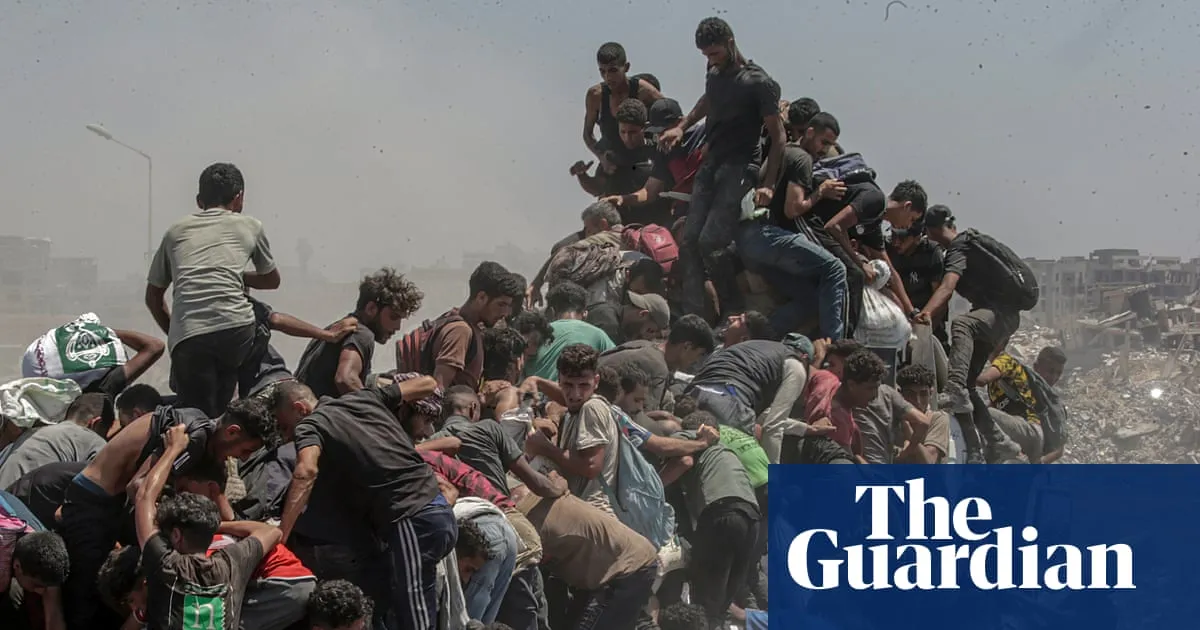
Hunger is being increasingly exploited as a weapon of war with more than 20,000 documented incidents of “food-related violence” in the past eight years, new analysis reveals.Attacks include 1,261 strikes on markets used by families for daily groceries and 863 incidents in which food distribution systems were targeted and workers killed.The analysis looked at the period since UN resolution 2417 unanimously condemned the deliberate starvation of civilians in 2018. It found starvation is being increasingly weaponised with the supply of food routinely targeted in Gaza, Sudan, Lebanon and Haiti among others.Data compiled by Insecurity Insight uncovered 21,403 incidents in 15 countries where food supplies have been deliberately targeted since 2018, when the UN security council unanimously passed a resolution condemning the unlawful denial of humanitarian aid as a tactic of warfare.Researchers discovered 1,909 military strikes on farmland, and another 563 on water infrastructure vital for crops, which affected food security in more than 42 countries and territories.The remains of a market at Lankien, Jonglei state, South Sudan, after an airstrike in April 2026. Photograph: Florence Miettaux/The GuardianStates with the highest recorded incidents are the occupied Palestinian Territory with 9,013 attacks, followed by Yemen – 1,863 incidents – and Sudan, where food was targeted in 1,605 strikes. One of the most recent attacks in Sudan occurred on Tuesday when a drone struck a busy market, killing 28 people.Witnesses said the main market in the town of Ghubaysh, West Kordofan, appeared to have been deliberately targeted by the military while it was crowded with civilians.Other countries that documented repeated attacks on food supplies include Syria, which saw 1,538 incidents, many attributed to government or Russian military forces before the fall of the Assad regime; and Mali, where 1,415 attacks were recorded as the ruling junta struggled to maintain its grip on power in the west African country.The research, to be released on Monday to coincide with the anniversary of the UN resolution, describes a “marked increase” in attacks on markets, farmland and food distribution systems.Giulia Contò, conflict and hunger advocacy manager at Action Against Hunger, said: “Famine in Gaza and Sudan has captured global headlines over the past two years, but most conflict-induced hunger never does. It unfolds daily, with relentless attacks on the systems communities depend on to survive: livestock looted, markets bombed, aid convoys blocked.”Fire destroys a livestock market in El Fasher, in Sudan’s North Darfur state, in September 2023 after an attack by the Rapid Support Forces. Photograph: AFP/Getty ImagesResearchers also found that civilians were frequently targeted as they attempted to obtain food. Between October 2023 and the end of 2025, more than 10,300 people were killed or injured trying to access aid.Christina Wille, director at Insecurity Insight, urged the international community to implement the UN resolution, saying that it had a responsibility “to act upon violations”.She said: “It is not that resolution 2417 has failed, but that member states have failed to implement it, and to demonstrate the political will to prevent those very same actions that the international community claims to oppose.”Wille said that women were disproportionately affected by the weaponisation of hunger.“Women in particular are faced with some of the toughest choices: unreliable access to food might mean travelling longer distances, increasing risks to their safety in volatile contexts.“Women who were primarily carers are forced to become breadwinners, often while reducing their food intake to prioritise their family members. Without enough food, children are unable to play, learn or grow, and the consequences on their development will last a lifetime.”Waiting for food rations on the outskirts of Sana’a, Yemen, where prolonged conflict has meant millions of people living with extreme hunger. Photograph: Yahya Arhab/EPAConflict remains the primary driver of hunger, accounting for more than half of all people facing severe hunger.Last month, UN agencies warned that a growing share of global hunger is becoming entrenched in a small group of conflict-hit countries, with two-thirds of people facing acute food insecurity concentrated in just 10 nations.
SRCThe Guardian - World News
LANGEN
LEANCenter-Left
WORDS659
ENT12
SUN · 2026-05-24 · 06:00 GMTBRIEF NSR-2026-0524-78775
NSR-2026-0524-78775News Report·EN·Conflict
Hunger increasingly used as weapon of war as ‘food-related violence’ surges, analysis shows
A new analysis reveals over 20,000 documented incidents of "food-related violence" globally since 2018, indicating hunger is increasingly used as a weapon of war. These attacks target markets, farmland, and food distribution systems, with over 1,200 strikes on markets and 800 on distribution networks where workers were killed.
Mark TownsendThe Guardian - World NewsFiled 2026-05-24 · 06:00 GMTLean · Center-LeftRead · 3 min
The Guardian - World NewsFIG 01
Reading time
3min
Word count
659words
Sources cited
2cited
Entities identified
12entities
Quality score
100%
§ 01
Briefing Summary
AI-generatedNEWSAR · AI
A new analysis reveals over 20,000 documented incidents of "food-related violence" globally since 2018, indicating hunger is increasingly used as a weapon of war. These attacks target markets, farmland, and food distribution systems, with over 1,200 strikes on markets and 800 on distribution networks where workers were killed. The occupied Palestinian Territory, Yemen, and Sudan have recorded the highest numbers of incidents. This surge in weaponized hunger occurs despite a 2018 UN resolution condemning the deliberate starvation of civilians. Researchers highlight that civilians are frequently targeted while trying to access food, and women are disproportionately affected by these tactics. The international community is urged to implement the UN resolution, as member states have failed to prevent these actions.
Confidence 0.90Sources 2Claims 5Entities 12
§ 02
Article analysis
Model · rule-basedFraming
Conflict
Human Rights
Tone
Mixed Tone
AI-assessed
CalmNeutralAlarmist
Factuality
0.80 / 1.00
Factual
LowHigh
Sources cited
2
Limited
FewMany
§ 03
Key claims
5 extracted01
Giulia Contò states that 'most conflict-induced hunger never does [capture global headlines], it unfolds daily, with relentless attacks on the systems communities depend on to survive.'
quoteGiulia Contò
Confidence
1.00
02
Civilians attempting to obtain food were frequently targeted, with over 10,300 killed or injured between October 2023 and the end of 2025.
statistic
Confidence
1.00
03
The occupied Palestinian Territory recorded the highest number of incidents with 9,013 attacks on food supplies since 2018.
statistic
Confidence
1.00
04
The analysis identified 1,261 strikes on markets and 863 incidents targeting food distribution systems and workers since 2018.
statistic
Confidence
1.00
05
Hunger is increasingly used as a weapon of war, with over 20,000 documented incidents of 'food-related violence' in the past eight years.
statistic
Confidence
1.00
§ 04
Full report
3 min read · 659 words§ 05
Entities
12 identifiedKey playerOppositionContextPositiveNeutralNegative
Organizations3
Locations7
§ 06
Keywords & salience
10 termsfood-related violence
1.00
weapon of war
1.00
hunger
0.90
food security
0.80
un resolution 2417
0.70
starvation
0.70
sudan
0.60
gaza
0.60
humanitarian aid
0.50
conflict-induced hunger
0.40
§ 07
Topic connections
Interactive graph No topic relationship data available yet. This graph will appear once topic relationships have been computed.