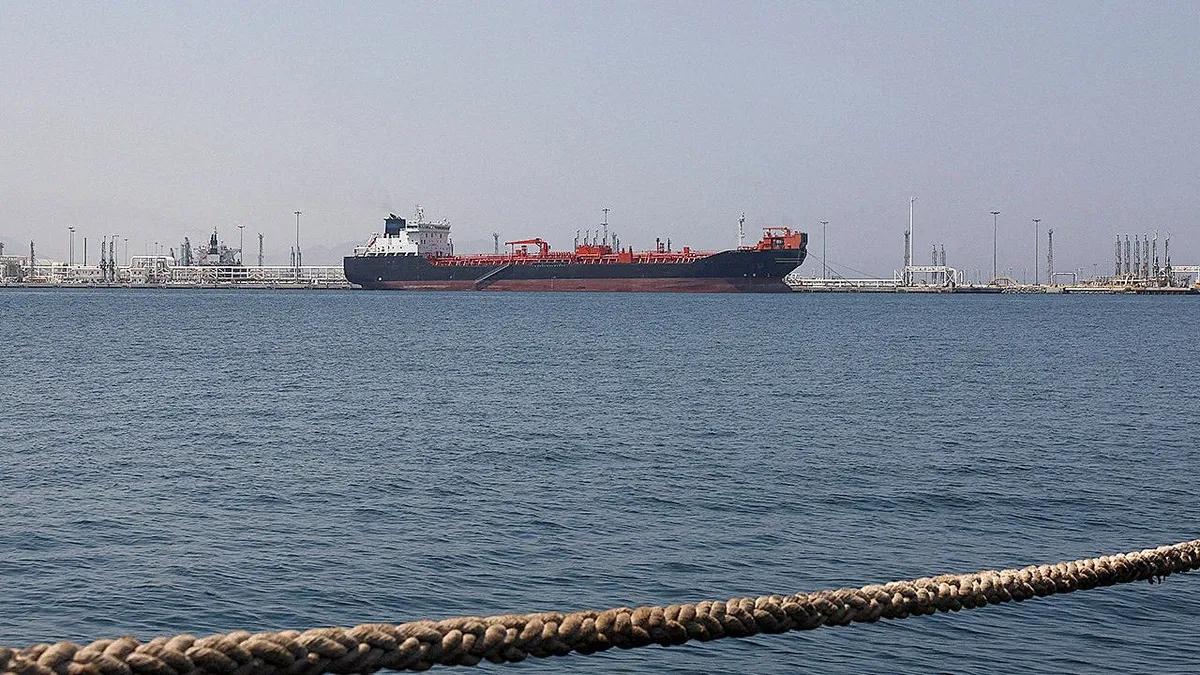
close Video Trump pushes Iran for toll-free Strait of Hormuz President Donald Trump insists on a toll-free Strait of Hormuz, pushing back against Iran's claims of a 'controlled maritime zone' and potential tolls. The U.S. maintains total control through blockade measures, while economic sanctions and diplomatic efforts with Gulf allies intensify pressure on Iran's nuclear program and regional ambitions. NEWYou can now listen to Fox News articles! Hören Sie sich diesen Artikel an 4 Min Maritime tracking transmissions collapsed near the UAE’s main oil hub, rattling Persian Gulf shipping hours before President Donald Trump announced progress was made on a bilateral peace deal with Iran, according to an AI maritime firm. Maritime intelligence firm Windward AI first detected the blackout in Automatic Identification System (AIS) transmissions near Fujairah, suggesting heightened electronic warfare, jamming, deliberate AIS shutdowns and intense Cyber Interference near the key UAE oil port. "Fujairah goes dark: AIS transmissions collapse after Iran’s PGSA announcement," Windward warned in a post shared on X. "Vessels are still in the area. They are loading less, and a meaningful number have gone dark," the firm said. GULF SHIPPING OPERATIONS GRIND TO HALT NEAR Iran, US QUIETLY PREPARES FOR POSSIBLE STRIKE: 'HEIGHTENED RISK' A tanker sits at the Port of Fujairah, as the U.S.-Israel conflict with Iran limits marine traffic in the Strait of Hormuz. (Reuters/Amr Alfiky/File Photo) As Trump announced that an Iran deal was "largely negotiated" and would see a reopening of the Strait of Hormuz, Fujairah went on to move 1.35 million barrels of crude Sunday aboard a single tanker bound for South Korea. "Today, May 24, the port moved 1.35 million barrels, a single VLCC, destined for South Korea," Windward said before reporting a tense, ongoing "ceasefire posture" and blockade footprint quickly being set into place. "One cargo doesn't mark a return to baseline, but it's the first signal of flow resuming out of Fujairah since the announcement," Windward said. Ahead of the barrel transfer, Trump had stated that Washington and Tehran had "largely finalized" a memorandum of understanding for a peace agreement. He posted an AI-generated image depicting exploding IRGC fast boats in the strait. TRUMP SAYS Iran DEAL ‘LARGELY NEGOTIATED’ AS 84-DAY WAR NEARS POSSIBLE END A cargo ship sails in the Persian Gulf toward the Strait of Hormuz on April 22, 2026. (AP Photo) Iran responded directly by continuing to declare the strategic maritime choke point stays under Tehran’s absolute control. "We reaffirm that the Strait of Hormuz will remain under full Iranian administration and sovereignty, even in the event of reaching any future agreement," Iran’s official military spokesperson, Ibrahim Al-Fiqar, said in a statement shared on X. "The Islamic Republic emphasizes that the authorities to determine transit routes, timing, and issuance of maritime licenses are an absolute sovereign right exclusively in the hands of Tehran." The tanker blackout, crude transfer activity and movement toward a U.S.-Iran deal accelerated following the launch of Iran’s Persian Gulf Strait Authority on May 20. Overseen by the Islamic Revolutionary Guard Corps (IRGC) Navy, the PGSA functions as a sovereign regulator by requiring ships to submit vessel, cargo, insurance and crew details — along with mandatory payments — for "safe passage" through the strait. Regional analysts told Fox News Digital that, ahead of deal progression, Iran’s territorial claims had even been stretching beyond its own waters into areas tied to Oman and the UAE. US EYES Iran FAST BOATS WITH ‘KILL’ TACTICS TESTED IN VENEZUELA DRUG-BOAT STRIKES An Islamic Revolutionary Guard Corps speedboat sails in the Persian Gulf near the Bushehr nuclear power plant during a marine parade marking Persian Gulf National Day in Bushehr, Iran, on April 29, 2024. (Morteza Nikoubazl/NurPhoto) Alex Vatanka, director of the Iran Program at the Middle East Institute, told Fox News Digital that enforcement "relies on the IRGC Navy’s asymmetric playbook." "This includes fast boats, drones, radar tracking, coastal missiles and selective intimidation rather than constant physical interdiction," Vatanka said. "Tehran wants Gulf states and major importers to gradually accept Iranian oversight of Hormuz as a new geopolitical reality," he added. While nuclear issues are dominating the current negotiations amid reports of a 60-day ceasefire, the PGSA has quickly emerged as an economic leverage tool threatening global oil and shipping markets. "Now Hormuz is Iran’s main non-nuclear leverage tool," Vatanka said as the PGSA he claimed gives Tehran a "mechanism to pressure rivals, favor allies and normalize IRGC oversight of one of the world’s most critical energy routes." According to Vatanka, the system was functioning as a wartime extortion mechanism. "Ships submit cargo and crew data for approval, while reports point to quiet ‘facilitation payments,’ preferential treatment for friendly states and uncertainty for everyone else," Vatanka warned. "Iran keeps the penalties deliberately vague. Noncompliant ships risk delays, harassment, drone surveillance, IRGC interception or denial of safe passage — enough pressure to encourage compliance without outright closing the strait." Emma Bussey is a breaking news writer for Fox News Digital. Before joining Fox, she worked at The Telegraph with the U.S. overnight team, across desks including foreign, politics, news, sport and culture.
SRCFox News - World
LANGEN
LEANCenter-Right
WORDS847
ENT12
SUN · 2026-05-24 · 20:11 GMTBRIEF NSR-2026-0524-78902
NSR-2026-0524-78902News Report·EN·Conflict
Mass tanker blackout rattles Gulf ahead of 1.35M-barrel oil transfer amid US-Iran talks: firm
Maritime tracking transmissions collapsed near Fujairah, a key UAE oil hub, amid heightened electronic interference. This occurred as President Trump announced progress on a U.S.-Iran peace deal, which Iran stated would not alter its control over the Strait of Hormuz.
Fox News - WorldFiled 2026-05-24 · 20:11 GMTLean · Center-RightRead · 4 min
Fox News - WorldFIG 01
Reading time
4min
Word count
847words
Sources cited
3cited
Entities identified
12entities
Quality score
100%
§ 01
Briefing Summary
AI-generatedNEWSAR · AI
Maritime tracking transmissions collapsed near Fujairah, a key UAE oil hub, amid heightened electronic interference. This occurred as President Trump announced progress on a U.S.-Iran peace deal, which Iran stated would not alter its control over the Strait of Hormuz. The blackout preceded the transfer of 1.35 million barrels of crude oil from Fujairah. The incidents follow Iran's launch of the Persian Gulf Strait Authority (PGSA), requiring ships to submit detailed information and payments for passage, which analysts suggest is a new leverage tool for Iran.
Confidence 0.90Sources 3Claims 4Entities 12
§ 02
Article analysis
Model · rule-basedFraming
Conflict
Political Strategy
Tone
Mixed Tone
AI-assessed
CalmNeutralAlarmist
Factuality
0.70 / 1.00
Factual
LowHigh
Sources cited
3
Well sourced
FewMany
§ 03
Key claims
4 extracted01
Iran stated the Strait of Hormuz remains under Tehran’s absolute control and sovereignty, even in the event of any future agreement.
quoteIbrahim Al-Fiqar (Iran's official military spokesperson)
Confidence
0.95
02
President Donald Trump announced progress made on a bilateral peace deal with Iran and that a deal was 'largely negotiated'.
quoteDonald Trump
Confidence
0.95
03
Fujairah moved 1.35 million barrels of crude on May 24th, the first signal of flow resuming out of the port since the announcement.
statisticWindward AI
Confidence
0.90
04
Maritime tracking transmissions collapsed near the UAE’s main oil hub, suggesting heightened electronic warfare, jamming, or cyber interference.
factualWindward AI
Confidence
0.90
§ 04
Full report
4 min read · 847 words§ 05
Entities
12 identifiedKey playerOppositionContextPositiveNeutralNegative
Organizations2
Locations6
§ 06
Keywords & salience
10 termsstrait of hormuz
1.00
ais transmissions
0.90
electronic warfare
0.80
oil transfer
0.80
us-iran talks
0.70
cyber interference
0.60
maritime security
0.60
crude oil
0.50
fujairah
0.50
ai maritime firm
0.40
§ 07
Topic connections
Interactive graph Network visualization showing 51 related topics
View Full Graph Person Organization Location Event|Click node to navigate|Edge numbers = shared articles