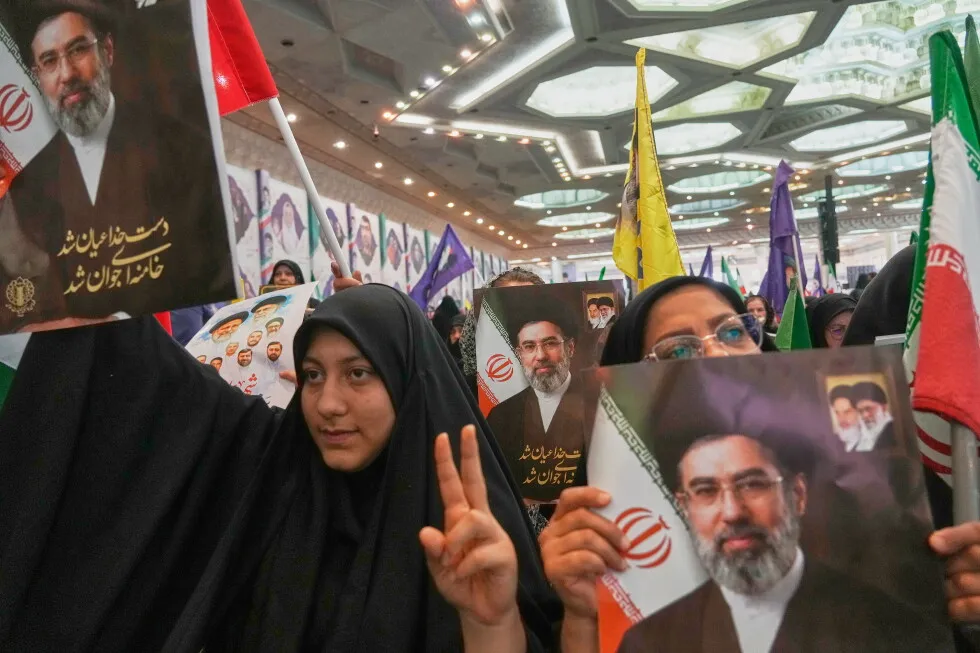
What we know and don’t know about the emerging deal to end the Iran war 1 of 2 | Women hold portraits of Iran’s Supreme Leader, Ayatollah Mojtaba Khamenei, during a ceremony honoring the armed forces and those killed in the war with Israel and the U.S. at the Imam Khomeini Grand Mosque in Tehran, Iran, Sunday, May 24, 2026. (AP Photo/Vahid Salemi) 2 of 2 | Government supporters hold Iranian flags and pictures of Iran’s Supreme Leader, Ayatollah Mojtaba Khamenei, during a ceremony honoring the armed forces and those killed in the war with Israel and the U.S. at the Imam Khomeini Grand Mosque in Tehran, Iran, Sunday, May 24, 2026. (AP Photo/Vahid Salemi) 1 of 2 | Women hold portraits of Iran’s Supreme Leader, Ayatollah Mojtaba Khamenei, during a ceremony honoring the armed forces and those killed in the war with Israel and the U.S. at the Imam Khomeini Grand Mosque in Tehran, Iran, Sunday, May 24, 2026. (AP Photo/Vahid Salemi) 1 of 2 Women hold portraits of Iran’s Supreme Leader, Ayatollah Mojtaba Khamenei, during a ceremony honoring the armed forces and those killed in the war with Israel and the U.S. at the Imam Khomeini Grand Mosque in Tehran, Iran, Sunday, May 24, 2026. (AP Photo/Vahid Salemi) Add AP News on Google Add AP News as your preferred source to see more of our stories on Google. Share 2 of 2 | Government supporters hold Iranian flags and pictures of Iran’s Supreme Leader, Ayatollah Mojtaba Khamenei, during a ceremony honoring the armed forces and those killed in the war with Israel and the U.S. at the Imam Khomeini Grand Mosque in Tehran, Iran, Sunday, May 24, 2026. (AP Photo/Vahid Salemi) 2 of 2 Government supporters hold Iranian flags and pictures of Iran’s Supreme Leader, Ayatollah Mojtaba Khamenei, during a ceremony honoring the armed forces and those killed in the war with Israel and the U.S. at the Imam Khomeini Grand Mosque in Tehran, Iran, Sunday, May 24, 2026. (AP Photo/Vahid Salemi) Add AP News on Google Add AP News as your preferred source to see more of our stories on Google. Share Updated [hour]:[minute] [AMPM] [timezone], [monthFull] [day], [year] Cairo (AP) — A deal appears to be emerging between the United States and Iran to end the war and open the Strait of Hormuz, and U.S. President Donald Trump over the weekend said it had been “largely negotiated.”It is not clear when or how the deal might be finalized and when its various parts will take effect. Trump spoke after calls with allies in the Middle East, including a separate call with Israel. Details come from two regional officials and a U.S. official who spoke on condition of anonymity to discuss the sensitive negotiations. Here’s what we know and don’t know: The war would endIn the 12 weeks since the U.S. and Israel launched the war with attacks on Iran that killed senior officials including Supreme Leader Ayatollah Ali Khamenei, Tehran has insisted that any deal focus on ending the fighting on all fronts. That includes Lebanon, where the Iranian-backed Hezbollah militant group has been fighting Israel since two days into the war.A fragile ceasefire has held since April 7. An end to the war would ease concerns throughout a region that saw Gulf havens and travel hubs like the United Arab Emirates struck by Iranian missiles and drones. It would allow for global shipping, including an estimated 20% of the world’s oil and natural gas, to begin flowing through the Strait of Hormuz again. It also would allow the rebuilding of energy and other infrastructure in the region. 3 MIN READ 1 MIN READ 4 MIN READ Both regional officials said the draft deal includes an end to the war between Israel and Hezbollah, as well as a commitment to not interfere in the domestic affairs of countries in the region including Iran. That’s a critical reference to Iran’s support for proxies, which also include the Houthi rebels in Yemen, Hamas militants in Gaza and Shiite armed groups in Iraq.The U.S. wants Israel to have a free hand to respond to what it views as threats in Lebanon while Iran rejects it, one regional official said. The U.S. official said the deal would guarantee Israel’s right to act against imminent threats in self-defense. The Strait of Hormuz would reopen graduallyIran’s nuclear program, missile program and support for armed proxies were the stated reasons for the U.S. and Israel attacking Iran. But Tehran’s retaliatory grip on the Strait of Hormuz quickly shot to the top of global concerns as hundreds of ships carrying oil, natural gas, fertilizer and other supplies were stranded.Under the emerging agreement, the strait would gradually reopen in parallel with the U.S. ending the blockade of Iran’s ports it launched on April 17, the regional officials said. The blockade has limited Iran’s ability to ship its oil and bring in badly needed cash for its long-suffering economy.The U.S. would allow Iran to sell its oil through sanctions waivers, said one of the officials, who has been briefed on the negotiations. Sanctions relief and the release of Iran’s billions of dollars in frozen funds would be negotiated during a 60-day period, the official said. Iran would give up its stockpile of highly enriched uraniumIran’s nuclear program and international concerns over its possible pursuit of a nuclear weapon underlie all tensions, and the U.S. and Israel have considered highly complex military operations to go in and take out its highly enriched uranium.Under the potential deal, Tehran would agree to give up that stockpile of highly enriched uranium, according to the regional officials. One official, with direct knowledge of the negotiations, said how Iran would give it up would be subject to further talks over the 60-day period. Some would likely be diluted and the rest transferred to a third country, potentially Russia, the official said. Russia has offered to take it. A U.S. official confirmed the 60-day period and said if Iran doesn’t give up its stockpile, there will be no sanctions relief.Iran has 440.9 kilograms (972 pounds) of uranium that is enriched up to 60% purity, a short, technical step from weapons-grade levels of 90%, according to the International Atomic Energy Agency.Iran says it has an “inalienable” right to nuclear technology while insisting its program is peaceful. On Sunday, President Masoud Pezeshkian told state TV they were ready “to assure the world that we are not after a nuclear weapon.”Trump on Sunday on social media said that “our relationship with Iran is becoming a much more professional and productive one. They must understand, however, that they cannot develop or procure a Nuclear Weapon or Bomb.” What appears to be missingOther issues have not been mentioned in descriptions of the emerging deal, including the status of Iran’s uranium enrichment.Another is Iran’s missile program, which Israel in particular has sought to destroy.And while the United States and Israel entered the war with stated ambitions of seeing Iranians rise up against their government after nationwide protests early in the year, any discussion of leadership change in Tehran appears to be out.As for Iran’s past stated aims during negotiations, there appears to be no mention of any withdrawal of U.S. forces from the region, or for reparations for the damage the war has caused.___Superville reported from Washington and Anna from Lowville, New York. Magdy is a Middle East reporter for The Associated Press, based in Cairo. He focuses on conflict, migration and human rights abuses. Superville covers the White House for The Associated Press, with a special emphasis on first ladies and first families. Anna is an editor on the AP’s Global Desk. She has reported from Africa, China, Ukraine, Afghanistan and the United Nations.
SRCAssociated Press (AP)
LANGEN
LEANCenter
WORDS1 286
ENT10
MON · 2026-05-25 · 07:53 GMTBRIEF NSR-2026-0525-78977
NSR-2026-0525-78977News Report·EN·Conflict
What we know and don’t know about the emerging deal to end the Iran war
A deal is reportedly emerging between the United States and Iran to end the ongoing war and reopen the Strait of Hormuz, with President Trump stating it is "largely negotiated." The agreement would involve an end to hostilities on all fronts, including between Israel and Hezbollah, and a commitment from Iran to cease interfering in regional domestic affairs. The Strait of Hormuz would gradually reopen as the U.S.
By
SAMY MAGDY, DARLENE SUPERVILLE and CARA ANNAAssociated Press (AP)Filed 2026-05-25 · 07:53 GMTLean · CenterRead · 6 min
Associated Press (AP)FIG 01
Reading time
6min
Word count
1 286words
Sources cited
3cited
Entities identified
10entities
Quality score
100%
§ 01
Briefing Summary
AI-generatedNEWSAR · AI
A deal is reportedly emerging between the United States and Iran to end the ongoing war and reopen the Strait of Hormuz, with President Trump stating it is "largely negotiated." The agreement would involve an end to hostilities on all fronts, including between Israel and Hezbollah, and a commitment from Iran to cease interfering in regional domestic affairs. The Strait of Hormuz would gradually reopen as the U.S. lifts its blockade of Iranian ports, allowing Iran to sell oil under sanctions waivers. A key component of the deal is Iran's agreement to relinquish its stockpile of highly enriched uranium within a 60-day period, with the specifics of its transfer to be further negotiated. However, details regarding Iran's missile program and uranium enrichment levels remain unaddressed in the emerging agreement.
Confidence 0.90Sources 3Claims 5Entities 10
§ 02
Article analysis
Model · rule-basedFraming
Conflict
Diplomatic
Tone
Measured
AI-assessed
CalmNeutralAlarmist
Factuality
0.60 / 1.00
Mixed
LowHigh
Sources cited
3
Well sourced
FewMany
§ 03
Key claims
5 extracted01
U.S. President Donald Trump stated over the weekend that the deal had been 'largely negotiated.'
quoteDonald Trump
Confidence
1.00
02
Details of the emerging deal come from two regional officials and a U.S. official speaking on condition of anonymity.
factual
Confidence
0.90
03
Tehran has insisted that any deal focus on ending the fighting on all fronts, including in Lebanon.
factualIran
Confidence
0.80
04
The war was launched 12 weeks ago by the U.S. and Israel with attacks on Iran that killed senior officials including Supreme Leader Ayatollah Ali Khamenei.
factual
Confidence
0.80
05
A deal appears to be emerging between the United States and Iran to end the war and open the Strait of Hormuz.
factual
Confidence
0.70
§ 04
Full report
6 min read · 1 286 words§ 05
Entities
10 identifiedKey playerOppositionContextPositiveNeutralNegative
Organizations1
§ 06
Keywords & salience
8 termsiran war deal
1.00
strait of hormuz
0.80
united states
0.70
iran
0.70
negotiated deal
0.60
middle east allies
0.50
supreme leader
0.40
armed forces
0.40
§ 07
Topic connections
Interactive graph Network visualization showing 51 related topics
View Full Graph Person Organization Location Event|Click node to navigate|Edge numbers = shared articles