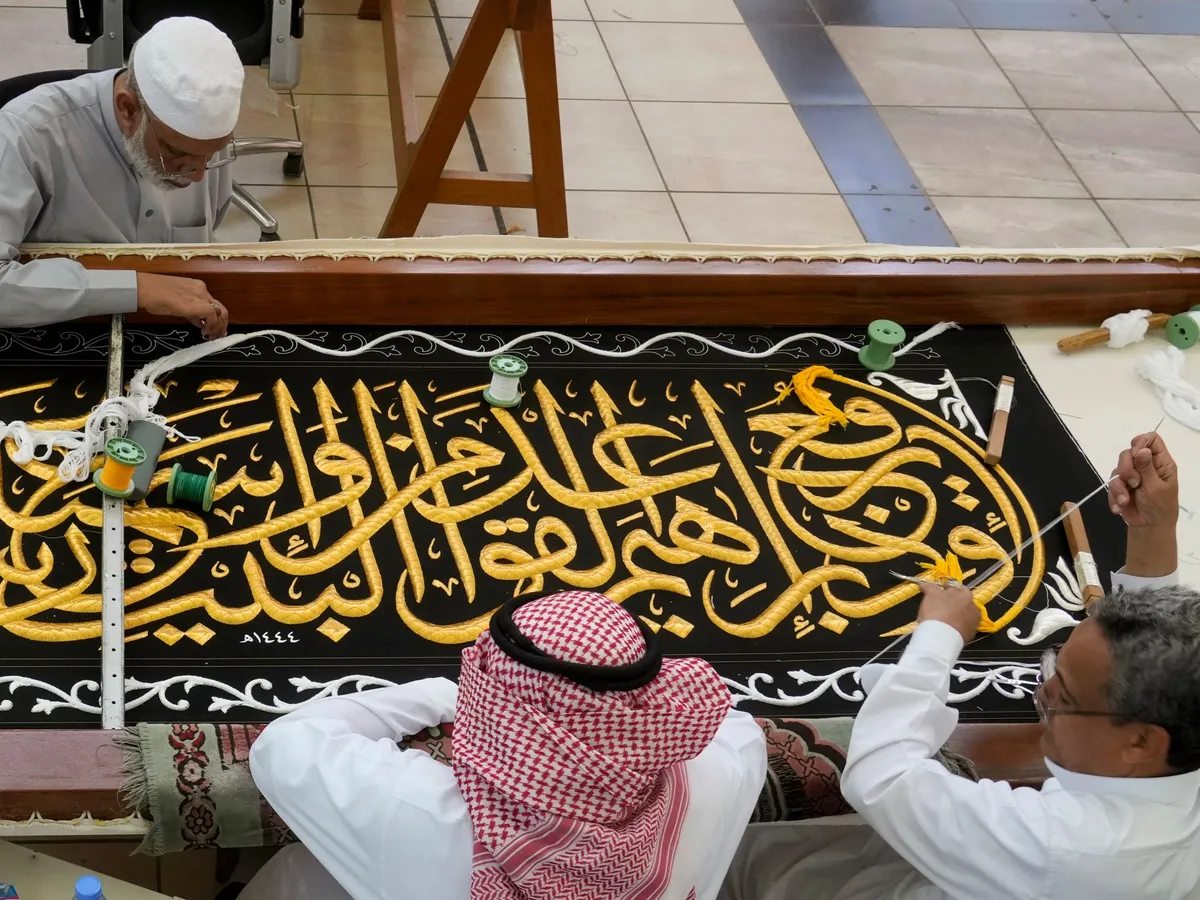
EXPLAINERAt the heart of Hajj stands the Kaaba, draped in 670kg of silk and embroidered with 200kg of gold and silver thread.Saudi workers embroider Islamic calligraphy using either pure silver threads or silver threads plated with gold, at the Kiswa factory in Mecca, Wednesday, July 6, 2022 [Amr Nabil/AP Photo]Published On 25 May 2026The first day of Hajj has begun, with more than 1.5 million Muslims from around the world making the annual pilgrimage to Mecca in Saudi Arabia – a once-in-a-lifetime journey for many.As part of the five-day rituals, pilgrims visit the Kaaba, encircling it counterclockwise several times.The Kaaba is draped in a black cloth called the Kiswah, which is embroidered in gold with Arabic Quranic verses.In this visual explainer, Al Jazeera breaks down 10 things to know about the Kaaba, its interior and its covering.1. What is the Kaaba?The Kaaba, meaning cube in Arabic, is Islam’s holiest site and is at the centre of Masjid al-Haram, the Grand Mosque in Mecca.Muslims around the world face towards it during their five daily prayers, a direction known as the qibla, unifying more than a billion people in a single act of worship, regardless of where they are worldwide.The Kaaba measures 13.1m (43 feet) high, 12.8m (42ft) long and 11.03m (36ft) wide.(Al Jazeera)2. What is the history of the Kaaba?Muslims believe the Kaaba was originally built by the Prophet Abraham (Ibrahim) and his son Prophet Ishmael (Ismail) as a house of worship, in direct obedience to God’s command.The Kaaba is referenced multiple times throughout the Quran, Islam’s holy book, including the moment Ibrahim and Ismail raised its foundations.Before Islam, the Kaaba was a site of worship for various Arabian tribes. That changed when Prophet Muhammad, who had migrated to Medina with his followers eight years earlier, returned to Mecca around 630 CE, cleansing the Kaaba of its idols and restoring it to a place of monotheistic worship.Mecca annually attracts more than 20 million Hajj and Umrah pilgrims. The images below offer a glimpse into how that journey has looked throughout history.3. What is inside the Kaaba?The Kaaba features a gold door on its northeastern side, standing more than two metres (six and a half feet) above the ground. Containing 280kg (617 pounds) of pure gold, it measures three point one metres (10 feet) in height and 1.9m (six feet) in width.The door is typically opened twice a year for a ceremonial washing of the interior.Muslim pilgrims touch the golden door of the Kaaba, as they pray ahead of the annual Hajj pilgrimage in the Muslim holy city of Mecca, Saudi Arabia, August 17, 2018 [Dar Yasin/AP Photo]The Kaaba’s interior is modest, with three wooden pillars supporting the roof and a staircase leading to the roof.Marble lines the floors and walls while lanterns hang from the ceiling.The interior textiles of the Kaaba drape part of its walls, and historically they were of red and green colours, in a zig-zag style, as well as dark blue.(Al Jazeera)Part of the green Kiswa lining the interior of the Kaaba, exhibited at the Museum of Islamic Art in Doha [Alma Milisic/Al Jazeera]4. What is the Kiswah?The Kiswah is the black silk cloth that drapes the Kaaba. The name comes from the Arabic root k-s-w, meaning “to cover” or “to drape,” and originally it referred to any type of robe or covering. Over time, the term became associated specifically with the covering of the Kaaba.During Hajj, the lower edges of the Kiswah are carefully lifted to preserve and protect it, due to the large number of pilgrims who seek closeness to the Kaaba by touching it.The main element of the Kiswah is the black silk cloth that drapes the Kaaba – historically the only component referred to as the Kiswah itself. It is 14m (45 feet) high, and it’s made up of 47 different strips of cloth.About two-thirds of the way up the walls runs the embroidered hizam, a decorative belt measuring around 95cm (37 inches) wide and 47m (154 feet) long.Above the Kaaba’s door hangs a curtain known as the sitara or burqu’. It is the most decorated part of Kiswah.The Kaaba’s door curtain (sitara), created in Cairo for Sultan Abdulmecid in the mid-19th century with embroidered metal threads and silk, now exhibited at Doha’s Museum of Islamic Art [Alma Milisic/Al Jazeera]5. Why is the Kaaba covered?The Kaaba is believed to be covered in order to protect, honour and beautify it.It is unknown who first covered the Kaaba with a Kiswah, with the most prevailing theory among historians being that the tradition has pre-Islamic origins. Most agree that Yemeni King Tubba As’ad Kamil was the first person to cover the Kaaba in 400 CE with a special cloth from Yemen.Another theory says that the Kaaba was first covered by Prophet Ismail (Ishmael) himself, however there is no definitive evidence to confirm that.“If he did place a covering over it, it was likely limited to a portion of the Kaaba rather than the entire structure,” Mensud Dulovic told Al Jazeera. He is a professor of Qur’anic studies at Gazi Husrev-beg Madrasa in Sarajevo, and author of A Guide Through Makkah al-Mukarramah.Close detail of the Ottoman-era silk and metal-thread embroidery woven into the Kaaba’s sitara, produced in Cairo in the mid-19th century [Alma Milisic/Al Jazeera]6. What material is the Kiswah made from?Today, the Kiswah is made of natural silk. However, throughout history, different materials were used to drape the Kaaba.Early Kiswahs were typically made from other natural fibres such as linen, cotton and wool, while some historical sources also mention the use of leather and animal skins, especially during the pre-Islamic era.The choice of material, as well as where the Kiswahs were produced, often reflected the availability of the fibres, as well as preferences and influence of the Muslim rulers of each period.Pilgrims at the Kaaba, Mecca, Saudi Arabia, the most sacred site in Islam. First published in 1925 [Culture Club/Getty Images]“It very much followed the caliphate,” Carol Bier, a research associate at The Textile Museum at George Washington University in DC, and a former curator for their Eastern Hemisphere Collections, told Al Jazeera.While Arabia was the centre of the early Islamic caliphate, the Kiswah was produced in Egypt, Bier explained. At the time, Egypt had a highly developed textile industry centred around Tiraz factories – state-run workshops under royal patronage – in Damietta and other places where the Kiswah was woven and prepared. It was then transported to the Kaaba in a ceremonial caravan that departed at the beginning of Dhu al-Hijjah – the twelfth and final month of the Islamic calendar, during which the Hajj pilgrimage takes place.An embroidered textile from the Mahmal, the ornate ceremonial pavilion that accompanied the annual procession carrying the Kaaba’s Kiswah from Cairo to Mecca [Alma Milisic/Al Jazeera]“It was a great work of devotion to cover the Kaaba, which, of course, is the central physical focus of the pilgrimage and the circumambulation of it,” Bier said.Later Kiswahs were made in Syria, under the Umayyads in Damascus, and in Baghdad, under the Abbasids, as well as in Yemen. It subsequently continued through the Ayyubid, Mamluk and Ottoman periods, before passing to the House of Saud in Saudi Arabia after the end of the Ottoman Empire.7. How much does the Kiswah weigh and cost?Today, the Kiswah is made from approximately 670kg (1,477 lbs) of natural silk, embroidered with around 120kg (265 lbs) of 24-carat gold thread and 100–120kg (220–265 lbs) of silver thread.More than 240 people at Mecca’s Kiswah factory are involved in producing the covering, using a combination of modern technology, traditional looms and Arabic calligraphy techniques.A Saudi worker embroiders Islamic calligraphy using gold-plated silver thread during the final stages in the preparation of a drape, or Kiswah, that covers the Kaaba, at the Kiswa factory in Mecca, July 6, 2022 [Amr Nabil/AP Photo]Making the Kiswah involves “a careful process that goes through several stages”, Dulovic said.“The silk, imported from Italy today, is first washed in cold water with special detergents and olive oil soap to remove the natural wax from the threads,” he said, adding that the silk is then washed several times in hot water at a temperature of around 90C (194F) to restore its natural colour, after which the silk is dyed black.While earlier versions of the Kiswah were believed to have been far less elaborate, the cost of producing it today is estimated to exceed 25 million Saudi riyals (about $6.65m).The Kiswa covering the Kaaba is changed every year [Amr Nabil/AP Photo]8. What is written on the Kiswah?The Kiswah is embroidered with different Qur’anic verses and phrases, some of which include the Shahada – Islam’s declaration of faith, as well as Qur’anic verses related to the Hajj itself, the sanctity of the Kaaba and remembrance of the God.A Saudi man embroiders Islamic calligraphy, using either pure silver threads or silver threads plated with gold, during the final stages in the preparation of the Kiswa, June 13, 2024 [Rafiq Maqbool/AP Photo]9. Has the Kiswah always been black?The textile colours of the Kiswah have varied throughout history, with the colours used being white, green, yellow and black.The Kiswahs that used to be made in Syria were red and green and yellow and white, explains Bier, adding that those colours have a very long history in Islamic art.“Just think of the flags of Islamic countries today: red, yellow, green, and white,” she said, adding that in the Abbasid period, black was often an identifying colour of the Kiswah.The pre-Islamic Kaaba Kiswah that was made in Yemen was believed to be a striped fabric, with Yemeni textiles often being striped, Bier said, adding that “there’s some consideration that those early Kiswahs were striped red and green”.“Those were early colours of wools in particular,” she said.Craftsman hand-embroidering the Kiswa at a Government facility in Mecca, Saudi Arabia, in 1976 [Mohamed Amin/Camerapix/Keystone/Hulton Archive/Getty Images]10. How often is the Kiswah changed?The Kiswah is replaced once a year by a specialised team of workers responsible for removing the old covering of the Kaaba and installing the new one.Once the old Kiswah is removed, it is returned to the factory where it was originally produced. Once there, the Kiswah “undergoes a preservation and distribution process that takes place in several stages,” Esmir Halilovic, a professor of Islamic Studies at the University of Zenica in Bosnia and Herzegovina, told Al Jazeera.Workers clean the Kiswah at the Grand Mosque, in Mecca, Saudi Arabia, February 24, 2020 [Amr Nabil/AP Photo]The most valuable sections of the Kiswah – such as those containing gold or silver embroidery, Quranic verses, or decorative panels – are carefully cut out and preserved, Halilovic explained, adding that these pieces are often donated to museums or given to institutions that have officially requested them through the relevant Saudi authorities.Other sections are also cut into smaller pieces and distributed to government officials, organisations, and representatives of foreign embassies accredited in Saudi Arabia.A new kiswa, or covering, is placed atop Islam’s holiest site the Kaaba in Mecca on July 29, 2020 [Saudi Media Ministry via AP]In addition, small fragments are sometimes given to people present during the replacement ceremony itself. These are usually modest pieces without significant material value.Because of this distribution process, some fragments of the Kiswah eventually find their way onto the open market and can occasionally be found for sale online, Halilovic said.
SRCAl Jazeera
LANGEN
LEANCenter
WORDS1 887
ENT12
MON · 2026-05-25 · 09:46 GMTBRIEF NSR-2026-0525-78979
NSR-2026-0525-78979Analysis·EN·Human Interest
What’s inside the Kaaba and what covers it? The story of the Kiswah
The Kaaba, Islam's holiest site in Mecca, is covered by a black silk cloth called the Kiswah, weighing 670kg and embroidered with 200kg of gold and silver thread. Muslims believe the Kaaba was built by Prophet Abraham and his son Ishmael.
Alma Milisic,AJLabsAl JazeeraFiled 2026-05-25 · 09:46 GMTLean · CenterRead · 8 min
Al JazeeraFIG 01
Reading time
8min
Word count
1 887words
Sources cited
0cited
Entities identified
12entities
Quality score
100%
§ 01
Briefing Summary
AI-generatedNEWSAR · AI
The Kaaba, Islam's holiest site in Mecca, is covered by a black silk cloth called the Kiswah, weighing 670kg and embroidered with 200kg of gold and silver thread. Muslims believe the Kaaba was built by Prophet Abraham and his son Ishmael. The interior is modest, featuring three wooden pillars, a staircase, marble, and lanterns. The Kiswah, meaning "to cover," is lifted during Hajj to protect it from pilgrims. The tradition of covering the Kaaba is believed to have pre-Islamic origins, with King Tubba As’ad Kamil of Yemen being the first to cover it around 400 CE. The Kiswah is adorned with Arabic Quranic verses, with the most decorated part being the curtain above the door.
Confidence 0.90Claims 5Entities 12
§ 02
Article analysis
Model · rule-basedFraming
Human Interest
Tone
Measured
AI-assessed
CalmNeutralAlarmist
Factuality
0.90 / 1.00
Factual
LowHigh
Sources cited
0
No named sources
FewMany
§ 03
Key claims
5 extracted01
Mecca annually attracts more than 20 million Hajj and Umrah pilgrims.
statistic
Confidence
1.00
02
The Kaaba features a gold door on its northeastern side, standing more than two metres (six and a half feet) above the ground.
factual
Confidence
1.00
03
The Kaaba measures 13.1m (43 feet) high, 12.8m (42ft) long and 11.03m (36ft) wide.
statistic
Confidence
1.00
04
Muslims believe the Kaaba was originally built by the Prophet Abraham (Ibrahim) and his son Prophet Ishmael (Ismail) as a house of worship.
factual
Confidence
1.00
05
The Kaaba is draped in a black cloth called the Kiswah, which is embroidered in gold with Arabic Quranic verses.
factual
Confidence
1.00
§ 04
Full report
8 min read · 1 887 words§ 05
Entities
12 identifiedKey playerOppositionContextPositiveNeutralNegative
People3
Organizations2
Locations4
Topics1
§ 06
Keywords & salience
10 termskiswah
1.00
kaaba
1.00
hajj
0.90
mecca
0.80
islam
0.70
pilgrimage
0.60
islamic calligraphy
0.50
prophet abraham
0.50
quran
0.40
monotheistic worship
0.40
§ 07
Topic connections
Interactive graph Network visualization showing 2 related topics
View Full Graph Person Organization Location Event|Click node to navigate|Edge numbers = shared articles