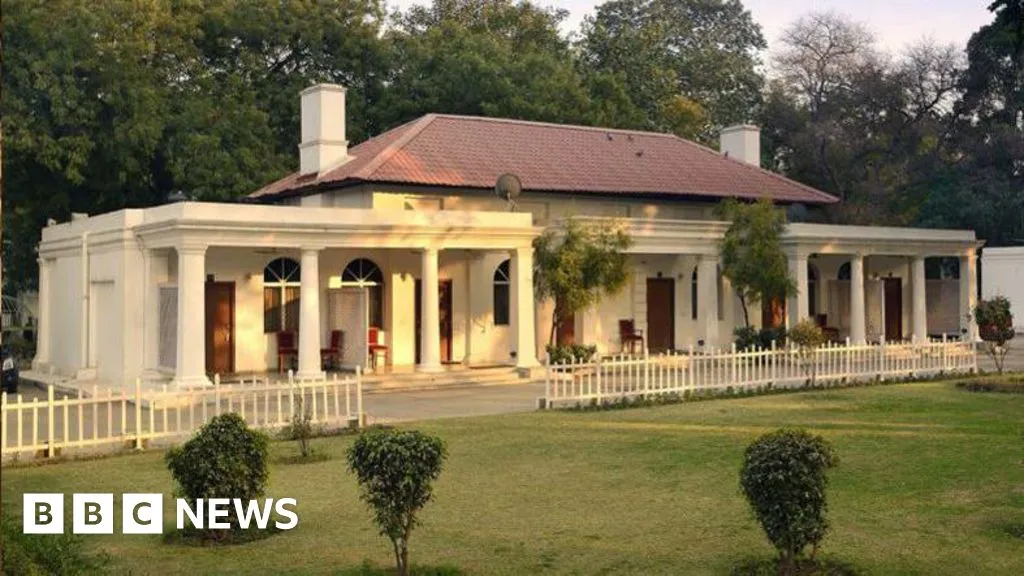
The Gymkhana is expensive to join, but access has long been controlled more by gatekeeping than price. Applicants must be proposed and seconded by members, after which a managing committee approves them. The process has traditionally favoured senior civil servants and defence officers, with a smaller share for others. Critics say this has helped sustain inequality, even as it has made the Gymkhana one of Delhi's most sought-after memberships.But many recall how the place kept alive a fragment of Delhi's elite past through small rituals: liveried waiters at dusk, gin and lime on shaded verandas, retired generals and diplomats lingering under neem trees.A Delhi-based senior journalist who never had a membership told the BBC the club always felt "distant". "But now I feel like stepping in once. It is one of the few structures in Delhi that has remained untouched while the city outside changed completely," he said.Getty ImagesThe club is located on Safdarjung Road in central DelhiFounded in 1913 as the Delhi-Gymkhana-club" class="entity-link entity-organization" data-entity-id="134139" data-entity-type="organization">Imperial Delhi Gymkhana Club, it emerged alongside the making of Delhi after the British shifted India's capital from Kolkata (formerly Calcutta). It first operated from the Coronation Grounds in Civil Lines, serving British administrators and military officers, before being allotted its present site on Safdarjung Road in 1928.The current clubhouse, designed in the 1930s by British architect Robert Tor Russell - who also designed the iconic Connaught Place - reflects the architecture of early central Delhi, with its deep verandahs, high ceilings and pale façades opening onto trees and lawns.Inside, time seemed to move differently: tennis whites drying beneath the afternoon sun, bridge rooms carrying the faint smell of cigarettes and talcum powder, elderly members reading newspapers beneath slow ceiling fans.History lingered there in intimate ways.In its early decades, westernised Indian Civil Service officers - among the few Indians admitted into elite colonial circles - reportedly learned ballroom dancing and British social etiquette at the club as they navigated the codes of imperial society.And in 1947, as the British Indian Army was divided between India and the newly created Pakistan, officers from regiments about to be separated gathered at the club for farewell drinks before history placed them on either side of a border.That image - officers sharing one final evening together - helps explain why the possible closure of the Gymkhana feels so emotional to many in Delhi.Places like these become repositories of memory, carrying traces of different eras inside them. "Cities are layered entities. Different generations leave their mark on them," historian Narayani Gupta once observed.During the final years of British rule and the early decades after independence, the club remained closely connected to the capital's political life. Speaking at the Gymkhana's centenary celebrations in 2013, then President Pranab Mukherjee recalled that Mahatma Gandhi and Lord Irwin, then Viceroy of India, had met privately there, leading to what became known as the Gandhi-Irwin pact.After 1947, "Imperial" was dropped from the club's name, but much of the atmosphere remained: dress codes, old carpets, evening drinks and familiar waiters serving generations of the same families.Delhi Gymkhana Club/GalleryCottages in the Gymkhana Club, which sits beside some of India's most powerful addressesOver time, the Gymkhana also became shorthand for a certain kind of inherited privilege in Delhi.Its notoriously long waiting lists - often stretching across decades - became part of city folklore, while critics saw the club as a symbol of influence shaped by personal networks and family legacy.A retired Indian Police Service officer told the BBC it took him 18 years to get a membership. "When I applied, I was fascinated by the idea," he said. "By the time I became one, I was totally indifferent and rarely visited it."Ghazal Tansir, a Delhi-based doctor who first visited the club for her wedding reception in 2019 through a relative's membership, described it as "a preserved, undisturbed little nook of memories".That exclusivity increasingly came under scrutiny after Modi's government came to power in 2014, promising to shift power away from Delhi's long-established English-speaking elite.Following inspections in 2016 and 2019, the Ministry of Corporate Affairs approached a government tribunal in 2020, alleging financial irregularities and violations of membership rules at the club.Two years later, the tribunal dissolved the club's elected governing committee and allowed the government to appoint administrators in its place - a move that drew criticism from some members.The latest eviction order has once again divided opinion.Kiran Bedi, a former top police officer who was once the chief ministerial candidate for Delhi from Modi's Bharatiya Janata Party (BJP), called it "unfortunate and tragic", describing the Gymkhana as part of the capital's sporting and institutional heritage. Historian Swapna Liddle acknowledged the club's elitist origins, but said she would have preferred efforts to reform the institution rather than shutting it down. "Instead of just saying 'let it not exist', you [the government] could have asked how it could be changed and made meaningful for more people," she said.Others took a different view. Journalist Prabhu Chawla criticised clubs like the Gymkhana as exclusionary institutions operating on heavily subsidised public land.Former diplomat KC Singh, however, said such clubs historically gave civil servants and military officers affordable recreational spaces despite modest government salaries.BJP spokesperson RP Singh rejected suggestions that the government was unfairly targeting the club. "It is a property leased by the government," he told the BBC. "Everything has happened according to the rule book and relevant laws."Beneath the legal and political arguments, however, runs a more emotional response - one tied to memory and loss in a city that is constantly changing. Delhi has spent decades remaking itself. Almost every resident carries a private atlas of vanished places: Regal Cinema, the old Coffee House, Urdu bookshops in Daryaganj, winter evenings at India Gate before barricades and security cordons reshaped the city.And yet some places seemed to outlast that churn.
SRCBBC News - World
LANGEN
LEANCenter
WORDS966
ENT9
MON · 2026-05-25 · 23:17 GMTBRIEF NSR-2026-0526-79211
NSR-2026-0526-79211News Report·EN·Human Interest
Delhi's most exclusive club is under threat of shutdown - can it survive?
Delhi's British-era Gymkhana Club, founded in 1913, is facing eviction following allegations of financial irregularities and membership rule violations. The Ministry of Corporate Affairs initiated proceedings in 2020, leading to a tribunal dissolving the club's governing committee and appointing administrators.
BBC News - WorldFiled 2026-05-25 · 23:17 GMTLean · CenterRead · 4 min
BBC News - WorldFIG 01
Reading time
4min
Word count
966words
Sources cited
2cited
Entities identified
9entities
Quality score
100%
§ 01
Briefing Summary
AI-generatedNEWSAR · AI
Delhi's British-era Gymkhana Club, founded in 1913, is facing eviction following allegations of financial irregularities and membership rule violations. The Ministry of Corporate Affairs initiated proceedings in 2020, leading to a tribunal dissolving the club's governing committee and appointing administrators. This has triggered a legal battle and sparked nostalgia for the club's historical significance as a repository of memory and a symbol of elite past. Critics have pointed to its gatekeeping practices and perceived perpetuation of inequality, while others lament the potential loss of a preserved, undisturbed space reflecting Delhi's architectural and social history. The club's exclusivity has been a subject of scrutiny, particularly after 2014.
Confidence 0.90Sources 2Claims 5Entities 9
§ 02
Article analysis
Model · rule-basedFraming
Human Interest
Social Justice
Tone
Measured
AI-assessed
CalmNeutralAlarmist
Factuality
0.60 / 1.00
Mixed
LowHigh
Sources cited
2
Limited
FewMany
§ 03
Key claims
5 extracted01
A senior journalist described the club as feeling 'distant' but now feels like 'stepping in once' due to its untouched nature.
quoteSenior journalist
Confidence
1.00
02
The current clubhouse was designed in the 1930s by British architect Robert Tor Russell.
factual
Confidence
1.00
03
Founded in 1913 as the Imperial Delhi Gymkhana Club, it served British administrators and military officers.
factual
Confidence
1.00
04
The Gymkhana club's membership process has traditionally favored senior civil servants and defense officers, contributing to inequality.
factualCritics
Confidence
0.80
05
The club's closure is perceived as emotional by many in Delhi due to its role as a repository of memory and traces of different eras.
factualArticle's interpretation based on historical context and quotes
Confidence
0.70
§ 04
Full report
4 min read · 966 words§ 05
Entities
9 identifiedKey playerOppositionContextPositiveNeutralNegative
Organizations3
§ 06
Keywords & salience
8 termsgymkhana club
1.00
elite club
0.90
delhi history
0.80
social inequality
0.70
colonial past
0.60
gatekeeping
0.50
club membership
0.50
architectural heritage
0.40
§ 07
Topic connections
Interactive graph Network visualization showing 51 related topics
View Full Graph Person Organization Location Event|Click node to navigate|Edge numbers = shared articles