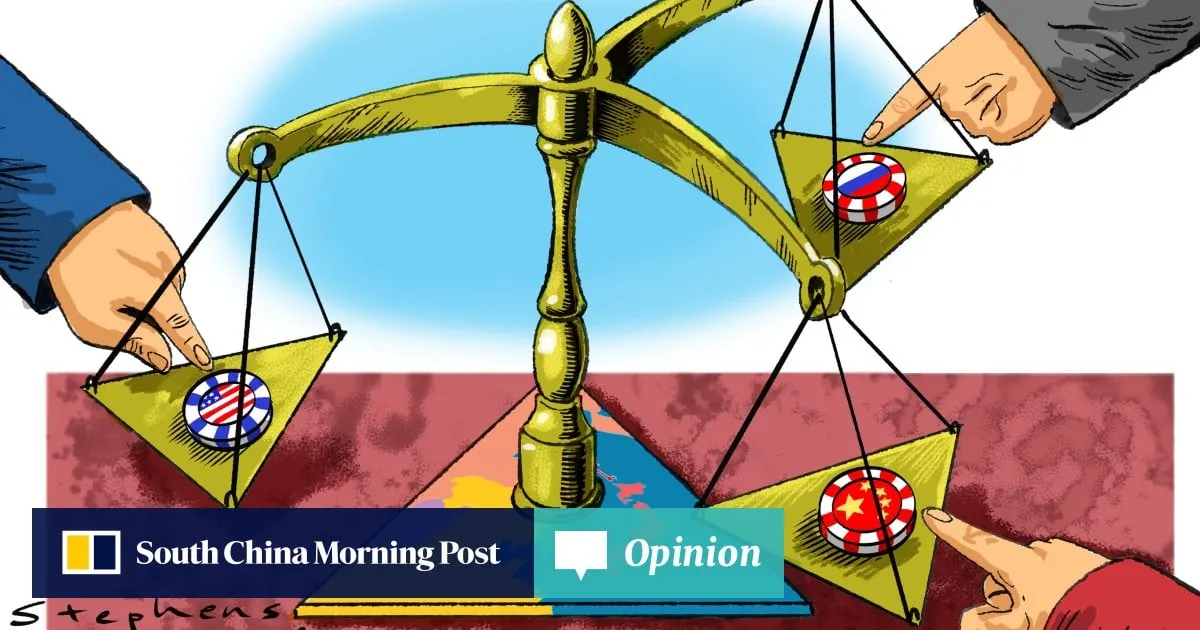
Hao Nan is a research fellow with the Charhar Institute, a 2025 Korean Peninsula specialist fellow with the National Committee on American Foreign Policy, and a Nuclear Futures fellow (2025-2026) with the Ploughshares Fund & Horizon 2045.When Washington, Beijing and Moscow begin to treat one another as bargaining partners again, northeast Asia feels the pressure. Taiwan, Korea, sanctions, energy routes, nuclear risks and missile defence are no longer separate theatres. They increasingly belong to one strategic conversation between the US, China and Russia.Northeast Asia itself is already being reorganised through three trilateral structures with different purposes, degrees of institutionalisation and strategic effects. Thus the region is now shaped by four layers of trilateralism: an emerging US-China-Russia great-power management; the US-Japan-South Korea deterrence partnership; China-Japan-South Korea functional cooperation; and a China-Russia-Korea" class="entity-link entity-location" data-entity-id="446" data-entity-type="location">North Korea counter-alignment.Northeast Asia is not being divided by one line. It is being pulled by several overlapping triangles.
SRCSouth China Morning Post
LANGEN
LEANCenter-Right
WORDS148
ENT12
TUE · 2026-05-26 · 21:30 GMTBRIEF NSR-2026-0526-79431
NSR-2026-0526-79431Analysis·EN·Political Strategy
The 4 trilateral frameworks defining northeast Asia’s future
Northeast Asia's strategic landscape is being reshaped by four overlapping trilateral frameworks as the US, China, and Russia re-engage as bargaining partners. This convergence means issues like Taiwan, Korea, sanctions, energy, and nuclear risks are now part of a single strategic conversation between these three great powers.
Hao NanSouth China Morning PostFiled 2026-05-26 · 21:30 GMTLean · Center-RightRead · 1 min
South China Morning PostFIG 01
Reading time
1min
Word count
148words
Sources cited
1cited
Entities identified
12entities
Quality score
100%
§ 01
Briefing Summary
AI-generatedNEWSAR · AI
Northeast Asia's strategic landscape is being reshaped by four overlapping trilateral frameworks as the US, China, and Russia re-engage as bargaining partners. This convergence means issues like Taiwan, Korea, sanctions, energy, and nuclear risks are now part of a single strategic conversation between these three great powers. The region is experiencing reorganization through an emerging US-China-Russia great-power management framework. Additionally, a US-Japan-South Korea deterrence partnership, a China-Japan-South Korea functional cooperation, and a China-Russia-North Korea counter-alignment are actively shaping the region's dynamics. These overlapping triangles, rather than a single dividing line, are defining Northeast Asia's future.
Confidence 0.90Sources 1Claims 4Entities 12
§ 02
Article analysis
Model · rule-basedFraming
Political Strategy
Diplomatic
Tone
Measured
AI-assessed
CalmNeutralAlarmist
Factuality
0.40 / 1.00
Mixed
LowHigh
Sources cited
1
Limited
FewMany
§ 03
Key claims
4 extracted01
Northeast Asia is being pulled by several overlapping triangles, not divided by one line.
factual
Confidence
0.90
02
Northeast Asia is shaped by four layers of trilateralism: US-China-Russia great-power management, US-Japan-South Korea deterrence, China-Japan-South Korea functional cooperation, and China-Russia-North Korea counter-alignment.
factual
Confidence
0.90
03
Taiwan, Korea, sanctions, energy routes, nuclear risks and missile defence are increasingly part of one strategic conversation between the US, China and Russia.
factual
Confidence
0.80
04
When Washington, Beijing and Moscow begin to treat one another as bargaining partners again, northeast Asia feels the pressure.
prediction
Confidence
0.70
§ 04
Full report
1 min read · 148 words§ 05
Entities
12 identifiedKey playerOppositionContextPositiveNeutralNegative
People1
Organizations4
§ 06
Keywords & salience
10 termsnortheast asia
1.00
trilateral frameworks
1.00
us-china-russia
0.90
strategic conversation
0.80
china-russia-north korea
0.70
us-japan-south korea
0.70
china-japan-south korea
0.70
nuclear risks
0.60
missile defence
0.50
sanctions
0.40
§ 07
Topic connections
Interactive graph Network visualization showing 51 related topics
View Full Graph Person Organization Location Event|Click node to navigate|Edge numbers = shared articles