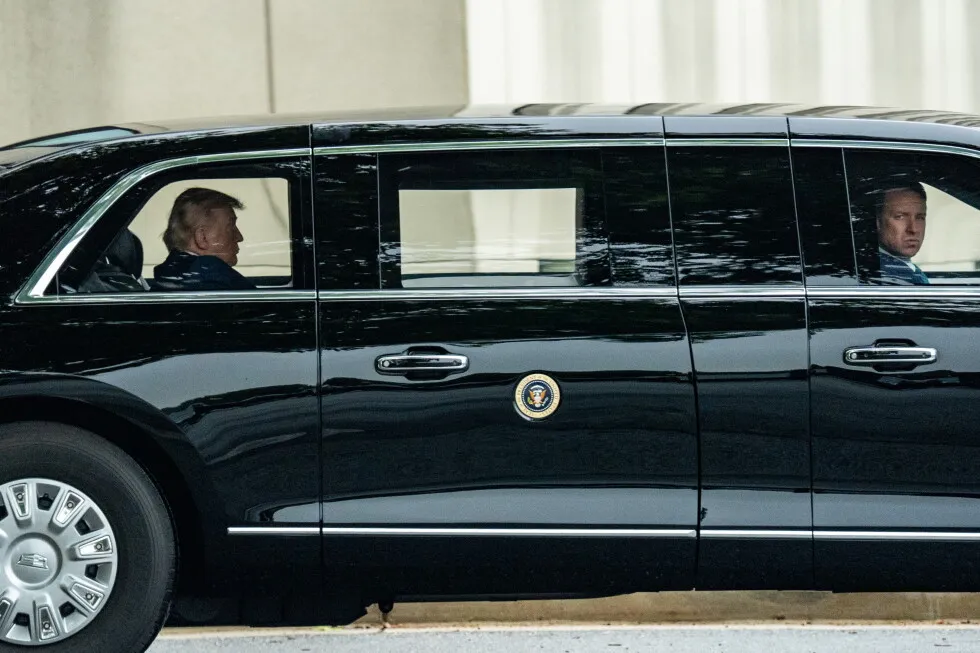
President Donald Trump departs Walter Reed National Military Medical Center, Tuesday, May 26, 2026, in Bethesda, Md. (AP Photo/Alex Brandon) Updated [hour]:[minute] [AMPM] [timezone], [monthFull] [day], [year] WASHINGTON (AP) — President Donald Trump will meet with his Cabinet on Wednesday at a precarious moment for talks aimed at ending the Iran" class="entity-link entity-event" data-entity-id="42010" data-entity-type="event">War with Iran, just days after insisting that his administration and Tehran had “largely negotiated” a settlement but with the negotiations still in a state of flux.As he prepares to huddle with his top aides, Trump is projecting confidence that he’s closing in on a deal that will reopen the Strait of Hormuz and provide him a credible argument that Iran’s nuclear capability has been diminished enough to declare victory, winding down a conflict that’s been politically unpopular for Republicans. But as things stand, Trump also risks finding closure to his war of choice comes with an unsatisfactory ending. The emerging deal puts off many critical issues to be resolved later and has already exposed the president to fierce criticism — even from some of his own supporters — that Iran’s hardline leaders will emerge from the conflict battered but emboldened. It all comes to a head just as the midterm elections to determine control of Congress come into focus and as Republicans worry that rising costs and fuel prices are darkening the American electorate’s mood. Talks were further complicated after U.S. forces carried out what the Pentagon called “defensive” strikes on missile launch sites and mine-laying boats in southern Iran on Monday. The U.S. said it acted with “restraint” in light of the weekslong ceasefire, while Iran decried the action as a sign of “bad faith and unreliability.” 5 MIN READ 2 MIN READ 4 MIN READ Secretary of State Marco Rubio said Tuesday that talks with Iran on reopening the strait and extending the ceasefire — a period that the administration says could be used to hash out the finer details of a nuclear agreement — will take several more days. “He’s either going to make a good deal or no deal,” Rubio told reporters.Trump for his part took to social media on Tuesday to grumble that even if Tehran were to offer a complete surrender, the media would paint the end of the conflict as Iran scoring “a Masterful and Brilliant Victory.” Some Trump backers are skepticalWhile Trump insists a deal is within reach, there appears to be daylight between the U.S. and Iran on several key issues. The president is also facing scrutiny from Republican allies, including Sens. Roger Wicker of Mississippi, Lindsey Graham of South Carolina and Ted Cruz of Texas, who have said the terms seem too favorable to Tehran. They’re balking at aspects of the deal that have emerged publicly that they say too closely resemble the nuclear agreement reached with Iran by former President Barack Obama, which Trump scrapped during his first term.Under the potential deal, Tehran would agree to give up its stockpile of highly enriched uranium — a key Trump demand — in return for sanctions relief. That’s according to two regional officials and one senior Trump administration official, all of whom spoke on condition of anonymity to discuss the sensitive negotiations. One regional official, with direct knowledge of the negotiations, said how Iran would give up the uranium would be subject to further talks during a 60-day period. Some would likely be diluted, while the rest would be transferred to a third country, the official said. Iran has 440.9 kilograms (972 pounds) of uranium that is enriched up to 60% purity, a short, technical step from weapons-grade levels of 90%, according to the International Atomic Energy Agency. Iran has not publicly committed to giving up its uranium.Trump on Monday said in a Truth Social post that the uranium, which is believed to be buried under nuclear sites battered by U.S. air strikes last year, would either be turned over to the U.S. or “destroyed in place or, at another acceptable location, with the Atomic Energy Commission, or its equivalent, being witness to this process and event.” The comment signals a softening of Trump’s previous insistence that the U.S. take control of Iran’s uranium stockpile. How Trump’s plan affects Israel’s war in LebanonAnother key issue unresolved is whether the ceasefire will also cover Israel’s operations against Hezbollah, the Iranian-backed militant group in Lebanon. Iran has insisted that Lebanon must be covered by any ceasefire agreement negotiated with the United States. The administration appears to leave some wiggle room on the Lebanon question. The emerging memorandum of understanding calls for a ceasefire between the U.S. and its allies against Iran and its proxies, such as Hezbollah, but also underscores Israel’s right to act against imminent threats and in self defense.Prime Minister Benjamin Netanyahu on Tuesday announced that the Israeli military is “deepening its operation” in Lebanon.Jonathan Conricus, a former spokesperson for the Israel Defense Forces, said Israel expects that Iran would quickly move to direct any sanctions relief to restore its military capability and boost proxy groups, including Hezbollah and Hamas in Gaza.“We’re not done fighting, because the Iranian regime isn’t done,” said Conricus, who is a senior fellow with the Foundation for Defense of Democracies, a hawkish Washington think tank. ‘Stunned silence’ as Trump ties Abraham Accords to Iran dealTrump on Monday said any agreement to end the Iran war should include a requirement for several additional countries, including Saudi Arabia, Qatar and Pakistan, to join the Abraham Accords, the U.S.-brokered agreements from Trump’s first term aimed at normalizing diplomatic and economic relations with Israel.Trump’s optimism that the other Middle Eastern and majority Muslim countries could soon sign on to the accords might be overly ambitious. For example, Saudi Arabia, the most significant power in the Arab world and long seen as the biggest prize for the normalization effort, has insisted that establishing a guaranteed path to a Palestinian state remains a precondition. It’s something that Israel vehemently opposes.Trump made the Abraham Accords push during a call with leaders of Mideast allies over the weekend. Barbara Leaf, a retired U.S. ambassador to the United Arab Emirates and senior State Department official during the Biden administration, said officials from Gulf countries who were on the call told her that Trump’s pitch was greeted by “stunned silence.” A person familiar with the call disputed that characterization and that some regional allies responded positively to the president’s call to join the accords. The person spoke on condition of anonymity about the private conversation.Leaf, a distinguished diplomatic fellow at the Middle East Institute, said that Middle Eastern allies of the United States recognize that Iran will likely use any money from sanctions relief to bolster its military capabilities. Still, they have been supportive of Trump pursuing an end to the conflict.“They see no other way out,” Leaf said of American allies in the region. “And they see no other way out because of many of these early mistakes that the president and the administration made in conducting the war.”___AP writers Matthew Lee and Darlene Superville in Washington, Samy Magdy in Cairo and Melanie Lidman in Jerusalem contributed to this report. Madhani covers the White House for The Associated Press. He is based in Washington.
SRCAssociated Press (AP)
LANGEN
LEANCenter
WORDS1 200
ENT10
WED · 2026-05-27 · 09:53 GMTBRIEF NSR-2026-0527-79538
NSR-2026-0527-79538News Report·EN·Political Strategy
Trump gathers Cabinet as he looks to seal deal to end war that some backers worry will embolden Iran
President Donald Trump is meeting with his Cabinet amid ongoing negotiations to end the war with Iran. Trump expressed confidence in reaching a settlement that would reopen the Strait of Hormuz and diminish Iran's nuclear capabilities.
By
AAMER MADHANIAssociated Press (AP)Filed 2026-05-27 · 09:53 GMTLean · CenterRead · 5 min
Associated Press (AP)FIG 01
Reading time
5min
Word count
1 200words
Sources cited
4cited
Entities identified
10entities
Quality score
100%
§ 01
Briefing Summary
AI-generatedNEWSAR · AI
President Donald Trump is meeting with his Cabinet amid ongoing negotiations to end the war with Iran. Trump expressed confidence in reaching a settlement that would reopen the Strait of Hormuz and diminish Iran's nuclear capabilities. However, the emerging deal faces criticism, even from some Republican supporters, who worry it may embolden Iran. Recent U.S. strikes on Iranian missile sites and mine-laying boats have further complicated talks, with Iran decrying the actions as "bad faith." Key unresolved issues include the fate of Iran's enriched uranium stockpile and whether a ceasefire will extend to Israel's operations against Hezbollah in Lebanon. Trump also suggested that other Middle Eastern countries should join the Abraham Accords as part of any agreement.
Confidence 0.90Sources 4Claims 5Entities 10
§ 02
Article analysis
Model · rule-basedFraming
Political Strategy
Conflict
Tone
Mixed Tone
AI-assessed
CalmNeutralAlarmist
Factuality
0.60 / 1.00
Mixed
LowHigh
Sources cited
4
Well sourced
FewMany
§ 03
Key claims
5 extracted01
Secretary of State Marco Rubio stated that talks with Iran will take several more days and that Trump will either make a good deal or no deal.
quoteMarco Rubio
Confidence
1.00
02
U.S. forces carried out "defensive" strikes on missile launch sites and mine-laying boats in southern Iran on Monday.
factualThe Pentagon
Confidence
1.00
03
President Donald Trump will meet with his Cabinet on Wednesday at a precarious moment for talks aimed at ending the war with Iran.
factual
Confidence
1.00
04
Some Republican supporters worry that the emerging deal puts off critical issues and will embolden Iran's hardline leaders.
factual
Confidence
0.90
05
Trump is projecting confidence that he’s closing in on a deal that will reopen the Strait of Hormuz and provide him a credible argument that Iran’s nuclear capability has been diminished.
factual
Confidence
0.80
§ 04
Full report
5 min read · 1 200 words§ 05
Entities
10 identifiedKey playerOppositionContextPositiveNeutralNegative
Locations3
§ 06
Keywords & salience
8 termsiran war
1.00
trump administration
0.90
nuclear agreement
0.80
strait of hormuz
0.70
ceasefire
0.60
midterm elections
0.50
political unpopularity
0.40
fuel prices
0.40
§ 07
Topic connections
Interactive graph Network visualization showing 51 related topics
View Full Graph Person Organization Location Event|Click node to navigate|Edge numbers = shared articles