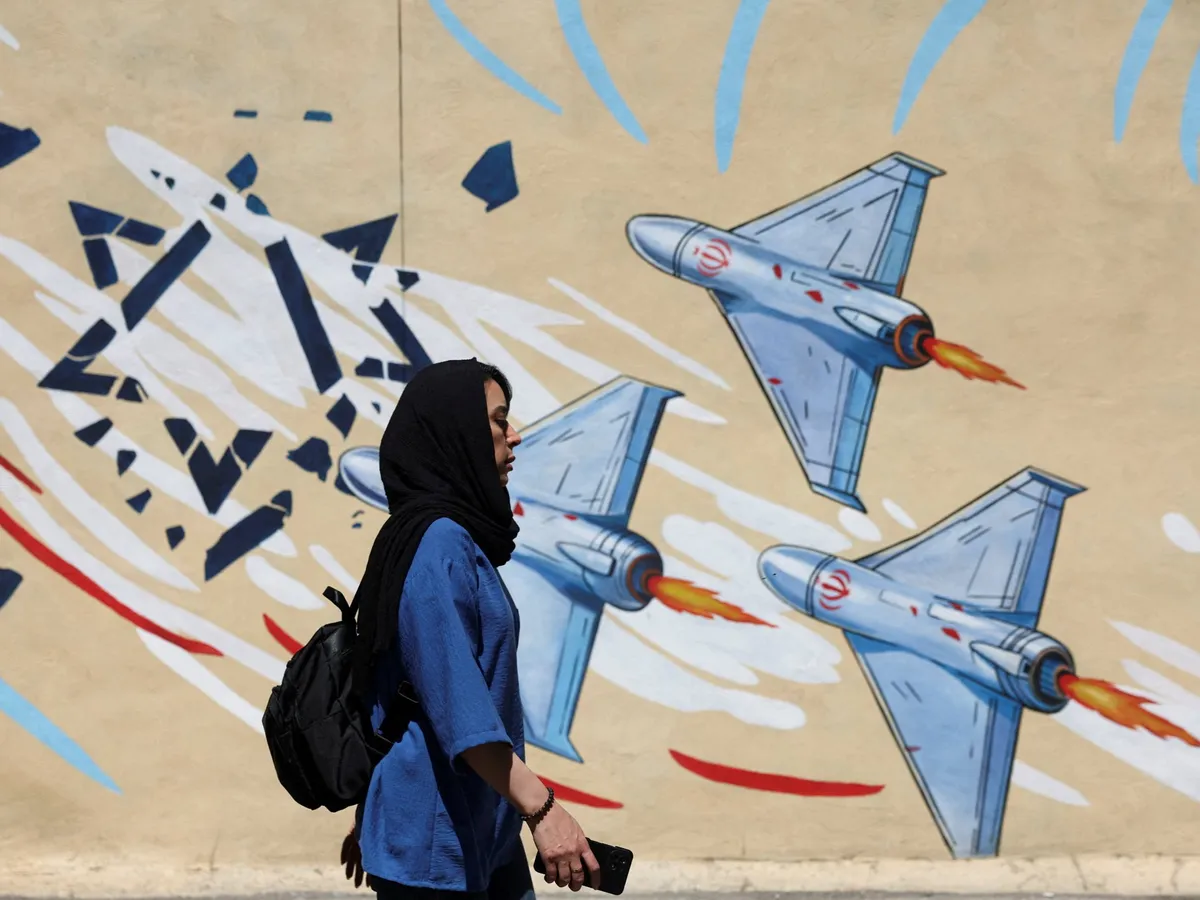
US president says Iran can’t ‘out-wait’ him, suggesting that Washington is not satisfied with Tehran’s offers for deal.A woman in Tehran, Iran, walks past a mural featuring Iranian drones on May 26 [File: Majid Asgaripour/West Asia News Agency via Reuters]Published On 27 May 2026Despite suggestions that a deal between the United States and Iran may be close, officials from both countries have continued to issue conflicting statements, signalling an ongoing diplomatic impasse.Speaking at Wednesday’s cabinet meeting, US President Donald Trump said Iran would not receive any sanctions relief as a result of the negotiations, despite Iran’s demands otherwise.Recommended Stories list of 3 itemslist 1 of 3Israeli strikes follow displacement order for Lebanese city of Tyrelist 2 of 3US, Iran have launched multiple attacks during ceasefire: A timelinelist 3 of 3Photos: Muslims worldwide celebrate Eid al-Adha, the Festival of Sacrificeend of list“We’re not talking about any easing of sanctions or giving money,” Trump said.Earlier in the day, in an interview with PBS News, the US president also reiterated his claim that Iran would surrender its reserves of enriched uranium.“They’re going to give up their highly enriched uranium, not for sanctions relief. No, no, not at all,” Trump told PBS News.Those comments followed similar remarks on Monday, when Trump said the enriched uranium “will either be immediately turned over to the United States to be brought home and destroyed or, preferably, in conjunction and coordination with the Iran" class="entity-link entity-organization" data-entity-id="8614" data-entity-type="organization">Islamic Republic of Iran, destroyed in place”.But Tehran has said it would not let go of the estimated 440kg (970 lbs) of nuclear material it possesses.More than one month ago, Trump claimed that Iran had agreed to allow the US to retrieve the uranium at a “leisurely pace”, but Tehran was quick to deny the statement.The back-and-forth over the future of Iran’s nuclear programme remains one of many points of divergence in the ceasefire negotiations, as the US and Iran seek an end to the war started more than 12 weeks ago.The two sides have also clashed over issues including the continuation of US sanctions against Iran, the US blockade on Tehran’s ports and control over the Strait of Hormuz, a major trade artery.Stalled diplomacyAt his cabinet meeting, Trump reiterated several statements he has made since the start of the war, including claims that Iran’s navy and air force are gone. He also once again sought to depict Iran as a fallen enemy, subdued by US military might.“They want very much to make a deal,” Trump said of Iran. But he added that the current negotiations had fallen short of his expectations.“We’re not satisfied with it, but we will be. We will be. Either that or we’ll have to just finish the job,” Trump said, suggesting further military action.The US and Israel launched a war against Iran on February 28 without direct provocation, killing the country’s Supreme Leader Ali Khamenei and several top officials, as well as hundreds of civilians.Iran responded by carrying out missile and drone attacks against Israel and across the entire region. It also closed the Strait of Hormuz, a waterway through which more than 20 percent of the world’s oil trade passes.The blockade has sent energy prices soaring across the world and fuelled inflation in the US. The Trump administration, meanwhile, has not been able to reopen the waterway by force.But on Wednesday, Trump stressed that Iran cannot “out-wait” him in the hope that he would back down. He framed the blockade as a tactic to undermine his domestic support ahead of the crucial midterm elections in the US.“I don’t care about the midterms,” Trump said. “People understand it. They know that — very simple — Iran cannot have a nuclear weapon.”Trump also batted aside the prospect of a short-term deal that would allow Iran and Oman to jointly control the strait, even hinting at a military response if Oman were to do so.“ Oman will behave just like everybody else, or we’ll have to blow ’em up. They understand that. They’ll be fine,” Trump said.While Trump has framed the deaths of Khamenei and other Iranian leaders as proof of leadership change, the war has failed to collapse Iran’s governing system.Khamenei was replaced by his son Mojtaba, and the Islamic Revolutionary Guard Corps (IRGC) continues to play a major role in Iran’s political and military establishment.A temporary ceasefire came into effect on April 8, but efforts to bring the crisis to a resolution have stalled, despite Trump’s assertion that Iran is weakened and desperate to make a deal with the US.However, there was renewed optimism about a possible agreement when Trump announced on Saturday that a deal was being finalised, after speaking to regional leaders.It remains unclear if either party has offered concessions to secure an agreement.Trump, for instance, told the cabinet meeting that he “wouldn’t be comfortable” with the prospect of Iran’s uranium being transferred to Russia or China, instead of the US.US says Iranian report ‘fabricated’Earlier on Wednesday, the White House dismissed a report by Iran’s state TV on the details of a memorandum of understanding (MOU) to reopen the Strait of Hormuz and end the war.The Iranian report said the draft deal would require the lifting of the US naval blockade on Iran in return for allowing ships to pass through Hormuz at pre-war levels within 30 days.According to the Iran" class="entity-link entity-organization" data-entity-id="8614" data-entity-type="organization">Islamic Republic of Iran Broadcasting (IRIB), military ships would not be part of the agreement, and the management of the waterway — including ship inspections and possible fees — would remain under the control of Iran in coordination with Oman.But the White House was quick to throw cold water on the Iranian claims.“This report from Iranian controlled media is not true and the MOU they ‘released’ is a complete fabrication. Nobody should believe what Iranian state media is putting out. FACTS MATTER,” the Trump administration said in a social media post.The White House did not specify what was not accurate about the report, and it did not provide details about the potential agreement with Iran.Trump said on Wednesday that the US will not accept Iranian control of Hormuz. “We’ll watch over it, but nobody’s going to control it. That’s part of the negotiation that we have,” he told reporters at the cabinet meeting.Initially, some US and Iranian reports suggested that the US would release frozen Iranian assets as part of the deal, but Trump emphasised on Wednesday that Washington will not offer immediate sanctions relief to Tehran.“When they behave properly and when they do what’s right, we’ll let them have their money,” he said.
SRCAl Jazeera
LANGEN
LEANCenter
WORDS1 086
ENT12
WED · 2026-05-27 · 18:19 GMTBRIEF NSR-2026-0527-79708
NSR-2026-0527-79708News Report·EN·Diplomatic
US, Iran issue conflicting reports on deal as Trump says no sanction relief
US President Donald Trump stated that Iran will not receive any sanctions relief in ongoing negotiations, despite Iran's demands. Trump indicated that Washington is not satisfied with Tehran's offers and that Iran cannot "out-wait" him.
Al Jazeera StaffAl JazeeraFiled 2026-05-27 · 18:19 GMTLean · CenterRead · 5 min
Al JazeeraFIG 01
Reading time
5min
Word count
1 086words
Sources cited
3cited
Entities identified
12entities
Quality score
100%
§ 01
Briefing Summary
AI-generatedNEWSAR · AI
US President Donald Trump stated that Iran will not receive any sanctions relief in ongoing negotiations, despite Iran's demands. Trump indicated that Washington is not satisfied with Tehran's offers and that Iran cannot "out-wait" him. He reiterated claims that Iran would surrender its enriched uranium, but Tehran denies this, stating it will not relinquish its nuclear material. The two nations are also at odds over continued US sanctions, blockades on Iranian ports, and control of the Strait of Hormuz. Despite a temporary ceasefire, diplomatic efforts to resolve the conflict, which began on February 28, have stalled. Trump suggested further military action if negotiations do not meet his expectations.
Confidence 0.90Sources 3Claims 5Entities 12
§ 02
Article analysis
Model · rule-basedFraming
Diplomatic
Conflict
Tone
Measured
AI-assessed
CalmNeutralAlarmist
Factuality
0.70 / 1.00
Factual
LowHigh
Sources cited
3
Well sourced
FewMany
§ 03
Key claims
5 extracted01
The US and Iran have conflicting reports and statements regarding a potential deal.
factual
Confidence
1.00
02
Iran has stated it would not allow the US to retrieve its estimated 440kg of nuclear material.
factualTehran
Confidence
1.00
03
US President Donald Trump stated Iran will not receive any sanctions relief as a result of negotiations.
quoteDonald Trump
Confidence
1.00
04
The US and Israel launched a war against Iran on February 28.
factual
Confidence
0.90
05
Trump suggested further military action if negotiations do not meet expectations.
predictionDonald Trump
Confidence
0.80
§ 04
Full report
5 min read · 1 086 words§ 05
Entities
12 identifiedKey playerOppositionContextPositiveNeutralNegative
Organizations4
§ 06
Keywords & salience
8 termssanctions relief
1.00
iran nuclear program
1.00
diplomatic impasse
0.90
enriched uranium
0.80
us-iran relations
0.70
ceasefire negotiations
0.60
strait of hormuz
0.50
donald trump
0.40
§ 07
Topic connections
Interactive graph Network visualization showing 51 related topics
View Full Graph Person Organization Location Event|Click node to navigate|Edge numbers = shared articles