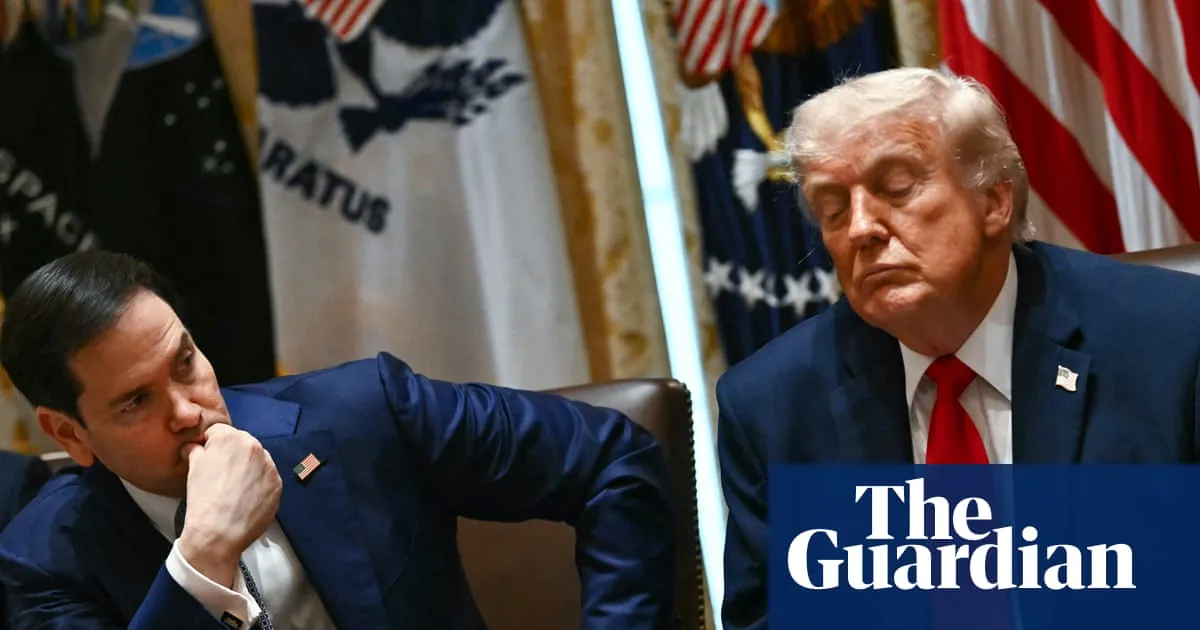
Donald Trump attending a cabinet meeting at the White House flanked by his secretary of state, Marco Rubio. Photograph: Kent Nishimura/AFP/Getty Images View image in fullscreen Donald Trump attending a cabinet meeting at the White House flanked by his secretary of state, Marco Rubio. Photograph: Kent Nishimura/AFP/Getty Images First Thing: Trump threatens to ‘blow up’ US ally Oman if it does not ‘behave’ over Strait of Hormuz President makes comments after reports Iran and Oman have discussed jointly charging a toll for ships. Plus, how ‘balcony solar’ could help fight rising energy costs In a casual aside during a cabinet meeting on Wednesday, Donald Trump threatened to “blow up” Oman, a US ally, if it failed to “behave” over the reopening the Strait of Hormuz. There have been reports of talks between Iran and Oman about jointly charging a toll for ships passing through the crucial waterway, which was open before US-Israel war on Iran but has been all but closed since. “The strait is going to be open to everybody,” Trump said. “Nobody’s going to control it. We’re going to watch over it. We’ll watch over it. But nobody’s going to control it … Oman will behave just like everybody else. Or else we’ll have to blow them up. They understand that.” Oman has decades-long military and economic ties with the US. It has also mediated in the war, and has been attacked by Tehran. What is the latest on a deal to end the war? Negotiations are continuing but the US earlier this week struck Iranian targets, reportedly killing four members of the Islamic Revolutionary Guard Corps, which prompted an apparent Iranian retaliatory attack on an American airbase in Kuwait. What is happening inside Iran? Internet restrictions were partially lifted this week, revealing increasing anger from Iranians over rapid food price inflation. Israeli military tells residents in southern Lebanon to leave View image in fullscreen Rescuers remove a body from the rubble of a home hit by an Israeli strike near the town of Burj al-Shamali. Photograph: Kawnat Haju/AFP/Getty Images Israel’s military has told residents across a swathe of southern Lebanon to leave and head north, as the Israeli prime minister, Benjamin Netanyahu, said his forces were escalating their offensive against Hezbollah. The Israel Defense Forces (IDF) said in a post on social media that all areas south of the Zahrani River, which runs about 25 miles (40km) north of the de facto Israel-Lebanon border, were considered combat zones. The warning came a day after Israel launched more than 120 airstrikes against Lebanon in one of the heaviest days of bombing in weeks. As of this morning, at least a dozen people have been killed in Israeli attacks on southern Lebanon, local media reported. What is the humanitarian toll of the war? More than 1 million people in Lebanon have been displaced in the latest round of hostilities between Hezbollah and Israel, which began in March. At least 3,213 people have been killed in Israeli strikes since the start of the war, according to the Lebanese health ministry. The office of Israel’s prime minister reported that 23 Israeli soldiers and a defence contractor had been killed in or near southern Lebanon, and two civilians had been killed in northern Israel. What is life like inside Israel’s “yellow line”? The Guardian’s William Christou, in Kfarchouba, Lebanon, spoke to the villagers living in fear of nightly raids and daytime bombings from the Israeli military occupying their land. World almost certain to endure record hot year by 2030, UN warns View image in fullscreen Southern Vietnam in 2024, the hottest year ever recorded globally. Photograph: Nhac Nguyen/AFP/Getty Images A record-breaking hot year is almost certain by 2030 as the climate crisis intensifies, the UN’s World Meteorological Organization has predicted. With an El Niño event expected later this year, the global temperature record could fall as soon as 2027. Carbon dioxide emissions from fossil fuels are continuing to rise, trapping more heat and creating more extreme weather. Global heating is estimated to take one life every minute, with the toll likely to rise unless emissions fall rapidly. What does the report show? It predicts an 86% chance that at least one year between 2026 and 2030 will surpass 2024 as the hottest ever recorded. There is a 75% chance that the average temperature for the five-year period from 2026 to 2030 will be more than 1.5C above the preindustrial average. In other news … View image in fullscreen Joe Biden in January 2025. Photograph: Bloomberg/Getty Images Jill Biden said she was worried her husband, Joe Biden, might have suffered a stroke as she watched him during his 2024 presidential debate, a poor performance that ultimately led him to withdraw from the race. Five people stuck in a flooded cave in central Laos since 19 May have been found alive, rescuers said, but two others are missing. Lawmakers in Hungary have voted overwhelmingly to remain a member of the international criminal court, reversing a decision by the previous government of Viktor Orbán. Stat of the day: WHO chief calls for DRC ceasefire to tackle Ebola outbreak as suspected deaths reach 246 View image in fullscreen Congolese soldiers stand inside the remains of an Ebola isolation tent burned down by ‘unidentified individuals’ in Mongbwalu, DRC. Photograph: Michel Lunanga/Getty Images The head of the World Health Organization, Tedros Adhanom Ghebreyesus, called for an immediate ceasefire in the eastern Democratic Republic of the Congo on Wednesday to help tackle the Ebola outbreak. There have been 1,077 suspected cases and 246 suspected Ebola deaths during the current outbreak, WHO data shows. It comes as the Trump administration said it was building a quarantine and treatment center in Kenya for Americans affected, instead of bringing them home. The Filter recommends: Tips on how to cat-proof your home View image in fullscreen Can you save your couch from landfill? Photograph: Tetiana Vitsenko/Alamy For the Filter US, Marissa Miller checked out 10 items to pet-proof a home, such as a water fountain, a calming diffuser and a built-in scratching post – which has “completely saved my couch from ending up in a landfill”, she says. Don’t miss this: Saint Levant – the pop star from Gaza caught between passionate fandom and bitter disapproval View image in fullscreen Palestinian singer and musician Saint Levant in Paris, 2025. Photograph: Sadaka Edmond/Sipa/Shutterstock His detractors say he should not be making pop music in times of war and destruction. His millions of fans say he has given them permission to celebrate their culture and their cause. Nesrine Malik writes about Saint Levant, the 25-year-old musician from Gaza. Climate check: How ‘balcony solar’ could help fight rising US utility costs View image in fullscreen A ‘balcony power plant’, as it is known in Germany. Photograph: Climate Central Since 2020, US residential energy prices have surged by about 30%, according to the US Energy Information Administration. But while the US has been slow to adopt personal solar technology, in Germany it has become a cultural phenomenon – known as Balkonkraftwerk, or “balcony power plant”. Ben Tracy reports on the potential US impact of “balcony solar” on energy bills. Last Thing: What are the best World Cup uniforms for 2026? View image in fullscreen The Japan away kit with, left, William Saliba in the France home kit and Ryan Christie in Scotland away. Composite: Guardian Design/Nike/Adidas With the World Cup only two weeks away, Lauren Cochrane, a senior Guardian fashion writer, looked at the teams’ top jerseys – from riffs on much-loved favourites, to new entries with the potential to become classics. If you have any questions or comments about any of our newsletters please email newsletters@theguardian.com Explore more on these topics US news First Thing newsletter news Share Reuse this content
SRCThe Guardian - World News
LANGEN
LEANCenter-Left
WORDS1 295
ENT12
THU · 2026-05-28 · 11:29 GMTBRIEF NSR-2026-0528-79900
NSR-2026-0528-79900News Report·EN·Conflict
Trump threatens to ‘blow up’ US ally Oman if it does not ‘behave’ over strait of Hormuz | First Thing
During a cabinet meeting, President Trump threatened to "blow up" Oman, a US ally, if it did not "behave" regarding the Strait of Hormuz. This statement followed reports of discussions between Iran and Oman about jointly charging tolls for ships passing through the waterway.
Jem BartholomewThe Guardian - World NewsFiled 2026-05-28 · 11:29 GMTLean · Center-LeftRead · 6 min
The Guardian - World NewsFIG 01
Reading time
6min
Word count
1 295words
Sources cited
3cited
Entities identified
12entities
Quality score
100%
§ 01
Briefing Summary
AI-generatedNEWSAR · AI
During a cabinet meeting, President Trump threatened to "blow up" Oman, a US ally, if it did not "behave" regarding the Strait of Hormuz. This statement followed reports of discussions between Iran and Oman about jointly charging tolls for ships passing through the waterway. Trump asserted the strait would remain open to everyone and that Oman would comply. The article also reports on ongoing negotiations for a ceasefire, US strikes on Iranian targets, and retaliatory attacks. In Iran, internet restrictions were partially lifted, revealing public anger over rising food prices. The conflict has displaced over a million people in Lebanon, with thousands killed on both sides. Separately, the UN warned of a record hot year by 2030 due to intensifying climate change.
Confidence 0.90Sources 3Claims 5Entities 12
§ 02
Article analysis
Model · rule-basedFraming
Conflict
Diplomatic
Tone
Mixed Tone
AI-assessed
CalmNeutralAlarmist
Factuality
0.70 / 1.00
Factual
LowHigh
Sources cited
3
Well sourced
FewMany
§ 03
Key claims
5 extracted01
Israel's military has told residents in southern Lebanon to leave and head north.
factualIsrael's military
Confidence
0.90
02
Donald Trump threatened to 'blow up' Oman if it failed to 'behave' over the Strait of Hormuz.
quoteDonald Trump
Confidence
0.90
03
At least a dozen people have been killed in Israeli attacks on southern Lebanon.
factuallocal media
Confidence
0.70
04
The US struck Iranian targets, reportedly killing four members of the Islamic Revolutionary Guard Corps.
factualreports
Confidence
0.70
05
Reports indicate Iran and Oman have discussed jointly charging a toll for ships passing through the Strait of Hormuz.
factualreports
Confidence
0.70
§ 04
Full report
6 min read · 1 295 words§ 05
Entities
12 identifiedKey playerOppositionContextPositiveNeutralNegative
People3
§ 06
Keywords & salience
9 termsdonald trump
1.00
oman
1.00
strait of hormuz
1.00
iran
0.90
us ally
0.80
threats
0.70
middle east conflict
0.60
lebanon
0.50
hezbollah
0.40
§ 07
Topic connections
Interactive graph Network visualization showing 51 related topics
View Full Graph Person Organization Location Event|Click node to navigate|Edge numbers = shared articles