No sign of new protests in Iran as a hard-line cleric calls for executions and threatens Trump 1 of 7 | Demonstrations over the country’s ailing economy which began on December 28 soon morphed into a direct challenge to its ruling theocracy. 2 of 7 | Iran’s Permanent Representative to the UN accused the U.S. and Israel of instilling “political destabilization, internal unrest and chaos” in the nation following the recent deadly protests. 3 of 7 | Iranian senior cleric Ahmad Khatami delivers his sermon during Friday prayer ceremony in Tehran, Iran, Friday, Jan. 5, 2018. (AP Photo/Ebrahim Noroozi, File) 4 of 7 | Vehicles drive in downtown Tehran, Iran, Friday, Jan. 16, 2026. (AP Photo/Vahid Salemi) 5 of 7 | A woman crosses an intersection in downtown Tehran, Iran, Friday, Jan. 16, 2026. (AP Photo/Vahid Salemi) 6 of 7 | A street vendor adjusts clothes for sale in downtown Tehran, Iran, Friday, Jan. 16, 2026. (AP Photo/Vahid Salemi) 7 of 7 | Iranian opposition leader Reza Pahlavi speaks during a news conference on Friday, Jan. 16, 2026, in Washington. (AP Photo/Mark Schiefelbein) 1 of 7 Demonstrations over the country’s ailing economy which began on December 28 soon morphed into a direct challenge to its ruling theocracy. Add AP News on Google Add AP News as your preferred source to see more of our stories on Google. 2 of 7 Iran’s Permanent Representative to the UN accused the U.S. and Israel of instilling “political destabilization, internal unrest and chaos” in the nation following the recent deadly protests. Add AP News on Google Add AP News as your preferred source to see more of our stories on Google. 3 of 7 Iranian senior cleric Ahmad Khatami delivers his sermon during Friday prayer ceremony in Tehran, Iran, Friday, Jan. 5, 2018. (AP Photo/Ebrahim Noroozi, File) Add AP News on Google Add AP News as your preferred source to see more of our stories on Google. 4 of 7 Vehicles drive in downtown Tehran, Iran, Friday, Jan. 16, 2026. (AP Photo/Vahid Salemi) Add AP News on Google Add AP News as your preferred source to see more of our stories on Google. 5 of 7 A woman crosses an intersection in downtown Tehran, Iran, Friday, Jan. 16, 2026. (AP Photo/Vahid Salemi) Add AP News on Google Add AP News as your preferred source to see more of our stories on Google. 6 of 7 A street vendor adjusts clothes for sale in downtown Tehran, Iran, Friday, Jan. 16, 2026. (AP Photo/Vahid Salemi) Add AP News on Google Add AP News as your preferred source to see more of our stories on Google. 7 of 7 Iranian opposition leader Reza Pahlavi speaks during a news conference on Friday, Jan. 16, 2026, in Washington. (AP Photo/Mark Schiefelbein) Add AP News on Google Add AP News as your preferred source to see more of our stories on Google. Updated [hour]:[minute] [AMPM] [timezone], [monthFull] [day], [year] DUBAI, United Arab Emirates (AP) — As Iran returned to uneasy calm after a wave of protests that drew a bloody crackdown, a senior hard-line cleric called Friday for the death penalty for detained demonstrators and directly threatened U.S. President Donald Trump — evidence of the rage gripping authorities in the Islamic Republic.Trump, though, struck a conciliatory note, thanking Iran’s leaders for not executing hundreds of detained protesters, in a further sign he may be backing away from a military strike. Executions, as well as the killing of peaceful protesters, are two of the red lines laid down by Trump for possible action against Iran.Harsh repression that has left several thousand people dead appears to have succeeded in stifling demonstrations that began Dec. 28 over Iran’s ailing economy and morphed into protests directly challenging the country’s theocracy. There have been no signs of protests for days in Tehran, where shopping and street life have returned to outward normality, though a week-old internet blackout continued. Authorities have not reported any unrest elsewhere in the country. “Iran canceled the hanging of over 800 people,” Trump told reporters in Washington, adding that “I greatly respect the fact that they canceled.” AP AUDIO: No sign of new protests in Iran as a hardline cleric calls for executions and threatens Trump AP’s Lisa Dwyer reports on an Iranian cleric’s call for the death penalty for detained protesters. Trump did not clarify who he spoke to in Iran to confirm the state of any planned executions.The U.S.-based Human Rights Activists News Agency on Friday put the death toll at 3,090. The number, which exceeds that of any other round of protest or unrest in Iran in decades and recalls the chaos surrounding the 1979 revolution, continues to rise. The agency has been accurate throughout the years of demonstrations, relying on a network of activists inside Iran that confirms all reported fatalities.The AP has been unable to independently confirm the toll. Iran’s government has not provided casualty figures. Hard-line cleric’s fiery sermonIn contrast, the sermon by Ayatollah Ahmad Khatami carried by Iranian state radio sparked chants from those gathered for prayers, including: “Armed hypocrites should be put to death!” Khatami, a member of Iran’s Assembly of Experts and Guardian Council long known for his hard-line views, described the protesters as the “butlers” of Israeli Prime Minister Benjamin Netanyahu and “Trump’s soldiers.” He said Netanyahu and Trump should await “hard revenge from the system.”“Americans and Zionists should not expect peace,” the cleric said.His fiery speech came as allies of Iran and the United States alike sought to defuse tensions. Russian President Vladimir Putin spoke Friday to both Iranian President Masoud Pezeshkian and Israel’s Netanyahu, Kremlin spokesman Dmitry Peskov said.Russia had previously kept largely quiet about the protests. Moscow has watched several key allies suffer blows as its resources and focus are consumed by its 4-year-old war against Ukraine, including the downfall of Syria’s former President Bashar Assad in 2024, last year’s U.S. and Israeli attacks on Iran and the U.S. seizure of Venezuelan leader Nicolas Maduro this month. Exiled Iranian royal calls for fight to continueDays after Trump pledged “help is on its way” for the protesters, both the demonstrations and the prospect of imminent U.S. retaliation appeared to have receded. One diplomat told The Associated Press that top officials from Egypt, Oman, Saudi Arabia and Qatar had raised concerns with Trump that a U.S. military intervention would shake the global economy and destabilize an already volatile region. Iran’s exiled Crown Prince Reza Pahlavi urged the U.S. to make good on its pledge to intervene. Pahlavi, whose father was overthrown by Iran’s 1979 Islamic Revolution, said he still believes the president’s promise of assistance.“I believe the president is a man of his word,” Pahlavi told reporters in Washington. He added that “regardless of whether action is taken or not, we as Iranians have no choice to carry on the fight.““I will return to Iran,” he vowed. Hours later, he urged protesters to take to the streets again from Saturday to Monday. Despite support by diehard monarchists in the diaspora, Pahlavi has struggled to gain wider appeal within Iran. But that has not stopped him from presenting himself as the transitional leader of Iran if the regime were to fall. Iran authorities list protest damageKhatami, the hard-line cleric, also provided the first overall statistics on damage from the protests, claiming 350 mosques, 126 prayer halls and 20 other holy places had sustained damage. Another 80 homes of Friday prayer leaders — an important position within Iran’s theocracy — were also damaged, likely underlining the anger demonstrators felt toward symbols of the government. He said 400 hospitals, 106 ambulances, 71 fire department vehicles, and another 50 emergency vehicles also sustained damage.Even as protests appeared to have been smothered inside Iran, thousands of exiled Iranians and their supporters have taken to the streets in cities across Europe to shout out their rage at the government of the Islamic Republic. Amid the continuing internet shutdown, some Iranians crossed borders to communicate with the outside world. At a border crossing in Turkey’s eastern province of Van, a trickle of Iranians crossing on Friday said they were traveling to get around the communications blackout.“I will go back to Iran after they open the internet,” said a traveler who gave only his first name, Mehdi, out of security concerns.Also crossing the border were some Turkish citizens escaping the unrest in Iran.Mehmet Önder, 47, was in Tehran for his textiles business when the protests erupted. He said he laid low in his hotel until it was shut for security reasons, then stayed with one of his customers until he was able to return to Turkey. Although he did not venture into the streets, Önder said he heard heavy gunfire.“I understand guns, because I served in the military in the southeast of Turkey,” he said. “The guns they were firing were not simple weapons. They were machine-guns.”In a sign of the conflict’s potential to spill over borders, a Kurdish separatist group in Iraq said it has launched attacks on Iran’s paramilitary Revolutionary Guard in recent days in retaliation for Tehran’s crackdown on protests.A representative of the Kurdistan Freedom Party, or PAK, said its members have “played a role in the protests through both financial support and armed operations to defend protesters when needed.” The group said the attacks were launched by members of its military wing based inside Iran.___Amiri reported from New York. Associated Press journalists Will Weissert and Darlene Superville in Washington and Serra Yedikardes at the Kapikoy Border Crossing, Turkey, contributed. Gambrell is the news director for the Gulf and Iran for The Associated Press. He has reported from each of the Gulf Cooperation Council countries, Iran and other locations across the world since joining the AP in 2006. Amiri covers foreign policy and the United Nations as a correspondent for The Associated Press, based in New York.
SRCAssociated Press (AP)
LANGEN
LEANCenter
WORDS1 642
ENT7
FRI · 2026-01-16 · 12:53 GMTBRIEF NSR-2026-0116-8000
NSR-2026-0116-8000News Report·EN·Political Strategy
Prayer leader in Iran and the faithful call for executions over protests, a red line for Trump
In Iran, a hard-line cleric called for the execution of protestors who challenged the ruling theocracy after demonstrations that began on December 28 over the country's struggling economy. The Iranian representative to the UN accused the U.S.
By
JON GAMBRELL and FARNOUSH AMIRIAssociated Press (AP)Filed 2026-01-16 · 12:53 GMTLean · CenterRead · 7 min
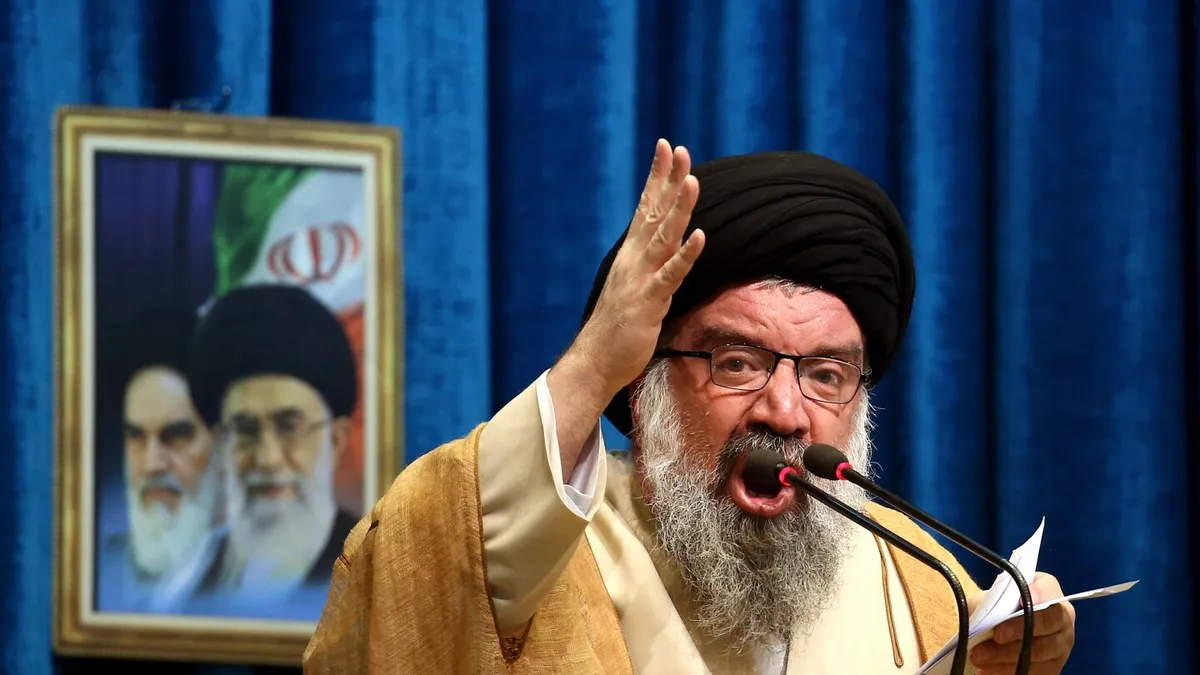
Associated Press (AP)FIG 01
Reading time
7min
Word count
1 642words
Sources cited
2cited
Entities identified
7entities
Quality score
100%
§ 01
Briefing Summary
AI-generatedNEWSAR · AI
In Iran, a hard-line cleric called for the execution of protestors who challenged the ruling theocracy after demonstrations that began on December 28 over the country's struggling economy. The Iranian representative to the UN accused the U.S. and Israel of inciting unrest and destabilization within the nation. The prayer leader's demand and the overall situation have drawn attention from the Trump administration, with potential implications for U.S.-Iran relations. As of the report, there were no signs of new protests. The original protests were triggered by economic grievances but evolved into a broader challenge to the Iranian government.
Confidence 0.90Sources 2Claims 3Entities 7
§ 02
Article analysis
Model · rule-basedFraming
Political Strategy
Conflict
Tone
Mixed Tone
AI-assessed
CalmNeutralAlarmist
Factuality
0.70 / 1.00
Factual
LowHigh
Sources cited
2
Limited
FewMany
§ 03
Key claims
3 extracted01
A senior hard-line cleric called Friday for the death.
factualsenior hard-line cleric
Confidence
1.00
02
Iran’s Permanent Representative to the UN accused the U.S. and Israel of instilling “political destabilization, internal unrest and chaos” in the nation.
quoteIran’s Permanent Representative to the UN
Confidence
1.00
03
Demonstrations over the country’s ailing economy which began on December 28 soon morphed into a direct challenge to its ruling theocracy.
factualAP
Confidence
0.90
§ 04
Full report
7 min read · 1 642 words§ 05
Entities
7 identifiedKey playerOppositionContextPositiveNeutralNegative
Organizations1
§ 06
Keywords & salience
9 termsiran protests
0.90
executions
0.80
ailing economy
0.70
theocracy
0.70
internal unrest
0.60
political destabilization
0.60
u.s. and israel
0.50
ahmad khatami
0.50
trump
0.40
§ 07
Topic connections
Interactive graph Network visualization showing 51 related topics
View Full Graph Person Organization Location Event|Click node to navigate|Edge numbers = shared articles