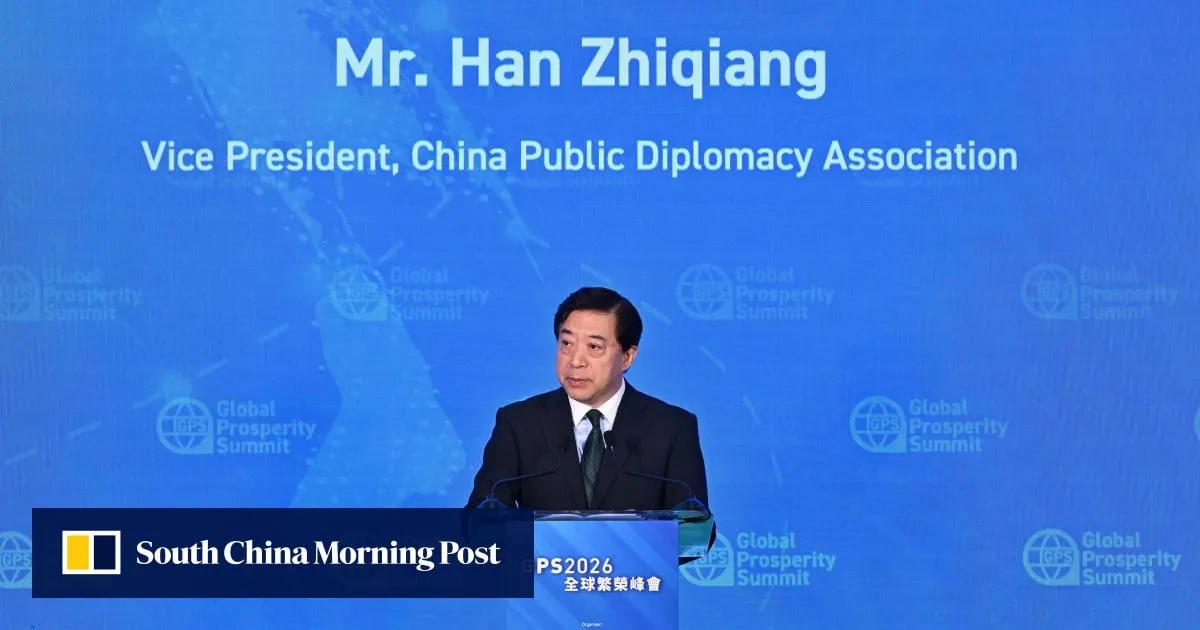
The Global Prosperity Summit 2026 (GPS 2026) highlighted Hong Kong’s expanding role in international and regional cooperation both within China’s Global Governance Initiative as well as Apec, ahead of a meeting of the bloc’s economic leaders in neighbouring Shenzhen later this year.The two-day event, which ran from May 19 to 20, brought together global leaders and renowned experts in Hong Kong to exchange insights on issues affecting the city’s future and global prosperity.Ambassador Han Zhiqiang, vice-president of the China-public-diplomacy-association" class="entity-link entity-organization" data-entity-id="129849" data-entity-type="organization">China Public Diplomacy Association, outlined Hong Kong’s key role in facilitating international exchanges in his keynote address, where he laid out the vision of China’s Global Governance Initiative.“Hong Kong, as an international metropolis connecting China and the world and bringing together Eastern and Western cultures, is not only a major hub for finance, trade and shipping, but also an important bridge for exchanges between civilisations,” he said.The Global Governance Initiative – unveiled during the Tianjin Summit of the Shanghai Cooperation Organisation last September – was China’s response to the needs of the world, Han said, as he outlined its three key messages: strong solidarity, upholding multilateralism, and a future of fairness and justice.“Geopolitical conflicts continue to flare up, development gaps are widening and global challenges are emerging one after another,” Han said. “These developments have made reform and improvement of global governance an urgent task for all countries and peoples.”“As we all advance towards a brighter future of a community with a shared future for humanity, China is ready to work with the international community to ensure that the Initiative takes root and yields fruitful outcomes.”Marking its third consecutive edition, GPS 2026 was co-organised by the Savantas Policy Institute, the Shanghai Institutes for International Studies and the European Chamber of Commerce in Hong Kong.The Asia-Pacific Economic Cooperation, the intergovernmental forum of 21 economies within the region hosted by China this year, took centre stage during a fireside chat between Regina Ip, the founder of GPS and chair of the board of governors of the Savantas Policy Institute, and Professor Li Kaisheng, vice-president of the Shanghai Institutes for International Studies.Regina Ip (left) and Li Kaisheng during a fireside chat at the Global Prosperity Summit 2026 in Hong Kong.To coincide with the event, Ip and Li jointly released a paper on behalf of their two think tanks detailing eight proposals aimed at injecting new momentum into Apec cooperation from the non-governmental sector.“Apec has several layers. In addition to the leaders’ level, ministerial level, senior officials’ level and the city level, there could be more cooperation, [such as] at the level of think tanks, which have been generating many new ideas,” Ip said.Among the key proposals was a call to strengthen exchanges between Chinese cities hosting Apec events, as well as the establishment of an “Apec Think Tank Cooperation Council” that would bring together representative think tanks from Apec-member economies to host forums and conduct joint research.“So we can look forward to more cooperation, more networking, paving the foundation for building greater global regional cooperation and prosperity,” Ip said.During the fireside chat, Li also touched on United States President Donald Trump’s visit to Beijing – which had concluded just days before GPS 2026 – describing the state visit as “a critical moment to recalibrate the world economic order and China-US relations”.During a later panel session focused on international trade in a changing world order, Li further elaborated on Hong Kong’s role as a “bridge” between mainland China and the world.“Economically, the mainland is very strong in many respects, but Hong Kong has so many advantages – its soft capabilities are in the areas of finance, insurance and law,” he said.“Hong Kong knows the West very well, and, of course, the mainland. It is indeed a bridge to minimise cultural gaps between China and the rest of the world.”Sean Stein, president of the US-China Business Council, said Hong Kong should focus on areas that make the city special, including its commitment to the rule of law, as well as its tradition of transparency and fairness.“That’s what makes Hong Kong indispensable,” he said.He also described the location of the Apec leaders’ summit as “absolutely inspiring” and said it would help bring together Shenzhen and Hong Kong as “two great global cities”.Industry experts considered Hong Kong’s expanding role in international cooperation at the Global Prosperity Summit 2026 held in the city.Shenzhen, China’s southern powerhouse tech hub, is set to host the Apec Economic Leaders’ Meeting in November, while Hong Kong will host the Finance Ministers’ Meeting in October.“The gateway to Shenzhen is actually not Beijing, and it’s not Shanghai. The gateway to Shenzhen is Hong Kong,” Stein said. “I believe we’ll see a record number of CEOs attending the summit, certainly more than we’ve seen in recent years.”Datuk Professor Dr Mohd Faiz Abdullah, executive chairman of the Institute of Strategic and International Studies Malaysia, lauded Hong Kong’s role as an engine for economic growth as he pitched further partnerships between the city and the Asean bloc.“The way I look at it, Hong Kong will have to be one of the major drivers in promoting regional growth. We must consider how best that can be leveraged to promote global growth,” he said.Faiz also touched on China’s Global Governance Initiative, describing it as “for the good of the general world, not just the region”.Mark Boris Andrijanic, a board member of the European Institute of Innovation and Technology, took a broader view centred on areas where he felt China and the European Union had room to form partnerships.“I think there’s an opportunity for a broader partnership between the EU and China across a variety of issues – be it climate change, where we think pretty much along the same lines, or in the area of UN reform, because both the EU and China are very committed to the UN and other international organisations,” he said.“And obviously, trade should be on the top of all issues.”
SRCSouth China Morning Post
LANGEN
LEANCenter-Right
WORDS984
ENT12
FRI · 2026-05-29 · 07:00 GMTBRIEF NSR-2026-0529-80130
NSR-2026-0529-80130News Report·EN·Diplomatic
Global Prosperity Summit 2026 reinforces Hong Kong’s strategic importance in advancing Apec cooperation and global governance
The Global Prosperity Summit 2026, held in Hong Kong from May 19-20, highlighted the city's growing importance in international cooperation, particularly within China's Global Governance Initiative and Apec. The summit brought together global leaders and experts to discuss Hong Kong's future and global prosperity.
Morning Studio staffSouth China Morning PostFiled 2026-05-29 · 07:00 GMTLean · Center-RightRead · 4 min
South China Morning PostFIG 01
Reading time
4min
Word count
984words
Sources cited
2cited
Entities identified
12entities
Quality score
100%
§ 01
Briefing Summary
AI-generatedNEWSAR · AI
The Global Prosperity Summit 2026, held in Hong Kong from May 19-20, highlighted the city's growing importance in international cooperation, particularly within China's Global Governance Initiative and Apec. The summit brought together global leaders and experts to discuss Hong Kong's future and global prosperity. Ambassador Han Zhiqiang emphasized Hong Kong's role as a bridge between China and the world, facilitating exchanges and supporting multilateralism. Co-organized by several institutes, the summit also focused on Apec, with proposals presented to enhance cooperation through think tanks and city-level exchanges. Experts discussed Hong Kong's unique strengths in finance, law, and transparency, reinforcing its position as a vital link between mainland China and the global community, especially with Shenzhen hosting the Apec Economic Leaders' Meeting later in the year.
Confidence 0.90Sources 2Claims 4Entities 12
§ 02
Article analysis
Model · rule-basedFraming
Diplomatic
Political Strategy
Tone
Measured
AI-assessed
CalmNeutralAlarmist
Factuality
0.70 / 1.00
Factual
LowHigh
Sources cited
2
Limited
FewMany
§ 03
Key claims
4 extracted01
The Global Governance Initiative is China’s response to the needs of the world, emphasizing strong solidarity, upholding multilateralism, and a future of fairness and justice.
quoteAmbassador Han Zhiqiang
Confidence
1.00
02
Ambassador Han Zhiqiang outlined Hong Kong’s key role in facilitating international exchanges and laid out the vision of China’s Global Governance Initiative.
quoteAmbassador Han Zhiqiang
Confidence
1.00
03
Regina Ip and Professor Li Kaisheng jointly released a paper with eight proposals to inject new momentum into Apec cooperation from the non-governmental sector.
factualRegina Ip and Professor Li Kaisheng
Confidence
0.90
04
Global Prosperity Summit 2026 highlighted Hong Kong’s expanding role in international and regional cooperation within China’s Global Governance Initiative and Apec.
factual
Confidence
0.90
§ 04
Full report
4 min read · 984 words§ 05
Entities
12 identifiedKey playerOppositionContextPositiveNeutralNegative
Organizations5
§ 06
Keywords & salience
9 termshong kong
1.00
global prosperity summit 2026
1.00
apec cooperation
0.90
global governance
0.90
china's global governance initiative
0.80
international cooperation
0.70
multilateralism
0.60
global challenges
0.50
community with a shared future
0.40
§ 07
Topic connections
Interactive graph Network visualization showing 51 related topics
View Full Graph Person Organization Location Event|Click node to navigate|Edge numbers = shared articles