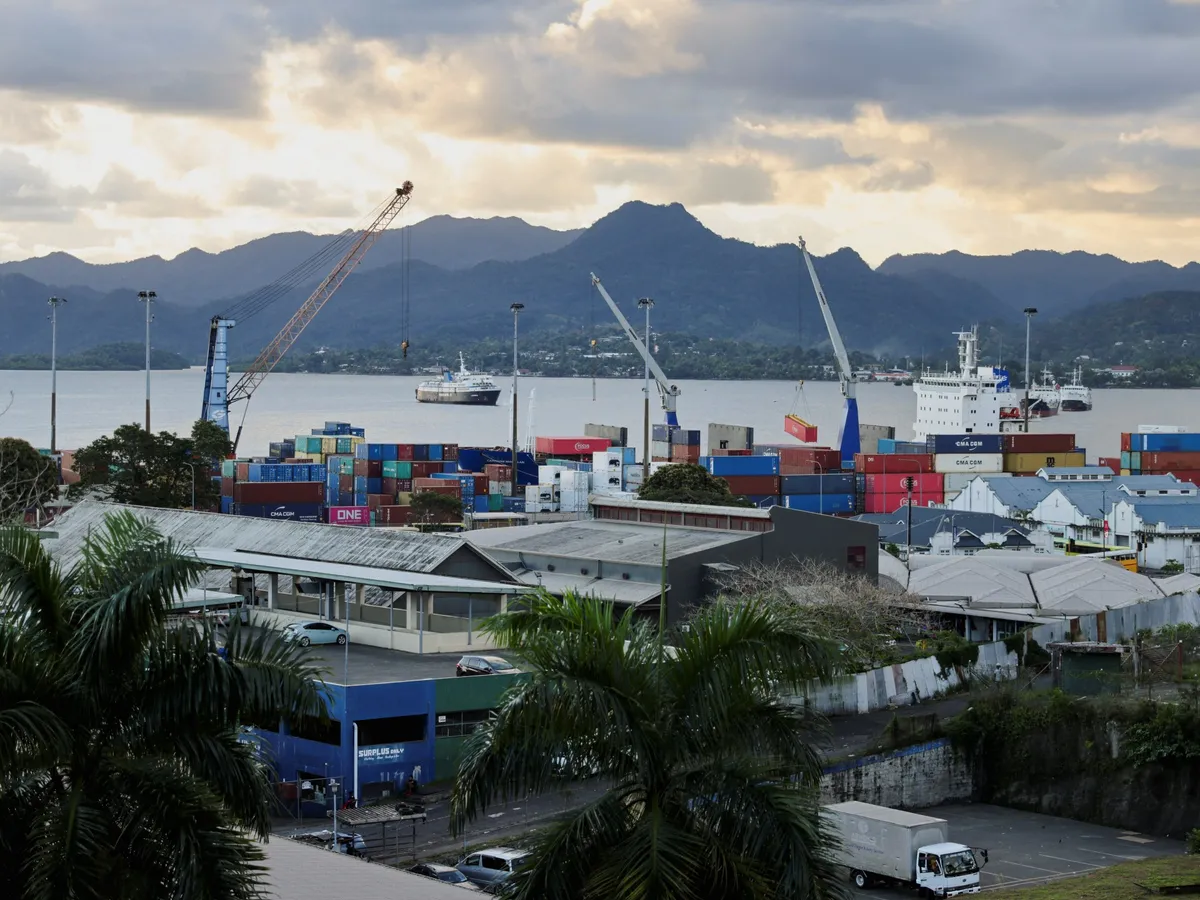
EXPLAINERQuad kicks back to life in Asia Pacific, looking to develop ports in Fiji, in a counter to China’s rise.View of the port in Suva, Fiji, September 5, 2024 [Kirsty Needham/Reuters]Published On 29 May 2026New Delhi, India – The foreign ministers of India, the United States, Australia and Japan have announced plans to jointly develop port infrastructure in Fiji, a strategically important Pacific island nation, following their meeting in New Delhi earlier this week.Their grouping, called the Quadrilateral Security Dialogue alliance – or Quad, for short – has worked over the past two decades as a counter force to China’s economic and political influence in the Asia Pacific region.China, in turn, has said groupings should “not target any third party”, and Beijing opposes “engaging in bloc confrontation”.Australian Foreign Minister Penny Wong hailed the initiative in Fiji as the strongest commitment to deliver high-quality infrastructure that the Quad has made in the Pacific region. She said a pilot for port infrastructure in Fiji reflects the group’s ability to deliver high-quality infrastructure in response to Pacific priorities.As the grouping faces questions about its relevance in today’s world order, and US President Donald Trump has been wooing China, Washington has pivoted away from the region as its top priority in favour of the Western Hemisphere and the Middle East.So, what is the significance of a port development in Fiji? And could this be the next flashpoint in the up-and-down relationship between the US and China?Penny Wong, Australia’s foreign affairs minister, centre, Subrahmanyam Jaishankar, India’s external affairs minister, fourth left, and US Secretary of State Antony Blinken arrive for the Quadrilateral Security Dialogue (Quad) ministerial meeting on July 29, 2024 in Tokyo, Japan [Kiyoshi Ota/Getty Images]What are the plans for port development in Fiji?Fiji’s foreign minister said Suva and Lautoka would be the first ports to be developed on the island under a pilot project by the newly announced “Quad Ports of the Future Partnership”.This marks the first such joint initiative by the Quad.Suva, the capital, is already the largest and busiest port of the country. Lautoka, which was historically established around sugar exports, sits in the northwest of Fiji, in the second-largest city.“It will have to be the two major ones,” Sakiasi Ditoka told the Fijian press, referring to Suva and Lautoka. “And then eventually we’ll probably spread it around – maybe Vanua Levu if you look north, and then maybe Levuka if the project goes that far.”However, there are as yet very few specific details about plans for the ports.The Suva port agency, 41 percent of which is owned by Fiji’s government, has discussed $181m of port upgrades, as well as a potential $1.82bn plan to relocate Suva Port, with the US officials, Fijian media reported this week.Suresh Prasad, the Fiji Ports acting chief executive officer who said he was “rather surprised” by the announcement, told reporters: “If it’s a Quad project, it is going to be a mega project, which is Suva Port most likely.”In 2023, Fiji’s Prime Minister Sitiveni Rabuka discussed the redevelopment of the Suva port with China, but plans for that did not materialise.Rabuka told the Fijian parliament this Monday about an agreement to undertake a study for potential US-backed infrastructure with the US Millennium Challenge Corporation, Washington’s foreign aid agency, adding that any project would be funded by grants, not loans.What does the Quad do in the Asia Pacific?The four Quad countries are the most influential powers in the region outside of Russia and China.The Quad’s area of cooperation has expanded beyond its original security-focused outlook and now stretches to a wide range of Asia Pacific initiatives for maritime security, infrastructure, technology, health and supply chains.The grouping also operates the Indo-Pacific Partnership for Maritime Domain Awareness (IPMDA), which helps Pacific countries monitor illegal fishing, smuggling and other maritime activity with the use of satellite data. It cooperates on facilitating supply chains for lithium, rare-earth minerals and other strategic minerals to reduce dependence on China, alongside cooperation on quantum computing and cybersecurity.Fiji has traditionally been aligned with Australia, and the Quad countries have pledged cooperation on disaster relief, climate resilience and humanitarian assistance to smaller Pacific islands.Quad countries also hold joint military exercises under the annual Malabar Exercise in the region, including anti-submarine warfare, aircraft carrier operations and maritime interoperability.Chinese President Xi Jinping speaks during a meeting with Fiji’s Prime Minister Sitiveni Rabuka at the Great Hall of the People in Beijing, China, August 20, 2024 [Andres Martinez Casres/Reuters]Why is China unhappy about the Quad?“China perceives the Quad as an anti-China coalition, and this new project in Fiji is viewed as the Quad expanding its operations from Indo-Pacific hotspots into the Pacific Island countries,” said Sana Hashmi, a postdoctoral fellow at the Taiwan-Asia Exchange Foundation with a special focus on China.Over the past few years, Beijing has pumped billions of dollars into the region, and its influence has risen in parallel.In response to a question from the media this week about the Quad’s initiative in Fiji, Chinese Foreign Ministry spokesperson Mao Ning warned that any cooperation in the region “should not target any third party”.“China has stated its position on the Quad on multiple occasions. Cooperation between countries should be conducive to regional peace, stability, and prosperity, and not target any third party,” she told reporters. “We oppose forming exclusive groupings or engaging in bloc confrontation.”In a joint statement following their meeting in New Delhi this week, the Quad countries’ foreign ministers also expressed concern about rising tensions in the East China Sea and the South China Sea, reiterating “strong opposition to any destabilising or unilateral actions, including by force or coercion, that threaten peace and stability in the region”.The statement did not name China specifically but is seen as referring to China’s claim over Taiwan and the number of military drills it has been conducting around the island. The next day, Chinese spokesperson Ning told reporters: “The situation in the East China Sea and the South China Sea is generally stable.“Certain countries should stop meddling in maritime affairs in China’s neighbourhood and earnestly respect regional countries’ efforts to safeguard peace and stability,” she replied, apparently in reference to the Quad. “Those who attempt to patch up small groupings, hype up tensions, and stoke confrontation will find no support.”How powerful is China in the region?Beijing has transformed in the past decades since the end of World War II into a continental Asian power, now presenting itself as the central economic and increasingly strategic force across the region.According to the Lowy Institute’s 2025 Asia Power Index, China is the region’s second-ranked comprehensive power after the US, but it dominates in several key areas, especially trade connectivity and economic leverage.China is also the primary regional trading partner for 22 of the 27 countries measured in the index, underscoring the dependency of Asian and Pacific economies on Chinese markets, manufacturing chains and imports.Beijing has recognised eight countries in the region as “comprehensive strategic partners”, the highest classification of diplomatic partnership in China’s foreign relations. Top Chinese officials have frequently visited the region, with Xi attending summits over the past decade.“China’s growing footprint in the [Pacific Island countries] remains a major concern for Australia and other regional actors,” Hashmi told Al Jazeera. “Consequently, the Quad’s willingness to operate more actively in the region is seen by Beijing as a form of strategic encirclement and the emergence of countervailing coalitions that could constrain China’s regional ambitions in the [Pacific Island countries].”Fiji, meanwhile, owes Chinese state banks more than $100m for road building and other infrastructure projects undertaken a decade ago.What else have Western powers done to counter China in the region?The US and Australia have stepped up their strategic engagement across the Pacific Islands in recent years as concerns grow over China’s expanding diplomatic and maritime footprint in the region.The AUKUS agreement between Australia, the US and the United Kingdom was announced in 2021. Under that, Canberra and London are working with Washington to design nuclear-class submarines ready for delivery to Australia in the 2040s.The US and Australia have also pursued a series of Pacific initiatives over the past year, including stronger defence agreements with Papua New Guinea. Australia has stepped up aid, policing support and climate financing for Pacific Island states.In 2022, China signed a landmark agreement with the Solomon Islands to allow Beijing to dispatch police, military, and armed forces to the Pacific nation. That gives Beijing a strong foothold in the waters, less than 2,000km (1,240 miles) from Australia.In the following months, Washington scrambled to reopen embassies and expand diplomatic outreach across the region. The US reopened its embassy in the Solomon Islands in 2023 after a 30-year absence, opened a new embassy in Tonga the same year, and announced plans for additional diplomatic missions in countries, including Vanuatu and Kiribati.The White House, under Joe Biden’s presidency, renewed the strategic Compacts of Free Association with three Pacific countries: the Marshall Islands, Micronesia, and Palau.However, China remains ahead of these collective efforts, Hashmi told Al Jazeera.“For several countries, particularly the US, engagement with the region has been episodic and ad hoc, without sustained attention to core local concerns such as climate change, infrastructure, and economic resilience,” the analyst said.“Countering China’s influence will, therefore, require sustained commitment and continuity. This is where the Quad’s recent announcement becomes important, although its impact will depend on whether these announcements are followed by implementation.”This picture taken on December 21, 2022 shows an aerial view of the shoreline close to a resort on the outskirts of Suva, the capital of Fiji [Andrew Leeson/AFP]Where does Fiji stand in this tango?China’s bilateral relations with Fiji have also come a long way.In 1975, Suva was among the first of the Pacific Island nations to recognise Beijing, rather than Taiwan, and to establish diplomatic relations with the People’s Republic of China.A real breakthrough in relations came after a military coup ousted the Fijian government in 2006 and faced sanctions from traditional allies, like Australia and New Zealand. The result was that Suva moved closer to China. That has continued even after the democratically elected government led by Sitiveni Rabuka was voted to power.“Fiji is considered the most influential country in the region and functions as a gateway and regional hub for the wider region,” said Hashmi, explaining the island nation’s importance for Beijing.“The Pacific Islands occupy vast stretches of oceanic space and sit astride critical sea lanes linking Asia, Australia, and the Americas,” she added. “Influence there provides strategic depth and enables China to gradually expand its maritime presence beyond the first and second island chains. An important function for expanding into a formidable blue water navy.”But this means that Fiji also has a balancing act on its hands.Its traditional alliance with Australia, and with the US and other Western allies by extension, has kept its pace of growth, and Suva is seen as a partner in the Pacific as the Quad scrambles for a stronger foothold.The US market is also the biggest export destination for Fijian goods, accounting for $383m in 2025, followed by Australia, worth $168m.China is the top exporter for Fiji, billing $531m last year, only after Singapore’s $761m worth of exports. Suva’s exports to Beijing are worth only $49.2m, resulting in its biggest trading deficit with any partner.Like Fiji, the Pacific Island nations maintain strong economic engagement with China while simultaneously deepening cooperation with Australia, the US, Japan, and India, said Hashmi.“They have largely adopted a multi-vector foreign policy and hedging strategy, whereby engagement with all major actors is welcomed without formally siding with any one country,” she told Al Jazeera.
SRCAl Jazeera
LANGEN
LEANCenter
WORDS1 925
ENT12
FRI · 2026-05-29 · 13:56 GMTBRIEF NSR-2026-0529-80243
NSR-2026-0529-80243Analysis·EN·Political Strategy
QUAD to build Fiji port: A new US-China flashpoint?
The foreign ministers of India, the United States, Australia, and Japan, known as the Quad, have announced plans to jointly develop port infrastructure in Fiji. This initiative, part of the "Quad Ports of the Future Partnership," aims to counter China's growing influence in the Asia Pacific.
Yashraj SharmaAl JazeeraFiled 2026-05-29 · 13:56 GMTLean · CenterRead · 8 min
Al JazeeraFIG 01
Reading time
8min
Word count
1 925words
Sources cited
4cited
Entities identified
12entities
Quality score
100%
§ 01
Briefing Summary
AI-generatedNEWSAR · AI
The foreign ministers of India, the United States, Australia, and Japan, known as the Quad, have announced plans to jointly develop port infrastructure in Fiji. This initiative, part of the "Quad Ports of the Future Partnership," aims to counter China's growing influence in the Asia Pacific. The pilot project will focus on developing the ports of Suva and Lautoka. While specific details are limited, discussions have included significant port upgrades and potential relocation plans for Suva Port. This move by the Quad, which has expanded its cooperation beyond security to include infrastructure and technology, is seen by China as targeting a third party, a stance Beijing opposes. The development could represent a new point of contention between the US and China.
Confidence 0.90Sources 4Claims 5Entities 12
§ 02
Article analysis
Model · rule-basedFraming
Political Strategy
Conflict
Tone
Mixed Tone
AI-assessed
CalmNeutralAlarmist
Factuality
0.60 / 1.00
Mixed
LowHigh
Sources cited
4
Well sourced
FewMany
§ 03
Key claims
5 extracted01
The pilot project for port infrastructure in Fiji reflects the group’s ability to deliver high-quality infrastructure in response to Pacific priorities.
quotePenny Wong
Confidence
1.00
02
China opposes "engaging in bloc confrontation".
quoteChina
Confidence
1.00
03
The Quad foreign ministers announced plans to jointly develop port infrastructure in Fiji.
factualIndia, United States, Australia, Japan Foreign Ministers
Confidence
1.00
04
Suva and Lautoka would be the first ports to be developed on the island under a pilot project by the "Quad Ports of the Future Partnership".
factualFiji's foreign minister
Confidence
0.90
05
The Quad has worked over the past two decades as a counter force to China’s economic and political influence in the Asia Pacific region.
factualArticle
Confidence
0.90
§ 04
Full report
8 min read · 1 925 words§ 05
Entities
12 identifiedKey playerOppositionContextPositiveNeutralNegative
Organizations2
§ 06
Keywords & salience
8 termsfiji port development
1.00
quad
1.00
us-china relations
0.90
asia pacific
0.80
china's influence
0.70
quadrilateral security dialogue
0.60
infrastructure
0.50
geopolitics
0.40
§ 07
Topic connections
Interactive graph Network visualization showing 14 related topics
View Full Graph Person Organization Location Event|Click node to navigate|Edge numbers = shared articles