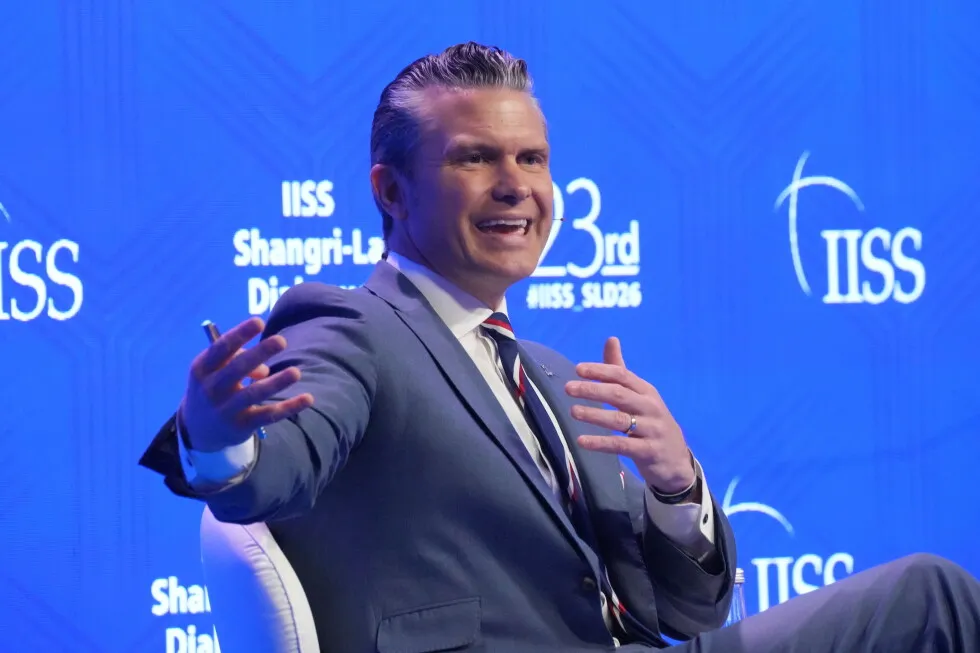
Hegseth tones down warnings about China but says US remains committed to Pacific security 1 of 6 | U.S. Defense Secretary Pete Hegseth on Saturday said President Donald Trump was being patient in negotiations with Iran and would only accept what he described as a “great deal.” 2 of 6 | U.S. Defense Secretary Pete Hegseth gestures as he speaks during the Shangri-La Dialogue, Asia’s annual defense and security forum, in Singapore, Saturday, May 30, 2026. (AP Photo/Achmad Ibrahim) 3 of 6 | Australian Defence Minister Richard Marles delivers his address during the Shangri-La Dialogue, Asia’s annual defense and security forum, in Singapore, Saturday, May 30, 2026. (AP Photo/Achmad Ibrahim) 4 of 6 | U.S. Defense Secretary Pete Hegseth listens to a question during the Shangri-La Dialogue, Asia’s annual defense and security forum, in Singapore, Saturday, May 30, 2026. (AP Photo/Achmad Ibrahim) 5 of 6 | Australian Defence Minister Richard Marles delivers his address during the Shangri-La Dialogue, Asia’s annual defense and security forum, in Singapore, Saturday, May 30, 2026. (AP Photo/Achmad Ibrahim) 6 of 6 | Australian Defence Minister Richard Marles delivers his address during the Shangri-La Dialogue, Asia’s annual defense and security forum, in Singapore, Saturday, May 30, 2026. (AP Photo/Achmad Ibrahim) 1 of 6 U.S. Defense Secretary Pete Hegseth on Saturday said President Donald Trump was being patient in negotiations with Iran and would only accept what he described as a “great deal.” Add AP News on Google Add AP News as your preferred source to see more of our stories on Google. Share 2 of 6 | U.S. Defense Secretary Pete Hegseth gestures as he speaks during the Shangri-La Dialogue, Asia’s annual defense and security forum, in Singapore, Saturday, May 30, 2026. (AP Photo/Achmad Ibrahim) 2 of 6 U.S. Defense Secretary Pete Hegseth gestures as he speaks during the Shangri-La Dialogue, Asia’s annual defense and security forum, in Singapore, Saturday, May 30, 2026. (AP Photo/Achmad Ibrahim) Add AP News on Google Add AP News as your preferred source to see more of our stories on Google. Share 3 of 6 | Australian Defence Minister Richard Marles delivers his address during the Shangri-La Dialogue, Asia’s annual defense and security forum, in Singapore, Saturday, May 30, 2026. (AP Photo/Achmad Ibrahim) 3 of 6 Australian Defence Minister Richard Marles delivers his address during the Shangri-La Dialogue, Asia’s annual defense and security forum, in Singapore, Saturday, May 30, 2026. (AP Photo/Achmad Ibrahim) Add AP News on Google Add AP News as your preferred source to see more of our stories on Google. Share 4 of 6 | U.S. Defense Secretary Pete Hegseth listens to a question during the Shangri-La Dialogue, Asia’s annual defense and security forum, in Singapore, Saturday, May 30, 2026. (AP Photo/Achmad Ibrahim) 4 of 6 U.S. Defense Secretary Pete Hegseth listens to a question during the Shangri-La Dialogue, Asia’s annual defense and security forum, in Singapore, Saturday, May 30, 2026. (AP Photo/Achmad Ibrahim) Add AP News on Google Add AP News as your preferred source to see more of our stories on Google. Share 5 of 6 | Australian Defence Minister Richard Marles delivers his address during the Shangri-La Dialogue, Asia’s annual defense and security forum, in Singapore, Saturday, May 30, 2026. (AP Photo/Achmad Ibrahim) 5 of 6 Australian Defence Minister Richard Marles delivers his address during the Shangri-La Dialogue, Asia’s annual defense and security forum, in Singapore, Saturday, May 30, 2026. (AP Photo/Achmad Ibrahim) Add AP News on Google Add AP News as your preferred source to see more of our stories on Google. Share 6 of 6 | Australian Defence Minister Richard Marles delivers his address during the Shangri-La Dialogue, Asia’s annual defense and security forum, in Singapore, Saturday, May 30, 2026. (AP Photo/Achmad Ibrahim) 6 of 6 Australian Defence Minister Richard Marles delivers his address during the Shangri-La Dialogue, Asia’s annual defense and security forum, in Singapore, Saturday, May 30, 2026. (AP Photo/Achmad Ibrahim) Add AP News on Google Add AP News as your preferred source to see more of our stories on Google. Share Updated [hour]:[minute] [AMPM] [timezone], [monthFull] [day], [year] Singapore (AP) — U.S. Defense Secretary Pete Hegseth assured Pacific allies on Saturday that Washington remained committed to the region, but toned down previous comments calling China a threat.Speaking to a group of world leaders, diplomats and top security officials at the Shangri-La defense conference in Singapore, Hegseth said that the region “has profound implications for U.S. security and prosperity” and that Washington’s priority was to “achieve a lasting and favorable balance of power in the Pacific.”It was his second time addressing the forum, hosted by the International Institute for Strategic Studies. Last year, he raised the ire of Beijing by warning of rapidly developing threats from China, particularly its aggressive stance toward Taiwan. He said China is no longer just building up its military forces to take Taiwan, it’s “actively training for it, every day.”This year, however, the meeting comes only about two weeks after U.S. President Donald Trump visited Chinese leader Xi Jinping in Beijing, following which Trump called Xi a “great leader” and said that they were going to have a “fantastic future together.” Hegseth says China won’t be allowed to dominate the regionHegseth, who was with Trump in Beijing, said the two leaders had agreed that China and the U.S. should “build a constructive relationship of strategic stability, based on fairness and reciprocity, reaffirming that while our nations will vigorously protect our respective interests, we can secure practical, mutually beneficial agreements where our interests align.”However, he said it was still an American priority to ensure that China is not allowed to dominate the Indo-Pacific. “There is rightful alarm regarding China’s historic military buildup and the expansion of its military activities in the region and beyond,” he said. “We share a clear-eyed assessment of that security environment and a mutual understanding that a Pacific dominated by any hegemon would unravel the regional balance of power and undermine the equilibrium we all seek to preserve.” 4 MIN READ 3 MIN READ 3 MIN READ U.S. Sen. Tammy Duckworth, part of a congressional delegation to the conference, accused the Trump administration of “cozying up” to China. “I worry that this administration is being distracted into wars that they’ve started in other parts of the world at the expense of our commitment here in the Indo-Pacific,” the Illinois Democrat told reporters on the sidelines. “I am concerned that it seems like our president is entering into, you know, policies where he’s doing what Beijing wants him to do,” she added.After the meetings between Xi and Trump, the American president raised questions about Washington’s willingness to defend Taiwan, calling a new $14 billion arms package that he has yet to greenlight “a very good negotiating chip for us” with China. China claims the democratic self-governing island as its own, and Xi has not ruled out using force to take it. The U.S. is required by law to help provide Taiwan with the means to defend itself, though follows a policy of “strategic ambiguity” on whether it would intervene militarily if China were to attack the island. Hegseth told the forum that there was “no change in our status” toward Taiwan, but would not comment on the arms deal. “Any decision about future Taiwan arms sales, as the president said, will rest with him,” he said. US praises countries that spent more on defenseHe underscored the Trump administration’s insistence that allies increase defense spending, saying “we need partners, not protectorates.” He lauded several countries in Asia for their efforts, while reiterating criticism of European allies, without naming names, who he suggested got “distracted by empty globalist rhetoric about the rules-based international order.”“Our partners in Asia have long understood that the bedrock of a durable partnership is not based on idealistic values but on the concrete alignment of national interests,” he said. “When our interests diverge, we adjust pragmatically, without the drama or the moralizing,” he added. “I think Western Europe might take note — this is a mindset we fully embrace.” Hegseth did not mention either the war in Ukraine or Iran war in his speech. When asked about Iran, he only said that Trump had assured him that when negotiations with Tehran had concluded, “any deal will be a good deal.”Australian Defense Minister Richard Marles, whose country was among those Hegseth praised for increased military spending, said that while the international rules-based order is not perfect, the “task before us, all of us, including the great powers, is the renovation of that order, not its dismemberment.” “When the rules apply, smaller states have agency,” Marles said in a speech that followed Hegseth’s. “When the rules yield to power, sovereignty becomes, as others have put it, the purview of the powerful, and no state in this room today, whatever its size, is well served by that outcome.” Rising covers regional Asia-Pacific stories for The Associated Press. He has worked around the world, including covering the wars in Iraq, Afghanistan and Ukraine, and was based for nearly 20 years in Berlin before moving to Bangkok.
SRCAssociated Press (AP)
LANGEN
LEANCenter
WORDS1 510
ENT10
SAT · 2026-05-30 · 06:53 GMTBRIEF NSR-2026-0530-80367
NSR-2026-0530-80367News Report·EN·National Security
Hegseth tones down warnings about China but says US remains committed to Pacific security
U.S. Defense Secretary Pete Hegseth, speaking at the Shangri-La Dialogue in Singapore, reaffirmed America's commitment to Pacific security while moderating his previous strong warnings about China.
By
DAVID RISINGAssociated Press (AP)Filed 2026-05-30 · 06:53 GMTLean · CenterRead · 7 min
Associated Press (AP)FIG 01
Reading time
7min
Word count
1 510words
Sources cited
2cited
Entities identified
10entities
Quality score
100%
§ 01
Briefing Summary
AI-generatedNEWSAR · AI
U.S. Defense Secretary Pete Hegseth, speaking at the Shangri-La Dialogue in Singapore, reaffirmed America's commitment to Pacific security while moderating his previous strong warnings about China. Hegseth stated that achieving a favorable balance of power in the Pacific is a U.S. priority, emphasizing the region's importance to American security and prosperity. This shift in tone follows President Trump's recent meeting with Chinese leader Xi Jinping, where they agreed to build a constructive relationship. Despite the softer rhetoric, Hegseth stressed that the U.S. will not allow China to dominate the Indo-Pacific, acknowledging concerns about China's military buildup. He also reiterated the U.S. expectation for allies to increase defense spending, praising Asian partners for their contributions.
Confidence 0.90Sources 2Claims 4Entities 10
§ 02
Article analysis
Model · rule-basedFraming
National Security
Diplomatic
Tone
Measured
AI-assessed
CalmNeutralAlarmist
Factuality
0.70 / 1.00
Factual
LowHigh
Sources cited
2
Limited
FewMany
§ 03
Key claims
4 extracted01
The U.S. remains committed to Pacific security.
quotePete Hegseth
Confidence
1.00
02
President Trump will only accept a "great deal" in negotiations with Iran.
quotePete Hegseth
Confidence
1.00
03
U.S. Defense Secretary Pete Hegseth stated President Trump is patient in negotiations with Iran.
quotePete Hegseth
Confidence
1.00
04
Hegseth toned down warnings about China.
factual
Confidence
0.90
§ 04
Full report
7 min read · 1 510 words§ 05
Entities
10 identifiedKey playerOppositionContextPositiveNeutralNegative
People3
Locations5
§ 06
Keywords & salience
7 termspacific security
1.00
shangri-la dialogue
0.90
china
0.80
us defense secretary
0.70
defense and security
0.60
iran negotiations
0.50
australian defence minister
0.40
§ 07
Topic connections
Interactive graph Network visualization showing 51 related topics
View Full Graph Person Organization Location Event|Click node to navigate|Edge numbers = shared articles