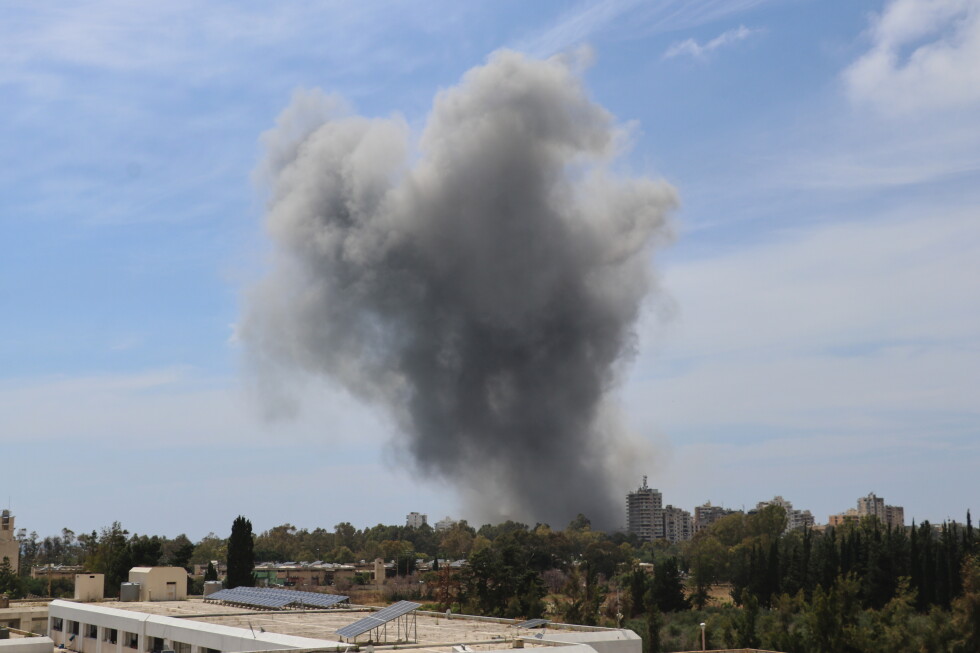
Israeli forces make historic push inside Lebanon and complicate an Iran-deal" class="entity-link entity-topic" data-entity-id="133298" data-entity-type="topic">Iran deal 1 of 4 | Israeli troops have captured a strategic mountain topped with a Crusader-built castle in southern Lebanon in their deepest incursion into the country in more than a quarter century, the military said Sunday. 2 of 4 | Smoke rises following an Israeli airstrike in the southern port city of Tyre, Lebanon, Sunday, May 31, 2026. (AP Photo) 3 of 4 | FILE -Villagers inspect the damage to Beaufort Castle, 10 kilometers (6 miles) northwest of the southern market town of Nabatiyeh, Lebanon, Wednesday, May 24, 2000. (AP Photo/Ahmed Mantash, File) 4 of 4 | Israel’s air defense system fires to intercept Lebanon" class="entity-link entity-event" data-entity-id="137731" data-entity-type="event">projectiles fired from Lebanon as seen from northern Israel, Sunday, May 31, 2026. (AP Photo/Ariel Schalit) 1 of 4 Israeli troops have captured a strategic mountain topped with a Crusader-built castle in southern Lebanon in their deepest incursion into the country in more than a quarter century, the military said Sunday. Add AP News on Google Add AP News as your preferred source to see more of our stories on Google. Share 2 of 4 | Smoke rises following an Israeli airstrike in the southern port city of Tyre, Lebanon, Sunday, May 31, 2026. (AP Photo) 2 of 4 Smoke rises following an Israeli airstrike in the southern port city of Tyre, Lebanon, Sunday, May 31, 2026. (AP Photo) Add AP News on Google Add AP News as your preferred source to see more of our stories on Google. Share 3 of 4 | FILE -Villagers inspect the damage to Beaufort Castle, 10 kilometers (6 miles) northwest of the southern market town of Nabatiyeh, Lebanon, Wednesday, May 24, 2000. (AP Photo/Ahmed Mantash, File) 3 of 4 FILE -Villagers inspect the damage to Beaufort Castle, 10 kilometers (6 miles) northwest of the southern market town of Nabatiyeh, Lebanon, Wednesday, May 24, 2000. (AP Photo/Ahmed Mantash, File) Add AP News on Google Add AP News as your preferred source to see more of our stories on Google. Share 4 of 4 | Israel’s air defense system fires to intercept Lebanon" class="entity-link entity-event" data-entity-id="137731" data-entity-type="event">projectiles fired from Lebanon as seen from northern Israel, Sunday, May 31, 2026. (AP Photo/Ariel Schalit) 4 of 4 Israel’s air defense system fires to intercept Lebanon" class="entity-link entity-event" data-entity-id="137731" data-entity-type="event">projectiles fired from Lebanon as seen from northern Israel, Sunday, May 31, 2026. (AP Photo/Ariel Schalit) Add AP News on Google Add AP News as your preferred source to see more of our stories on Google. Share Updated [hour]:[minute] [AMPM] [timezone], [monthFull] [day], [year] TEL AVIV, Israel (AP) — Israeli forces are making their deepest incursion inside Lebanon since they withdrew from the country over a quarter-century ago, despite a nominal U.S.-brokered ceasefire and the first direct Israel-Lebanon talks in decades. It’s a challenge in the emerging deal to extend the Iran war ceasefire as Tehran wants it to end fighting in Lebanon, too.On Sunday, Israeli forces seized a symbolic fort in southern Lebanon, Beaufort Castle, perched at over 700 meters (3,000 feet) above sea level. It offers commanding views across Lebanon and into northern Israel. The site has been a military asset for close to a millennium.Israel says it is targeting the Iranian-backed Hezbollah militant group, which has a strong political presence in southern Lebanon and has launched thousands of missiles and drones at Israeli soldiers in southern Lebanon and at northern Israel. Israel has warned Lebanese civilians across the south to evacuate or risk being in the line of fire. Lebanese Prime Minister Nawaf Salam on Saturday accused Israel of “implementing a policy of total destruction of cities and towns.” 1 MIN READ 4 MIN READ 5 MIN READ Over 3,300 people including dozens of children have been killed in Lebanon since the fighting began on March 2, two days after the Iran war started. About 1 million people have been displaced. At least 25 Israeli soldiers and a defense contractor have been killed in Lebanon or northern Israel, along with two civilians in northern Israel.Here’s what to know: For nearly 1,000 years, a strategic military assetBeaufort, also called Al-Shaqif, was built as a Crusader castle around the 12th century and also has been used by Saladin’s Jerusalem army, Mamluks, Ottomans, the French mandate, the Palestinian Liberation Organization and the Israeli military until 2000, when it was partially restored and opened to visitors.On Sunday, Israeli Prime Minister Benjamin Netanyahu noted that Beaufort is “a symbol of a heroic battle for our fighters, but was also a symbol of deep division between us.”The military’s return feels like Israel is going in circles, said Orna Mizrahi, a former deputy director in the government’s National Security Council. “There’s a feeling of, ‘For what?’” she said. The word “Beaufort” summons a sense of victory for the Israeli military that captured it in 1982, but also symbolizes the high price to defend the site before it was handed over in 2000, said Mizrahi, now a senior researcher at the Institute for National Security Studies.Israel likely eventually will relinquish control of the fortress, she said, even as Defense Minister Israel Katz vows to make it part of Israel’s permanent security zone in southern Lebanon.The military’s presence there will not solve the issue with Hezbollah, Mizrahi said: “Yes, we are damaging them in the operations, but in parallel we need to pursue a political and diplomatic solution.” Israel sees a threat to its northern communitiesIsrael has long considered Hezbollah a threat. The Shiite Muslim armed group emerged in 1982 in response to an Israeli occupation of southern Lebanon. Hezbollah has targeted communities in northern Israel, and joined the war in Gaza in 2023 in solidarity with the Palestinians.Israel badly weakened Hezbollah during months of war. Fighting ended with a U.S.-brokered ceasefire in late 2024 after indirect talks, and Israeli forces withdrew except from five strategic hilltops along the border.The new Lebanese government came to power with promises to disarm groups like Hezbollah, but the militants resisted. Israel meanwhile claimed that Hezbollah was rearming and rebuilding.On March 2, Hezbollah again fired at Israel, prompting Israel to invade southern Lebanon. Lately, Israel has said it is trying to keep Hezbollah from hurting its forces and civilians with a new kind of fiber-optic drone that has been widely used in the war in Ukraine.Lebanon says Israel has gone too farThe United States brokered a ceasefire that began in mid-April. Unlike the one in the Iran war, it has not held.Hundreds of thousands of people have fled southern Lebanon as Israeli forces carried out airstrikes and ground troops pushed into the country. Many people now shelter in the capital, Beirut, where hundreds have been killed, including in an intense, minutes-long bombardment in April.Israeli forces now control large areas in southern Lebanon and have demolished homes and historical sites. Israel is trying to “uproot Lebanon’s memory and erase the people’s history,” Lebanon’s prime minister, Salam, said Saturday. Hezbollah has refused to accept results of talksHistoric talks between senior officials from Israel and Lebanon began in April in Washington, the first in more than three decades between the countries that have no formal diplomatic relations.On Friday, the first direct military talks occurred in decades.Issues to work out include an Israeli withdrawal from southern Lebanon, deployment of Lebanese forces there and the disarming of Hezbollah, which has refused to give up weapons while Israeli forces remain in the country.The talks will continue this week. Hezbollah is not taking part and has said it would not accept any results. The group prefers that negotiations benefit from Iran’s leverage and sees the Lebanese government as weak, a position shared by some others in the country. Lebanon’s people have been divided over the talks, whose announcement was met with protests. Many Lebanese are angry with Hezbollah for the destruction it has caused in the country, but also wary of Israel.Lebanon’s prime minister on Saturday called the direct negotiations “currently the least costly option,” adding that they don’t mean a surrender and acknowledging they are not guaranteed to produce results.___ Chehayeb reported from Beirut and Anna reported from Lowville, New York. Lidman is an Associated Press reporter based in Tel Aviv, Israel. Chehayeb is an Associated Press reporter in Beirut. Anna is an editor on the AP’s Global Desk. She has reported from Africa, China, Ukraine, Afghanistan and the United Nations.
SRCAssociated Press (AP)
LANGEN
LEANCenter
WORDS1 384
ENT10
SUN · 2026-05-31 · 14:53 GMTBRIEF NSR-2026-0531-80656
NSR-2026-0531-80656News Report·EN·Conflict
Israeli forces make historic push inside Lebanon and complicate an Iran deal
Israeli forces have launched their deepest incursion into Lebanon in over 25 years, capturing the strategically significant Beaufort castle. This move complicates emerging efforts to extend a ceasefire in the Iran war, as Iran desires the fighting in Lebanon to cease as well.
By
MELANIE LIDMAN, KAREEM CHEHAYEB and CARA ANNAAssociated Press (AP)Filed 2026-05-31 · 14:53 GMTLean · CenterRead · 6 min
Associated Press (AP)FIG 01
Reading time
6min
Word count
1 384words
Sources cited
1cited
Entities identified
10entities
Quality score
100%
§ 01
Briefing Summary
AI-generatedNEWSAR · AI
Israeli forces have launched their deepest incursion into Lebanon in over 25 years, capturing the strategically significant Beaufort castle. This move complicates emerging efforts to extend a ceasefire in the Iran war, as Iran desires the fighting in Lebanon to cease as well. Israel states its operations target the Iranian-backed Hezbollah militant group, which has launched numerous missiles and drones into Israel. Lebanon accuses Israel of widespread destruction, with over 3,300 people killed and one million displaced in Lebanon since the conflict began on March 2. Despite a U.S.-brokered ceasefire, fighting persists, and direct Israel-Lebanon military talks are ongoing but have not included Hezbollah, which refuses to disarm.
Confidence 0.90Sources 1Claims 4Entities 10
§ 02
Article analysis
Model · rule-basedFraming
Conflict
Diplomatic
Tone
Measured
AI-assessed
CalmNeutralAlarmist
Factuality
0.80 / 1.00
Factual
LowHigh
Sources cited
1
Limited
FewMany
§ 03
Key claims
4 extracted01
Israeli forces captured Beaufort castle, a strategic mountain in southern Lebanon.
factualIsraeli military
Confidence
1.00
02
Israeli forces have made their deepest incursion into Lebanon in over a quarter-century.
factualIsraeli military
Confidence
1.00
03
The incursion complicates an emerging deal to extend the Iran war ceasefire.
factual
Confidence
0.90
04
The deal involves direct Israel-Lebanon talks.
factual
Confidence
0.80
§ 04
Full report
6 min read · 1 384 words§ 05
Entities
10 identifiedKey playerOppositionContextPositiveNeutralNegative
Organizations1
Locations6
Topics1
§ 06
Keywords & salience
9 termslebanon
1.00
israeli forces
1.00
iran deal
0.90
military incursion
0.80
strategic mountain
0.70
beaufort castle
0.60
air defense system
0.50
airstrike
0.50
projectiles
0.40
§ 07
Topic connections
Interactive graph Network visualization showing 33 related topics
View Full Graph Person Organization Location Event|Click node to navigate|Edge numbers = shared articles