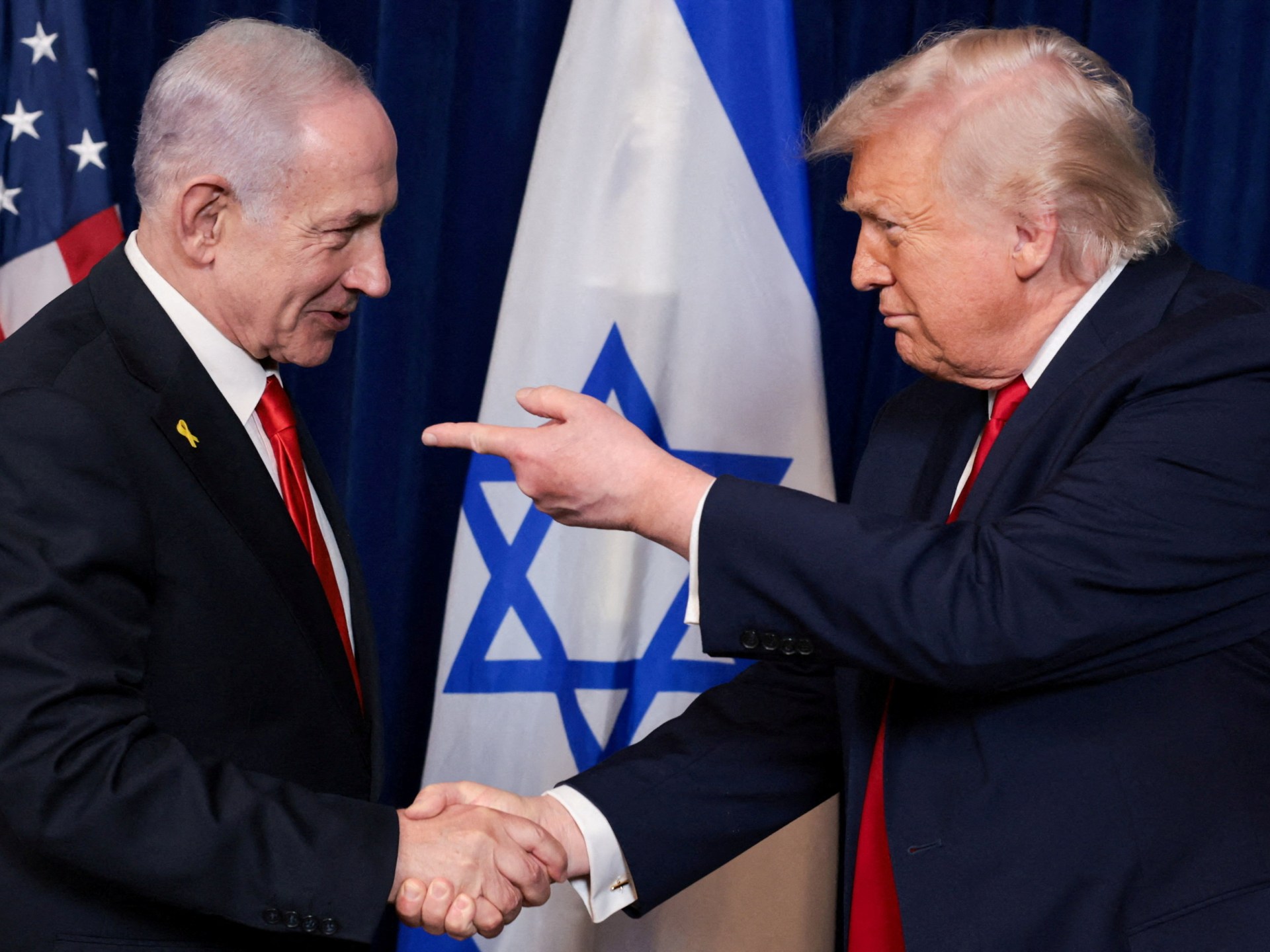
EXPLAINERAnalysts say the plan would weave Israeli military interests more deeply into the fabric of US national security policy.US President Donald Trump and Israeli Prime Minister Benjamin Netanyahu after meeting in Florida, December 29, 2025. [Jonathan Ernst/ Reuters]Published On 31 May 2026Lawmakers in the United States are quietly advancing a proposal that could deepen military ties between the US and Israel in unprecedented ways, at a time when public support for Israel among Americans is increasingly fractured.Among the provisions included in the 2027 National Defence Authorisation Act (NDAA) released this week is Section 224, the “Israel-defence-technology-cooperation-initiative" class="entity-link entity-topic" data-entity-id="137786" data-entity-type="topic">United States-Israel Defence Technology Cooperation Initiative”.Recommended Stories list of 4 itemslist 1 of 4Congress advances US-Israeli military integration planlist 2 of 4Iran war day 93: Trump won’t ‘rush’ deal; Israel expands Lebanon invasionlist 3 of 4South Lebanon faces ‘death, destruction’ as Israel deepens invasionlist 4 of 4Israeli forces cross Lebanon’s Litani River and seize 12th century castleend of listThe NDAA, which Congress passes annually to set military policy and authorise defence spending, will undergo further debate and amendments before becoming law. Some legislators have already signalled opposition, with Representative Thomas Massie saying he would seek to remove the provision if it reaches the House floor.The measure remains at an early stage, but analysts say if passed, it would limit political oversight over the defence relationship.Analysts added that it could mark a significant shift in the US-Israel relationship, moving beyond a model centred on American military aid towards deeper institutional integration between the two countries’ defence industries and militaries.Critics argue that such a move would make support for Israel less a matter of political choice and more a structural feature of US national security policy, embedding the relationship within joint military and industrial programmes that would be difficult to unwind.What does the proposal include?Section 224 incorporates elements of the US-Israel Future of Warfare Act legislation introduced by Representative Ronny Jackson, according to Track AIPAC. While the legislation did not advance as a standalone bill, key elements of it were instead folded into the NDAA.The provision would require the US defence secretary to designate an official responsible for coordinating military cooperation between the two countries. According to the text, that official would be tasked with “synchronising cooperative efforts between the United States and Israel”, including “bilateral defence technology research, development, testing, evaluation, integration and industrial cooperation”.The legislation envisages cooperation across a wide range of military technologies. It specifically identifies as priority areas; “counter-unmanned systems including aerial, maritime and ground platforms”, “anti-tunnelling and subterranean threats”, and “missile and air defence technologies”.The proposal also seeks to deepen collaboration on emerging technologies, including “artificial intelligence, quantum machine learning and autonomous systems”, as well as “directed energy and advanced sensing”, “cyber defence, electronic warfare and digital resilience”, and “biotechnology, biomanufacturing, and medical defence”.The inclusion of “network integration” and “data fusion” has drawn particular attention because it suggests significantly closer integration of military information systems between the two countries.The United States and Israel already cooperate on defence projects, including missile defence systems such as Iron Dome. However, analysts say that Section 224 would expand cooperation into nearly every major area of emerging military technology, and could create a “lock-in” between the two countries military infrastructure.Mark Hilborne, a senior lecturer, the School of Security Studies at King’s College London, told Al Jazeera the proposal goes well beyond the traditional foundations of the US-Israel defence relationship.“While historically, the US-Israel defence relationship has included US military aid and weapons transfers, joint missile defence programmes such as Iron Dome, David’s Sling and Arrow, and intelligence and operational cooperation, the proposed agreement increases cooperation to include a wider set of emerging technologies,” he said.“So this all suggests a much tighter integration – less about provision and perhaps sharing technologies and capabilities, and more about jointly developing these.“It would point to a more institutionalised relationship, and perhaps one that might survive changing administrations in the US, as some of the development cycles could be very long and would become entrenched,” he said.Why is it controversial?The proposal comes amid growing debate in the US over military support for Israel, particularly as Israel’s genocidal war on Gaza continues, and concerns mount over the use of US-made weapons.Human rights organisations and United Nations experts have repeatedly raised concerns about Israeli military actions in Gaza, where despite a so-called ceasefire in place since last October, at least 850 Palestinians have been killed. Israel is also advancing into southern Lebanon, where it has killed more than 3,000 people since the beginning of March.These wars have led to increasing scepticism among Americans towards unconditional support for Israel, recent opinion polls suggest.A New York Times poll in May found that only 30 percent of respondents believed Donald Trump made the right decision in ordering military strikes against Iran, while 64 percent said it was the wrong decision.An Institute for Global Affairs poll released last week found that only 16 percent of Americans support continuing weapons transfers to Israel without additional restrictions. Thirty-eight percent said the US should stop supplying weapons entirely, while 24 percent said military aid should be conditioned on how the weapons are used.Opposition has also emerged from parts of the Republican Party, which traditionally has always been aligned with Israel.Former Representative Marjorie Taylor Greene criticised the proposal on social media, writing: “This is what complete capture to a foreign government looks like, and there hasn’t been a single shot fired.”Massie, who has opposed military aid to Israel, likewise pledged to introduce an amendment removing the provision from the NDAA. The Republican senator was defeated in the primary elections last month, highlighting the financial and political influence of pro-Israel lobby groups in the US.Influential conservative commentator, Tucker Carlson, has increasingly criticised US support for Israel, reflecting divisions within the broader MAGA movement. Criticism has also intensified among left-wing Democrats, with many calling for restrictions on military aid to Israel.What could it mean in practice?Critics of the measures warn that the proposal could create a form of institutional “lock-in” that makes both countries simultaneously reliant on each other for military development and procurement.Some analysts say such integration would move key aspects of the US-Israel relationship away from highly visible aid votes or commercial contracting, and into the less transparent world of defence procurement and industrial partnerships at a state-to-state level.Hilborne from the King’s College said the initiative could also have direct implications for Palestinians. “If joint R&D produces more effective technology, then systems related to surveillance, autonomous vehicles, AI and targeting, and various counter-drone or counter-missile technology would be improved, providing a capability boost to Israeli forces operating in Gaza or the West Bank,” he said.“This enhanced integration would further embed US technology into Israeli forces. These would all be concerns from a Palestinian perspective.”Critics also point to the economic implications, where expanded co-production agreements could lead to new manufacturing facilities and defence jobs in the United States, creating a further reliance on Israel.
SRCAl Jazeera
LANGEN
LEANCenter
WORDS1 150
ENT12
SUN · 2026-05-31 · 18:40 GMTBRIEF NSR-2026-0531-80683
NSR-2026-0531-80683Analysis·EN·National Security
US Congress moves to deepen military ties with Israel: Why it matters
US lawmakers are advancing a proposal within the 2027 National Defence Authorisation Act (NDAA) to significantly deepen military ties with Israel. Section 224, the "United States-Israel Defence Technology Cooperation Initiative," aims to integrate Israeli military interests into US national security policy by fostering joint research, development, and industrial cooperation across a wide range of military technologies, including emerging areas like AI and cyber defence.
Caolán MageeAl JazeeraFiled 2026-05-31 · 18:40 GMTLean · CenterRead · 5 min
Al JazeeraFIG 01
Reading time
5min
Word count
1 150words
Sources cited
2cited
Entities identified
12entities
Quality score
100%
§ 01
Briefing Summary
AI-generatedNEWSAR · AI
US lawmakers are advancing a proposal within the 2027 National Defence Authorisation Act (NDAA) to significantly deepen military ties with Israel. Section 224, the "United States-Israel Defence Technology Cooperation Initiative," aims to integrate Israeli military interests into US national security policy by fostering joint research, development, and industrial cooperation across a wide range of military technologies, including emerging areas like AI and cyber defence. Analysts suggest this move would shift the relationship beyond military aid towards deeper institutional integration of defence industries and militaries, potentially making support for Israel a structural feature of US policy. While the proposal is in its early stages and faces potential opposition, it signifies a move towards a more institutionalized and entrenched defense partnership.
Confidence 0.90Sources 2Claims 5Entities 12
§ 02
Article analysis
Model · rule-basedFraming
National Security
Political Strategy
Tone
Measured
AI-assessed
CalmNeutralAlarmist
Factuality
0.60 / 1.00
Mixed
LowHigh
Sources cited
2
Limited
FewMany
§ 03
Key claims
5 extracted01
Section 224 of the NDAA is named the 'United States-Israel Defence Technology Cooperation Initiative'.
factual
Confidence
0.95
02
The initiative aims to synchronize cooperative efforts in defense technology research, development, and industrial cooperation.
factual
Confidence
0.90
03
A proposal in the 2027 National Defence Authorisation Act (NDAA) could deepen US-Israel military ties.
factual
Confidence
0.90
04
Critics argue the move would embed the US-Israel relationship as a structural feature of US national security policy.
quoteCritics
Confidence
0.85
05
Analysts suggest the plan would limit political oversight over the defense relationship.
quoteAnalysts
Confidence
0.80
§ 04
Full report
5 min read · 1 150 words§ 05
Entities
12 identifiedKey playerOppositionContextPositiveNeutralNegative
People4
Locations4
Events1
§ 06
Keywords & salience
8 termsus-israel military ties
1.00
national defence authorisation act
0.90
defence technology cooperation
0.80
institutional integration
0.70
us national security policy
0.60
military aid
0.50
political oversight
0.40
defence industries
0.40
§ 07
Topic connections
Interactive graph Network visualization showing 51 related topics
View Full Graph Person Organization Location Event|Click node to navigate|Edge numbers = shared articles