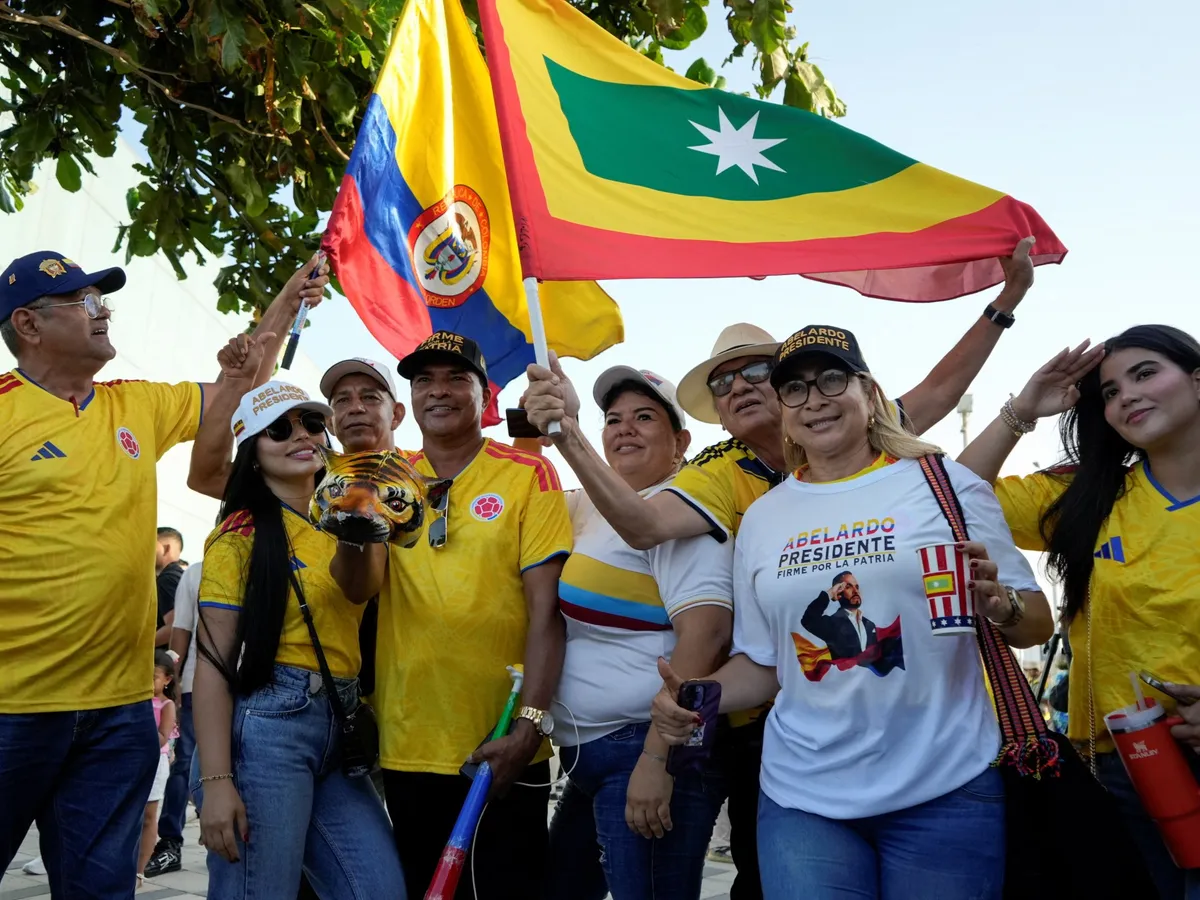
The left-wing senator and far-right newcomer will face each other in a runoff on June 21, with security a top issue.Supporters of Colombian presidential candidate Abelardo de la Espriella celebrate the first-round results in Barranquilla, Colombia, on May 31 [Charlie Cordero/Reuters]Published On 31 May 2026Far-right outsider Abelardo de la Espriella will face left-wing Senator Ivan Cepeda in the runoff for Colombia’s presidential election next month.As polls closed on Sunday, the two candidates surged ahead in the vote tally, quickly extinguishing the hopes of right-wing Senator Paloma Valencia, a former frontrunner.Recommended Stories list of 3 itemslist 1 of 3Colombia’s ‘Total Peace’ plan: A failure or unfinished business for Petro?list 2 of 3‘Opposite visions’: What to know about Colombia’s presidential electionlist 3 of 3Colombians head to the polls to choose President Gustavo Petro’s successorend of listAs of Sunday afternoon, with 99 percent of the votes tallied, de la Espriella took the lead, with 43 percent of the ballots cast in his favour.Cepeda trailed him by more than 600,000 votes, earning 40 percent of the ballots.Neither candidate breached the 50-percent threshold needed to avoid a head-to-head match-up on June 21. But the results are likely to buoy de la Espriella’s campaign going into the final round.Cepeda had consistently topped public opinion polls in the final weeks before voting. A May 24 poll from the National Consulting Centre (CNC), for instance, showed him with more than 33 percent support, ahead of de la Espriella’s 30.9 percent.Ivan Cepeda, left, will face Abelardo de la Espriella in the June 21 runoff election [AFP]De la Espriella’s ‘outsider’ campaignBut questions about security were at the forefront of voters’ concerns going into Sunday’s election.De la Espriella, a businessman and lawyer who has never held elected office, leaned heavily into fears of crime as he launched an outsider campaign, similar in the style to the dark-horse bid of Argentinian President Javier Milei.By contrast, Cepeda is a well-known quantity in Colombian politics. His father was a senator too, as well as a leader in Colombia’s Communist Party, before he was assassinated in 1994, in what was widely considered to be an act of political violence.Cepeda himself has served as a senator since 2014. Before that, he served in the Chamber of Deputies, representing the capital Bogota.During his political career, he became embroiled in a long-running legal dispute with former right-wing President Alvaro Uribe, whom he accused of complicity with right-wing paramilitaries.Uribe initially sued Cepeda for defamation, but in a dramatic twist, Colombia’s Supreme Court dismissed the charge and instead investigated Uribe for witness tampering.While Uribe was found guilty and sentenced to 12 years of house arrest, an appeals court ultimately struck down the verdict, citing procedural errors, including insufficient evidence.Electoral workers greet voters at a polling station in Bogota, Colombia, on May 31 [Mauricio Duenas Castaneda/EPA]security a top concernCentral to the rift in Colombia’s politics is the country’s six-decade-long internal conflict.Since 1964, criminal networks, government forces, left-wing rebels and right-wing paramilitaries have all jockeyed against one another for power and territory.Cepeda has been critical of right-wing efforts to solve the conflict through military might alone. Instead, he has allied himself with Colombia’s outgoing president, Gustavo Petro, the first left-wing figure ever elected to the country’s highest office.A former rebel fighter, Petro has championed a platform he calls “Total Peace”, which actively seeks negotiated solutions to the fighting, in addition to military tactics.While critics have questioned the efficacy of “Total Peace”, pointing to a recent uptick in violence, Cepeda has nevertheless pledged to carry it forward. He represents Petro’s left-wing Historic Pact party in this year’s election.In an interview this month with CNN, Cepeda acknowledged “immense challenges” with the policy, saying, “We cannot continue to develop conversations that do not yield clear results.”But he rejected overly militaristic solutions, as well as the prospect of intervention by the United States. The US-led “war on drugs”, he said, has “failed spectacularly”.De la Espriella, meanwhile, has embraced the kind of hardline security platform commonly associated with El Salvador’s leader Nayib Bukele.His platform includes a pledge to undertake a crackdown on crime and build 10 mega-prisons. Nicknamed “The Tiger”, he founded the Defenders of the Homeland political party, known for its slogan, “Stand firm for the nation.”“The only peace process I believe in is one imposed by the force of arms and the laws of the republic,” de la Espriella told The Associated Press.Like United States President Donald Trump, de la Espriella has also threatened to launch a bombing campaign to disrupt drug-trafficking, killing suspects by downing planes and shooting boats.But such campaigns have been widely denounced as a form of extrajudicial killing, effectively denying suspects the chance of defending themselves in a court of law.More than 23.6 million Colombians voted in Sunday’s election, though there was a high number of blank or nullified ballots.Early estimates, with 99 percent of ballots tallied, indicate that 245,342 voting sheets were null, and another 406,830 were left blank.The second round is likely to be an uphill battle for Cepeda. Colombia’s right-wing is expected to consolidate behind de la Espriella in the second round.In Sunday’s vote count, more than 10.3 million ballots were cast for de la Espriella, compared to roughly 9.7 million for Cepeda.A victory for the right would continue a regional trend in Latin America. Last year alone, left-wing governments in Chile, Honduras and Bolivia were all replaced by right-wing presidential contenders.De la Espriella signalled optimism about the second round in a social media post as the results rolled in.“We are going to defeat tyranny and absolutism,” de la Espriella wrote. “We have advanced to the runoff thanks to the more than 10 million Colombians who answered the roar. In 21 days, we will make history!”
SRCAl Jazeera
LANGEN
LEANCenter
WORDS948
ENT12
SUN · 2026-05-31 · 23:02 GMTBRIEF NSR-2026-0601-80711
NSR-2026-0601-80711News Report·EN·Political Strategy
Cepeda, de la Espriella advance in Colombia’s presidential election
Far-right newcomer Abelardo de la Espriella and left-wing Senator Ivan Cepeda will face each other in a runoff election for Colombia's presidency on June 21. Both candidates secured enough votes in the first round to advance, but neither reached the 50% threshold needed for an outright victory.
Al Jazeera StaffAl JazeeraFiled 2026-05-31 · 23:02 GMTLean · CenterRead · 4 min
Al JazeeraFIG 01
Reading time
4min
Word count
948words
Sources cited
3cited
Entities identified
12entities
Quality score
100%
§ 01
Briefing Summary
AI-generatedNEWSAR · AI
Far-right newcomer Abelardo de la Espriella and left-wing Senator Ivan Cepeda will face each other in a runoff election for Colombia's presidency on June 21. Both candidates secured enough votes in the first round to advance, but neither reached the 50% threshold needed for an outright victory. Security was a primary concern for voters, with de la Espriella campaigning on a hardline approach including building mega-prisons, while Cepeda, aligned with President Gustavo Petro's "Total Peace" initiative, advocates for negotiated solutions to the country's internal conflict. De la Espriella, a businessman and lawyer, ran as an outsider, drawing parallels to Argentinian President Javier Milei, while Cepeda is a seasoned politician with a history in the Senate.
Confidence 0.90Sources 3Claims 5Entities 12
§ 02
Article analysis
Model · rule-basedFraming
Political Strategy
Conflict
Tone
Measured
AI-assessed
CalmNeutralAlarmist
Factuality
0.80 / 1.00
Factual
LowHigh
Sources cited
3
Well sourced
FewMany
§ 03
Key claims
5 extracted01
Ivan Cepeda has been a senator since 2014 and previously served in the Chamber of Deputies.
factual
Confidence
1.00
02
De la Espriella, a businessman and lawyer, ran an 'outsider' campaign focusing on fears of crime.
factual
Confidence
1.00
03
Neither candidate reached the 50 percent threshold needed to win in the first round.
factual
Confidence
1.00
04
As of Sunday afternoon, with 99 percent of votes tallied, de la Espriella led with 43 percent, and Cepeda had 40 percent.
statistic
Confidence
1.00
05
Left-wing senator Ivan Cepeda and far-right newcomer Abelardo de la Espriella will face each other in a runoff election on June 21.
factual
Confidence
1.00
§ 04
Full report
4 min read · 948 words§ 05
Entities
12 identifiedKey playerOppositionContextPositiveNeutralNegative
People5
Organizations2
Topics1
§ 06
Keywords & salience
10 termscolombia
1.00
presidential election
1.00
runoff election
0.90
ivan cepeda
0.80
abelardo de la espriella
0.80
security
0.70
far-right
0.60
left-wing
0.60
political violence
0.50
outsider campaign
0.40
§ 07
Topic connections
Interactive graph Network visualization showing 51 related topics
View Full Graph Person Organization Location Event|Click node to navigate|Edge numbers = shared articles