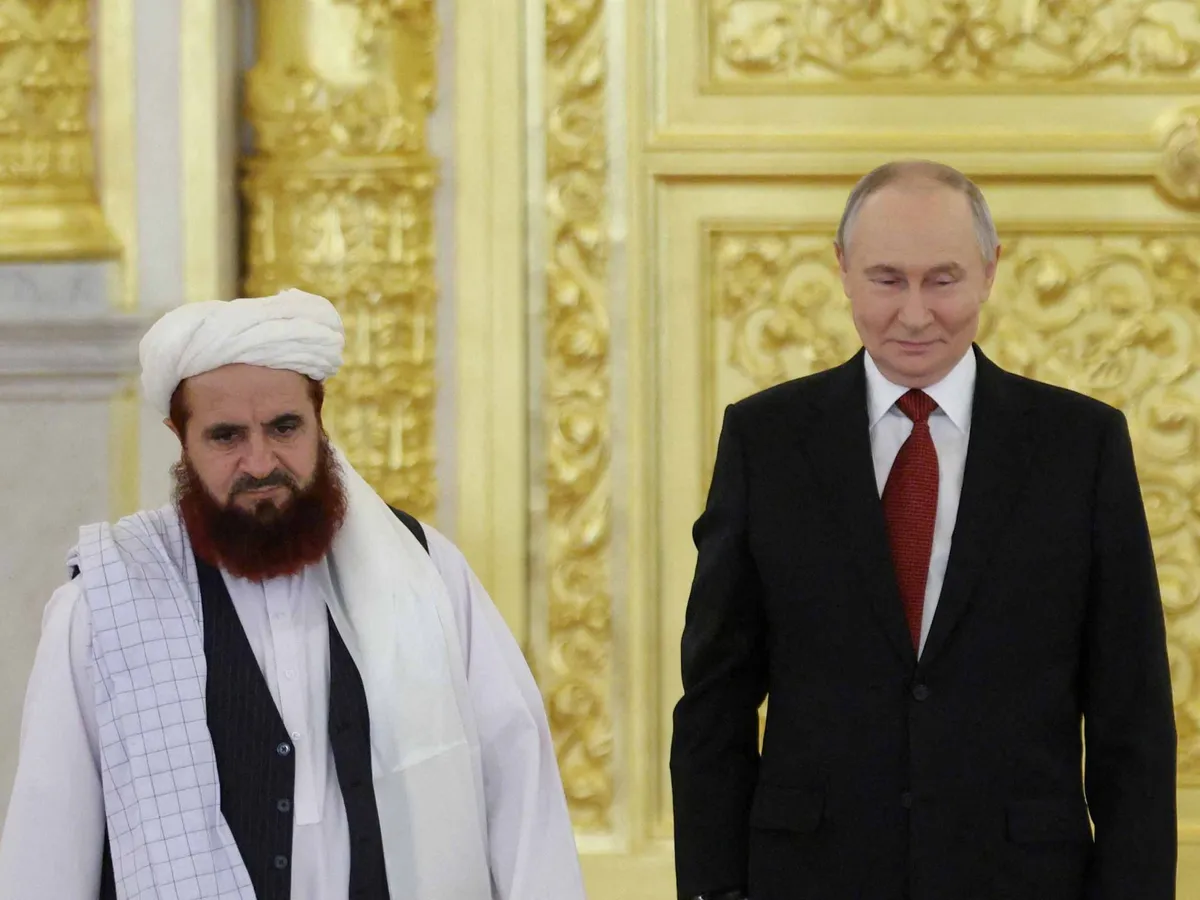
The recently signed agreement is unlikely to advance the country’s long-term national interests.Published On 2 Jun 2026Ambassador of the Afghanistan" class="entity-link entity-organization" data-entity-id="139030" data-entity-type="organization">Islamic Emirate of Afghanistan to Russia Gul Hassan Hassan attends a ceremony to present his letter of credence to Russia's President Vladimir Putin in Moscow on January 15, 2026 [Ramil Sitdikov/Reuters]The Memorandum of Understanding (MoU) on security cooperation signed by the Taliban and Russia on May 27 has generated considerable discussion, despite the fact that its contents remain undisclosed. It raises important questions about its implications for Afghanistan’s future security, foreign policy, and international standing.From a legal perspective, agreements concluded by a government that lacks broad domestic legitimacy and formal international recognition face inherent limitations in terms of legal and political acceptance. More importantly, at the strategic level, this arrangement may not necessarily advance Afghanistan’s long-term national interests. Instead, it risks drawing the country further into regional and global power rivalries.The MoU’s pitfallsEvery country has the sovereign right to establish relations and cooperate with other states. However, Afghanistan’s current geopolitical circumstances require particular caution. Major powers rarely enter strategic partnerships primarily to advance Afghan interests; rather, they do so to pursue their own national priorities.Russia, at present, neither appears willing nor able to provide Afghanistan with the level of economic, military, or political support that would normally characterise a strategic partnership. This raises a fundamental question: if Russia is being presented as a strategic partner, what strategic opportunity or threat is driving such a relationship?The growing engagement between Russia and the Taliban appears to be driven by immediate security and political considerations rather than by a deep strategic partnership.For Russia—and to a significant extent China—the primary concerns in Afghanistan are preventing extremist groups from using Afghan territory to threaten their interests and reducing the flow of narcotics across the region. Beyond that, neither country currently has major economic investments in Afghanistan that would justify a long-term strategic commitment.Historical experience is also instructive. Following the withdrawal of Soviet forces from Afghanistan and the collapse of the Soviet Union, Russia did not provide substantial military or economic support to successive Afghan governments. There is little evidence to suggest that Moscow is now prepared to offer the level of assistance that would significantly transform Afghanistan’s economic or security situation.The Taliban, for its part, is attempting to strengthen Afghanistan’s position amid growing tensions with Pakistan. Recent cross-border military incidents and reported strikes inside Afghanistan have heightened concerns about sovereignty, security, and regional stability.At the same time, Afghanistan’s military capabilities have deteriorated considerably. Much of the military equipment inherited from the former Afghan government consisted of a mix of US- and Russian-made systems. The United States is unlikely to provide maintenance support or spare parts, so US-made equipment may not be salvageable.At the same time, much of the remaining Soviet-era or Russian-made equipment is either obsolete or no longer operational.Under these circumstances, expectations that a security MoU with Russia would translate into substantial military assistance may prove unrealistic. In practical terms, the agreement may produce limited tangible benefits while increasing the risk of Afghanistan becoming further entangled in regional geopolitical competition.Afghanistan cannot realistically maintain equivalent strategic relationships with countries whose interests directly conflict with one another. It is difficult to envision Afghanistan simultaneously pursuing the same strategic understanding with India and Pakistan, Russia and Ukraine, or the US, China, and Iran.As a relatively weak and vulnerable state operating within a highly competitive geopolitical environment, Afghanistan risks becoming a casualty of great power competition rather than a beneficiary of international cooperation.The need for domestic legitimacyThe Taliban may view agreements, such as the MoU with Russia, as a means of strengthening its international standing, but such efforts are unlikely to resolve the underlying challenge of legitimacy.International legitimacy begins with domestic legitimacy. Governments that lack broad public acceptance, political inclusion, and representative institutions face significant obstacles in obtaining meaningful international recognition. Even when recognition is granted, its value is limited if it is not rooted in domestic consent and political legitimacy.The reality is that most countries are unlikely to formally recognise the Taliban government unless there is a significant shift in the position of the US and other major Western powers. While Russia and China have expanded their engagement with the Taliban, neither has succeeded in securing the removal of Taliban leaders from United Nations sanctions lists. As long as key Taliban figures remain under UN sanctions, full international recognition will remain difficult to achieve.For Afghanistan today, the priority should not be strategic alignment with competing global powers. The more urgent challenge is addressing domestic political shortcomings and building genuine legitimacy at home.The guiding principle of any Afghan government should be straightforward: Afghanistan should not pose a threat to other countries, and regional and global powers should refrain from turning Afghanistan into a theatre of geopolitical competition. Rather than serving as a battleground for competing interests, Afghanistan should aspire to become a platform for regional connectivity, trade, and cooperation.Achieving that vision requires a legitimate, representative, and law-based political system. Without transparent governance, political inclusion, and public accountability, foreign powers are likely to engage Afghanistan primarily through short-term geopolitical calculations and security-driven relationships rather than through genuine long-term partnerships. History suggests that such arrangements rarely serve Afghanistan’s enduring national interests.Ultimately, Afghanistan’s future stability and international standing will depend less on security memoranda with major powers and more on the creation of a political order that enjoys the confidence and support of its own people. Only then can Afghanistan move from being an arena of competition to becoming a bridge for regional cooperation, economic development, and lasting stability.The views expressed in this article are the author’s own and do not necessarily reflect Al Jazeera’s editorial stance.
SRCAl Jazeera
LANGEN
LEANCenter
WORDS945
ENT9
TUE · 2026-06-02 · 14:57 GMTBRIEF NSR-2026-0602-81176
NSR-2026-0602-81176Analysis·EN·Political Strategy
Is the Taliban-Russia MoU good for Afghanistan?
Afghanistan's Taliban government and Russia signed a Memorandum of Understanding (MoU) on security cooperation on May 27. The article argues this agreement is unlikely to advance Afghanistan's long-term national interests and risks drawing the country into regional power rivalries.
Shahmahmood MiakhelAl JazeeraFiled 2026-06-02 · 14:57 GMTLean · CenterRead · 4 min
Al JazeeraFIG 01
Reading time
4min
Word count
945words
Sources cited
0cited
Entities identified
9entities
Quality score
100%
§ 01
Briefing Summary
AI-generatedNEWSAR · AI
Afghanistan's Taliban government and Russia signed a Memorandum of Understanding (MoU) on security cooperation on May 27. The article argues this agreement is unlikely to advance Afghanistan's long-term national interests and risks drawing the country into regional power rivalries. Russia's current engagement appears driven by immediate security and political considerations, such as preventing extremism and drug trafficking, rather than a deep strategic partnership or significant economic investment. The MoU's tangible benefits are expected to be limited, while increasing Afghanistan's entanglement in geopolitical competition. The article suggests that international legitimacy for the Taliban hinges on domestic acceptance and representative institutions, which are currently lacking.
Confidence 0.90Claims 5Entities 9
§ 02
Article analysis
Model · rule-basedFraming
Political Strategy
Diplomatic
Tone
Measured
AI-assessed
CalmNeutralAlarmist
Factuality
0.40 / 1.00
Mixed
LowHigh
Sources cited
0
No named sources
FewMany
§ 03
Key claims
5 extracted01
Major powers engage in strategic partnerships primarily to pursue their own national priorities, not Afghan interests.
factual
Confidence
0.90
02
Agreements by governments lacking broad domestic legitimacy and international recognition face limitations in acceptance.
factual
Confidence
0.90
03
Russia and China's primary concerns in Afghanistan are preventing extremist threats and reducing narcotics flow.
factual
Confidence
0.85
04
Russia is unlikely to provide Afghanistan with significant economic, military, or political support characteristic of a strategic partnership.
prediction
Confidence
0.80
05
The Taliban-Russia MoU on security cooperation is unlikely to advance Afghanistan's long-term national interests.
prediction
Confidence
0.80
§ 04
Full report
4 min read · 945 words§ 05
Entities
9 identifiedKey playerOppositionContextPositiveNeutralNegative
Locations4
§ 06
Keywords & salience
8 termstaliban-russia mou
1.00
afghanistan national interests
0.90
security cooperation
0.80
international recognition
0.70
geopolitical circumstances
0.60
regional power rivalries
0.50
extremist groups
0.40
narcotics flow
0.40
§ 07
Topic connections
Interactive graph Network visualization showing 51 related topics
View Full Graph Person Organization Location Event|Click node to navigate|Edge numbers = shared articles