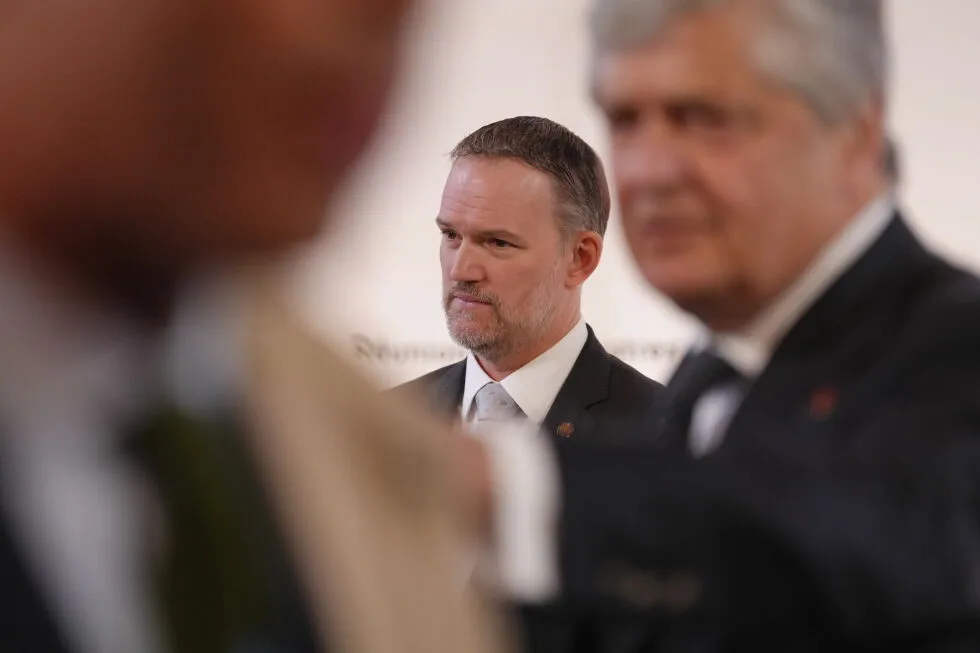
US says it plans extra tariffs of 10% or more for most trading partners after forced labor probe 1 of 4 | U.S. Trade Representative Jamieson Greer arrives for the G7 trade meeting in Paris, Wednesday, May 6, 2026. (AP Photo/Aurelien Morissard, Pool) 2 of 4 | President Donald Trump and European Commission President Ursula von der Leyen shake hands after reaching a trade deal at the Trump Turnberry golf course in Turnberry, Scotland, on July 27, 2025. (AP Photo/Jacquelyn Martin, File) 3 of 4 | Goods imported from Brazil are displayed at Amazonia Brasil, a Brazilian goods store, in Newark, N.J., Aug. 7, 2025. (AP Photo/Seth Wenig, File) 4 of 4 | President Donald Trump, left, and Chinese President Xi Jinping, shake hands after their U.S.-China summit talk at Gimhae International Airport Jinping in Busan, South Korea, Oct. 30, 2025. (AP Photo/Mark Schiefelbein, File) 1 of 4 | U.S. Trade Representative Jamieson Greer arrives for the G7 trade meeting in Paris, Wednesday, May 6, 2026. (AP Photo/Aurelien Morissard, Pool) 1 of 4 U.S. Trade Representative Jamieson Greer arrives for the G7 trade meeting in Paris, Wednesday, May 6, 2026. (AP Photo/Aurelien Morissard, Pool) Add AP News on Google Add AP News as your preferred source to see more of our stories on Google. Share 2 of 4 | President Donald Trump and European Commission President Ursula von der Leyen shake hands after reaching a trade deal at the Trump Turnberry golf course in Turnberry, Scotland, on July 27, 2025. (AP Photo/Jacquelyn Martin, File) 2 of 4 President Donald Trump and European Commission President Ursula von der Leyen shake hands after reaching a trade deal at the Trump Turnberry golf course in Turnberry, Scotland, on July 27, 2025. (AP Photo/Jacquelyn Martin, File) Add AP News on Google Add AP News as your preferred source to see more of our stories on Google. Share 3 of 4 | Goods imported from Brazil are displayed at Amazonia Brasil, a Brazilian goods store, in Newark, N.J., Aug. 7, 2025. (AP Photo/Seth Wenig, File) 3 of 4 Goods imported from Brazil are displayed at Amazonia Brasil, a Brazilian goods store, in Newark, N.J., Aug. 7, 2025. (AP Photo/Seth Wenig, File) Add AP News on Google Add AP News as your preferred source to see more of our stories on Google. Share 4 of 4 | President Donald Trump, left, and Chinese President Xi Jinping, shake hands after their U.S.-China summit talk at Gimhae International Airport Jinping in Busan, South Korea, Oct. 30, 2025. (AP Photo/Mark Schiefelbein, File) 4 of 4 President Donald Trump, left, and Chinese President Xi Jinping, shake hands after their U.S.-China summit talk at Gimhae International Airport Jinping in Busan, South Korea, Oct. 30, 2025. (AP Photo/Mark Schiefelbein, File) Add AP News on Google Add AP News as your preferred source to see more of our stories on Google. Share Updated [hour]:[minute] [AMPM] [timezone], [monthFull] [day], [year] WASHINGTON (AP) — The Trump administration is proposing that tariffs of 10% or more be imposed on products from dozens of major trading partners following a probe into imports of goods allegedly made with forced labor. The report released early Wednesday by the U.S. Trade Representative said Canada, Mexico, Taiwan and the United Kingdom and some other countries and territories would face 10% additional tariffs for allegedly failing to enforce a forced labor import ban. A 12.5% additional tariff would be imposed on China, Japan, India, South Korea, Brazil and Switzerland and dozens of other countries. “The failure of our most important trading partners to address the importation of goods made with forced labor is unacceptable. This creates a dynamic where American workers are forced to compete globally on an unlevel playing field,” USTR Ambassador Jamieson Greer said in a statement. He added that “each of our trading partners must do more to ensure that trade does not perversely encourage and entrench forced labor globally.” The USTR said failure to prevent such imports is “unreasonable and burdens or restricts U.S. commerce.” 3 MIN READ 1 MIN READ 4 MIN READ This latest barrage of tariffs is likely to unsettle key trading partners that have been hit by waves of tariffs since President Donald Trump returned to office early last year. Just two weeks ago, the European Union approved a tariff deal with the United States to cap tariffs on most EU exports at 15% following intense debates among the EU’s 27 nations and threats by European lawmakers to block the agreement. Trump recently returned from a visit to China, where he and its leader Xi Jinping discussed expanding market access for American businesses in China and increasing Chinese investment into U.S. industries. The two leaders agreed to set up separate boards of trade and investment — though few details were provided. The new tariffs would not take effect immediately. They are subject to public comment and review. Public hearings on the proposed duties are due to begin on July 7.The investigation into alleged failure to prevent imports of goods allegedly made by forced labor was conducted under Section 301 of the Trade Act of 1974. The strategy would enable Trump to skirt limits on his tariffs imposed by the Supreme Court. It found that 60 countries investigated had failed to enforce a prohibition on the importation of goods produced with forced labor.The report defined forced labor as “work or service exacted from a person under the menace of any penalty for its nonperformance and for which the worker does not offer himself voluntarily.” It cited an estimate by the UN’s International Labor Organization that as of 2021, 27.6 million people were engaged in forced labor.Rice imported from Myanmar, tobacco from Malawi, beef from Brazil, and cotton and polysilicon from China were among the many products it said are prone to involving forced labor. The U.S. has long said imports of goods that include material from China’s far-western Xinjiang are at risk of using forced labor. Beijing denies allegations of forced labor in the Muslim majority region. The Supreme Court ruled in February that Trump had overstepped his authority by using a different law – the International Emergency Economic Powers Act (IEEPA) of 1977 – to impose sweeping tariffs on U.S. trading partners.The Trump administration has said it would appeal a federal judge’s order making all companies that paid the duties on those earlier tariffs eligible for refunds.Earlier this week, the administration separately proposed 25% tariffs on imports from Brazil, charging that the world’s 10th-biggest economy engages in trade practices that are “unreasonable’’ and that “burden or restrict U.S. commerce.’’The USTR said its investigation showed Brazil had lax anti-corruption enforcement and unfair tariffs of its own, among other things.In its nearly 100-page report on forced labor, the USTR said that even if a country enforces a ban on forced labor domestically, importing goods made with forced labor violates the rules of fair trade. It said some key items would be exempt from the additional tariffs or subject to lower tariffs, including certain textiles, tomatoes, bananas, coffee and some metals. ___AP Business Writer Elaine Kurtenbach contributed to this report.
SRCAssociated Press (AP)
LANGEN
LEANCenter
WORDS1 183
ENT12
WED · 2026-06-03 · 05:23 GMTBRIEF NSR-2026-0603-81319
NSR-2026-0603-81319News Report·EN·Economic Impact
US says it plans extra tariffs of 10% or more for most trading partners after forced labor probe
The Trump administration is proposing additional tariffs of 10% or more on goods from dozens of major trading partners. This action follows a probe into imports allegedly made with forced labor, with the U.S.
By
THE ASSOCIATED PRESSAssociated Press (AP)Filed 2026-06-03 · 05:23 GMTLean · CenterRead · 5 min
Associated Press (AP)FIG 01
Reading time
5min
Word count
1 183words
Sources cited
0cited
Entities identified
12entities
Quality score
100%
§ 01
Briefing Summary
AI-generatedNEWSAR · AI
The Trump administration is proposing additional tariffs of 10% or more on goods from dozens of major trading partners. This action follows a probe into imports allegedly made with forced labor, with the U.S. Trade Representative stating that partners have failed to enforce import bans on such goods. Canada, Mexico, Taiwan, and the United Kingdom are among those facing a 10% tariff, while China, Japan, India, South Korea, Brazil, and Switzerland, along with others, will face a 12.5% tariff. USTR Ambassador Jamieson Greer stated that this is to ensure American workers are not at a disadvantage and that trade does not encourage forced labor. These proposed tariffs are subject to public comment and review and are not immediately effective.
Confidence 0.90Claims 3Entities 12
§ 02
Article analysis
Model · rule-basedFraming
Economic Impact
Human Rights
Tone
Measured
AI-assessed
CalmNeutralAlarmist
Factuality
0.80 / 1.00
Factual
LowHigh
Sources cited
0
No named sources
FewMany
§ 03
Key claims
3 extracted01
The article includes file photos from trade meetings and goods imports from Brazil.
factual
Confidence
1.00
02
The proposed tariffs are a result of a forced labor probe.
factualTrump administration
Confidence
0.90
03
The Trump administration is proposing tariffs of 10% or more for most trading partners.
factualTrump administration
Confidence
0.90
§ 04
Full report
5 min read · 1 183 words§ 05
Entities
12 identifiedKey playerOppositionContextPositiveNeutralNegative
People4
§ 06
Keywords & salience
9 termsextra tariffs
1.00
forced labor probe
1.00
trading partners
0.90
trade deal
0.70
us trade representative
0.60
g7 trade meeting
0.50
president donald trump
0.40
european commission president
0.40
chinese president
0.40
§ 07
Topic connections
Interactive graph Network visualization showing 51 related topics
View Full Graph Person Organization Location Event|Click node to navigate|Edge numbers = shared articles