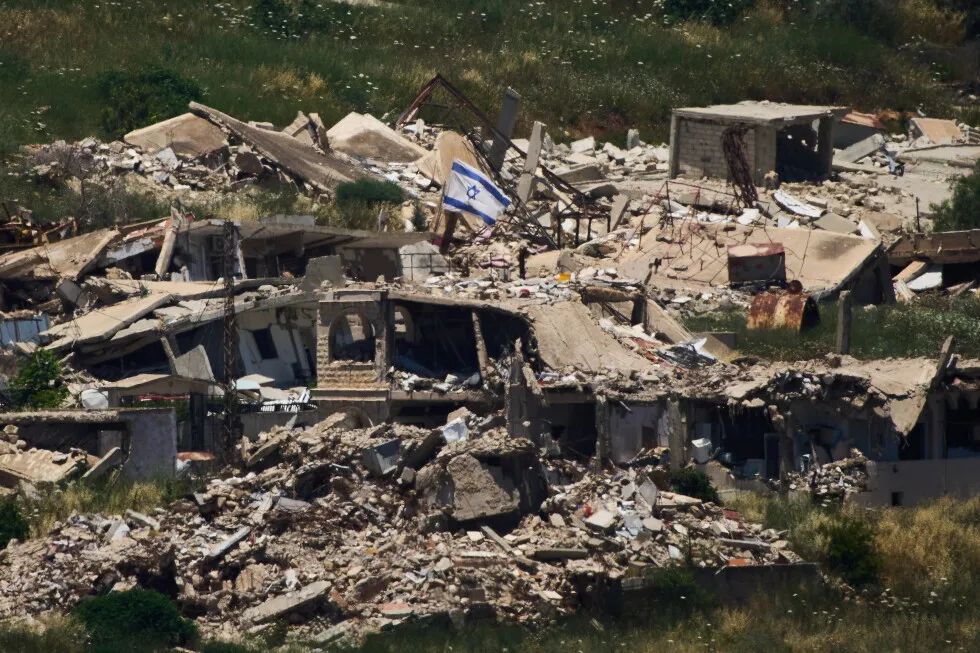
Hezbollah rejects latest ceasefire agreement as Israeli strikes kill 4 in Lebanon 1 of 6 | In a joint statement released after a fourth round of U.S.-mediated talks at the State Department, the two sides said the ceasefire “is contingent on a complete cessation of Hezbollah fire and the evacuation of all Hezbollah operatives” from areas south of the Litani River, which is roughly 30 kilometers (20 miles) north of the northern Israel-Lebanon border. It was not immediately clear how the security zones would be established but the agreement calls for the Lebanese Army to take full control of those areas. 2 of 6 | An Israeli flag hangs on a destroyed building in southern Lebanon as seen from northern Israel, Thursday June 4, 2026. (AP Photo/Ariel Schalit) 3 of 6 | Smoke rises near the Beaufort Castle in southern Lebanon as seen from northern Israel, Thursday June 4, 2026. (AP Photo/Ariel Schalit) 4 of 6 | Israeli soldiers drive in southern Lebanon as seen from northern Israel, Thursday June 4, 2026. (AP Photo/Ariel Schalit) 5 of 6 | Israeli troops gather on the border with Lebanon in northern Israel, Thursday June 4, 2026. (AP Photo/Ariel Schalit) 6 of 6 | Israeli troops gather on the border with Lebanon in northern Israel, Thursday June 4, 2026. (AP Photo/Ariel Schalit) 1 of 6 In a joint statement released after a fourth round of U.S.-mediated talks at the State Department, the two sides said the ceasefire “is contingent on a complete cessation of Hezbollah fire and the evacuation of all Hezbollah operatives” from areas south of the Litani River, which is roughly 30 kilometers (20 miles) north of the northern Israel-Lebanon border. It was not immediately clear how the security zones would be established but the agreement calls for the Lebanese Army to take full control of those areas. Add AP News on Google Add AP News as your preferred source to see more of our stories on Google. Share 2 of 6 | An Israeli flag hangs on a destroyed building in southern Lebanon as seen from northern Israel, Thursday June 4, 2026. (AP Photo/Ariel Schalit) 2 of 6 An Israeli flag hangs on a destroyed building in southern Lebanon as seen from northern Israel, Thursday June 4, 2026. (AP Photo/Ariel Schalit) Add AP News on Google Add AP News as your preferred source to see more of our stories on Google. Share 3 of 6 | Smoke rises near the Beaufort Castle in southern Lebanon as seen from northern Israel, Thursday June 4, 2026. (AP Photo/Ariel Schalit) 3 of 6 Smoke rises near the Beaufort Castle in southern Lebanon as seen from northern Israel, Thursday June 4, 2026. (AP Photo/Ariel Schalit) Add AP News on Google Add AP News as your preferred source to see more of our stories on Google. Share 4 of 6 | Israeli soldiers drive in southern Lebanon as seen from northern Israel, Thursday June 4, 2026. (AP Photo/Ariel Schalit) 4 of 6 Israeli soldiers drive in southern Lebanon as seen from northern Israel, Thursday June 4, 2026. (AP Photo/Ariel Schalit) Add AP News on Google Add AP News as your preferred source to see more of our stories on Google. Share 5 of 6 | Israeli troops gather on the border with Lebanon in northern Israel, Thursday June 4, 2026. (AP Photo/Ariel Schalit) 5 of 6 Israeli troops gather on the border with Lebanon in northern Israel, Thursday June 4, 2026. (AP Photo/Ariel Schalit) Add AP News on Google Add AP News as your preferred source to see more of our stories on Google. Share 6 of 6 | Israeli troops gather on the border with Lebanon in northern Israel, Thursday June 4, 2026. (AP Photo/Ariel Schalit) 6 of 6 Israeli troops gather on the border with Lebanon in northern Israel, Thursday June 4, 2026. (AP Photo/Ariel Schalit) Add AP News on Google Add AP News as your preferred source to see more of our stories on Google. Share Updated [hour]:[minute] [AMPM] [timezone], [monthFull] [day], [year] BEIRUT (AP) — Hezbollah on Thursday rejected the latest ceasefire agreement reached between Israel and the Lebanese government, and the militant group demanded a complete Israeli withdrawal from Lebanon as continued fighting there hampered moves to end the Iran war.The Hezbollah announcement came as Israeli strikes killed at least four people, according to local authorities, and a U.N. peacekeeper was killed in the crossfire.Hezbollah leader Naim Kassem, in a written statement read on TV, said the agreement’s demand that Hezbollah fighters leave southern Lebanon under fire would mean “surrender, defeat and achieving the enemy’s goals.”“What we are concerned about is an end to the aggression, ceasefire and Israel’s withdrawal,” he said, underscoring that Hezbollah had not made any commitment to stop fighting. “So long as our villages are not safe and are being bombed and destroyed and our people are killed,” he said, northern Israel “will not be safe.” Kassem called the negotiations “absurd, humiliating, and insulting” and designed to give Israel control of what it has been unable to wrest through war. 2 MIN READ 6 MIN READ 4 MIN READ The ongoing fighting in Lebanon, where Israeli forces have seized large swaths of the south, threatens efforts to end the Iran war and reopen the Strait of Hormuz, a key transit point for oil and gas. Its closure has jolted the world economy. Iran has demanded that any lasting truce extend to Lebanon. Israeli Prime Minister Benjamin Netanyahu, who faces elections later this year, wants to press ahead with Israel’s offensive until Hezbollah no longer poses a threat. U.S. President Donald Trump, who faced a rare rebuke from Congress on Wednesday, has sought to downplay the diplomatic deadlock and the failure of declared ceasefires to end the fighting. He told reporters that in the Middle East, “a ceasefire is when you’re shooting in a more moderate manner.” Peacekeeper killed in crossfireA Serbian peacekeeper was killed, and two other peacekeepers were wounded, when a mortar struck their location near Marjayoun, a Christian-majority town that has seen intense fighting, according to the U.N. mission, known as UNIFIL, and Serbia’s Defense Ministry.Neither said whether the mortar fire came from Israel or Hezbollah.Lebanon’s state-run National News Agency said a drone strike killed a motorcyclist and wounded four people in the village of Maaroub. It said airstrikes on the village of Sohmor in the Bekaa Valley, in eastern Lebanon, killed three people and wounded others. It also reported airstrikes in other areas of the south.There was no immediate comment from the Israeli military, which has warned people not to go into parts of southern Lebanon where it says it is striking Hezbollah facilities. Fighting has raged despite declared ceasefiresHezbollah resumed rocket fire days after Israel and the United States launched their surprise Feb. 28 attack on Iran, which backs Hezbollah. Before then, Israel had regularly carried out strikes in Lebanon against what it said were militant targets, often killing civilians, despite an earlier truce reached in 2024.Lt. Gen. Eyal Zamir, the Israeli military’s chief of staff, acknowledged Thursday that the ongoing war was straining northern Israeli towns living under the threat of Hezbollah fire. He said Israel’s operations in Iran and Lebanon had “created a new security reality,” by weaking Iran and Hezbollah “to an unprecedented degree.” After Hezbollah’s rocket and drone attacks resumed, Israeli troops seized around a fifth of Lebanon, pushing further into the country’s south than at any time since the end of Israel’s 1982-2000 occupation. In the southern city of Sidon, residents reacted to Wednesday’s ceasefire announcement with skepticism, saying previous agreements had failed to stop the violence.“Every few days a ceasefire is announced, but people keep getting killed,” said Mayada Hijazi.“It’s all talk and no action,” said Salah Nassab. “We keep going back to our homes, and then we get displaced again, back and forth. We’re very tired.” More than 3,500 people have been killed in Lebanon and over 1.2 million have been displaced. The fighting has killed 27 Israeli soldiers and three civilians. The ceasefire came from ongoing Israeli-Lebanese talksThe latest declared ceasefire came about through U.S. brokered talks held between Israel and Lebanon’s government, which accuses Hezbollah of dragging the country into war and had made efforts to disarm it before the latest hostilities.The ceasefire agreement calls for Lebanon’s armed forces to take control of security zones in Lebanon from which the militants would be banned. Lebanese President Joseph Aoun on Thursday called the new agreement “the last chance to enter a final and comprehensive ceasefire.” He said Lebanon was ready to implement Wednesday’s deal once he receives responses from relevant factions in Lebanon, including Hezbollah. The United States — and Trump himself — would determine how and when the deal is implemented, Aoun told journalists on Thursday. The agreement terms Hezbollah “an enemy” of Israel, the U.S. and Lebanon and calls for dismantling it. The government has promised to do so in the past but does not have the capabilities to disarm Hezbollah by force.The latest agreement did not say when Israel would withdraw from southern Lebanon but said the U.S. would support the Lebanese Army as it works to assert control in areas where Hezbollah has long wielded power.Iran has demanded a durable Lebanon ceasefireA top Iranian general on Thursday reiterated Tehran’s demand for a full ceasefire in Lebanon and called for Israel to pull troops back to where they were when the wider war began. At that time, Israel held five strategic points along the border.“Supporting the resistance in Lebanon is the duty of all of us, and eliminating Israel from the region is an achievable goal for Muslims,” Esmail Qaani, the head of the paramilitary Revolutionary Guard’s elite Quds Force, was quoted as saying by the semiofficial Fars and Tasnim news agencies.As diplomatic efforts have repeatedly faltered, Iran and the U.S. have traded fire in and around the Strait of Hormuz, which remains effectively closed. Before the war, around a fifth of the world’s oil and gas, as well as large shipments of fertilizer and other goods, passed through the narrow waterway.The U.S. has targeted what it says are Iranian threats to commercial shipping and its own forces, while Iran has launched missile and drone attacks on Gulf states hosting U.S. troops. ___ Gambrell reported from Dubai, United Arab Emirates, and Metz from Ramallah, West Bank. Associated Press reporter Malak Harb in Beirut contributed. Gambrell is the news director for the Gulf and Iran for The Associated Press. He has reported from each of the Gulf Cooperation Council countries, Iran and other locations across the world since joining the AP in 2006. Metz covers Morocco, Algeria, Tunisia and points beyond for The Associated Press.
SRCAssociated Press (AP)
LANGEN
LEANCenter
WORDS1 783
ENT10
THU · 2026-06-04 · 12:53 GMTBRIEF NSR-2026-0604-81748
NSR-2026-0604-81748News Report·EN·Conflict
Hezbollah rejects latest ceasefire agreement as Israeli strikes kill 4 in Lebanon
Hezbollah has rejected a new ceasefire agreement between Israel and the Lebanese government, demanding a complete Israeli withdrawal from Lebanon. The rejection comes as Israeli strikes killed at least four people in Lebanon and a UN peacekeeper was killed in the crossfire.
By
BASSEM MROUE, JON GAMBRELL and SAM METZAssociated Press (AP)Filed 2026-06-04 · 12:53 GMTLean · CenterRead · 8 min
Associated Press (AP)FIG 01
Reading time
8min
Word count
1 783words
Sources cited
0cited
Entities identified
10entities
Quality score
100%
§ 01
Briefing Summary
AI-generatedNEWSAR · AI
Hezbollah has rejected a new ceasefire agreement between Israel and the Lebanese government, demanding a complete Israeli withdrawal from Lebanon. The rejection comes as Israeli strikes killed at least four people in Lebanon and a UN peacekeeper was killed in the crossfire. Hezbollah leader Naim Kassem stated that the agreement's demand for fighters to leave southern Lebanon under fire would constitute surrender. The ongoing conflict in Lebanon is hindering efforts to end the Iran war and reopen the Strait of Hormuz. The proposed ceasefire, brokered by the U.S., calls for the Lebanese army to control security zones in southern Lebanon where Hezbollah fighters would be banned. Iran has reiterated its demand for a full ceasefire in Lebanon and an Israeli withdrawal.
Confidence 0.90Claims 4Entities 10
§ 02
Article analysis
Model · rule-basedFraming
Conflict
Diplomatic
Tone
Measured
AI-assessed
CalmNeutralAlarmist
Factuality
0.80 / 1.00
Factual
LowHigh
Sources cited
0
No named sources
FewMany
§ 03
Key claims
4 extracted01
Ceasefire is contingent on a complete cessation of Hezbollah fire and evacuation of all Hezbollah operatives from areas south of the Litani River.
quotejoint statement
Confidence
1.00
02
Hezbollah rejects latest ceasefire agreement.
factualHezbollah
Confidence
1.00
03
The agreement calls for the Lebanese army to take full control of areas south of the Litani River.
factualarticle
Confidence
0.90
04
Israeli strikes kill 4 in Lebanon.
factualarticle
Confidence
0.90
§ 04
Full report
8 min read · 1 783 words§ 05
Entities
10 identifiedKey playerOppositionContextPositiveNeutralNegative
Organizations3
Locations5
§ 06
Keywords & salience
9 termshezbollah
1.00
israeli strikes
1.00
ceasefire agreement
1.00
lebanon
0.90
u.s.-mediated talks
0.80
litani river
0.70
security zones
0.60
lebanese army
0.50
border
0.40
§ 07
Topic connections
Interactive graph Network visualization showing 51 related topics
View Full Graph Person Organization Location Event|Click node to navigate|Edge numbers = shared articles