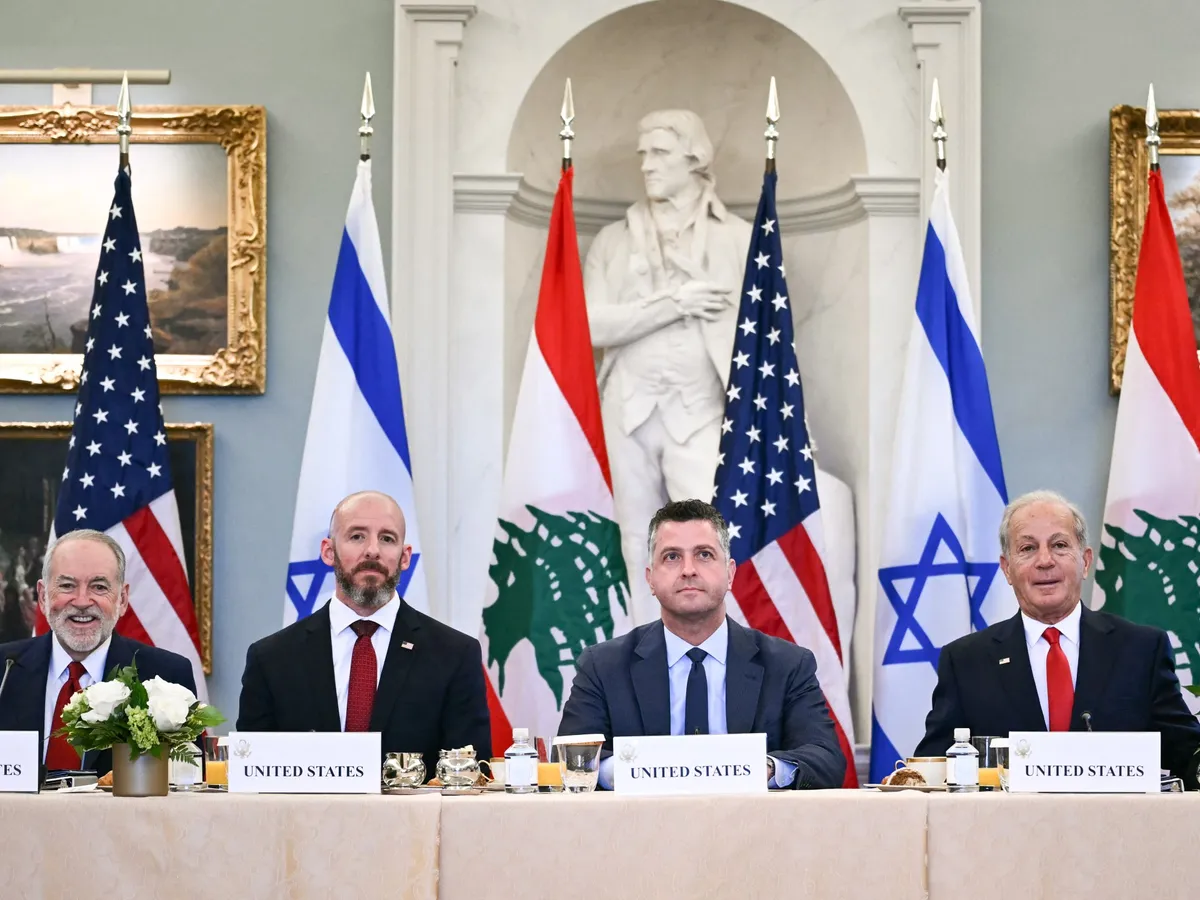
EXPLAINERThe ceasefire’s prospects appear uncertain before its implementation has even started.US Ambassador to Israel Mike Huckabee, State Department Chief of Staff Daniel Holler, Deputy National Security Adviser Mike Needham, and US Ambassador to Lebanon Michel Issa attend a meeting with Israeli and Lebanese delegations at the State Department in Washington, DC, on June 2, 2026 [AFP]Published On 4 Jun 2026Israel and the Lebanese government have agreed to implement a new US-mediated ceasefire, the Trump administration has said, despite Israel’s defence minister insisting the military will continue operations in Lebanon.Furthermore, while Lebanese President Joseph Aoun said on Thursday that the ceasefire would come into force within 24 hours of approval by all concerned parties, Hezbollah leader Naim Qassem has dismissed the deal, labelling it a “surrender and defeat”.Recommended Stories list of 4 itemslist 1 of 4Man City threatens legal action against Real Madrid following Haaland claimlist 2 of 4Israel’s Smotrich announces plan for 2,162 homes in occupied West Banklist 3 of 4Who are the Golden Boot favourites at World Cup 2026?list 4 of 4N Korea’s Kim Jong Un calls for ‘exponential’ expansion of nuclear arsenalend of listThe Trump administration announcement comes just weeks after a previous agreement to cease hostilities was supposedly reached on April 16. Since then, however, more than 600 people have been killed in Israeli strikes across Lebanon while Israel has expanded its military presence in the south of the country, now occupying about one-fifth of the country.The renewed diplomatic push also comes as Washington pursues parallel shuttle negotiations with Iran. Tehran, a close ally of Hezbollah, has made a ceasefire in Lebanon a condition for any broader agreement to end the war with the US and has repeatedly called for Israel to withdraw from southern Lebanon.Iran’s position was underlined when Quds Force commander Esmail Qaani said the baseline demand in Lebanon is for Israeli forces to withdraw to the positions they held before the start of the US-Israel war on Iran at the end of February – a demand that is not explicitly reflected in the agreement.Iran and Hezbollah’s responses to the US announcement, coupled with Israel’s insistence that military operations will continue, have cast serious doubt on its viability. Critics of Israel’s war on Lebanon also point to the April truce, which they say has completely failed to halt Israeli attacks or Israel’s occupation of the south of the country.What has been announced?According to the Trump administration, Israel and Lebanon have agreed to implement a ceasefire contingent on a “complete cessation” of Hezbollah fire and the evacuation of its fighters from the area south of the Litani River.The agreement also calls for the creation of “pilot zones” where Lebanese Armed Forces would take exclusive control “to the exclusion of all non-state actors”. The stated aim is to move towards a wider political and security agreement, including the dismantling of non-state armed groups and preventing their re-emergence.But Hezbollah was not party to the talks and has already rejected the agreement. Lebanon was represented by government diplomats, even though the Lebanese army is not a party to this conflict.According to the wording of the agreement, the parties are due to reconvene during the week of June 22 to continue diplomatic and security talks, with the US facilitating communications in the meantime. It remains unclear if that stage of the agreement will ever be reached.[Al Jazeera]What was agreed in April?The April agreement used different language, saying Israel and Lebanon would implement a “cessation of hostilities” from April 16, and never actually used the word ceasefire.It also included a clause allowing Israel to “take all necessary measures in self-defence, at any time, against planned, imminent or ongoing attacks”.That clause does not appear in the new text, which could be interpreted as a small concession. That was until Israel Katz said Israel would continue its military operations in Lebanon regardless.The latest agreement also repeats Israel’s longstanding demand that Hezbollah withdraw from south of the Litani River.Meanwhile, there is one major glaring omission. While the text focuses heavily on Hezbollah’s withdrawal from parts of southern Lebanon, it does not mention Israel’s withdrawal from southern Lebanon.Lebanese journalist and analyst Souhayb Jawhar told Al Jazeera the agreement is defined as much by what it leaves out as by what it includes.The text, he said, focuses on Hezbollah’s obligations and those of the Lebanese state: removing armed elements from south of the Litani and creating zones where the Lebanese army holds exclusive control.“This point alone explains much of the scepticism within Hezbollah and its political environment,” Jawhar told Al Jazeera. “From the party’s perspective, any agreement should include a clear ceasefire, an Israeli withdrawal, and a framework for addressing outstanding issues, rather than becoming a document focused primarily on restructuring Lebanon’s internal security landscape.”What else is different this time?Other points of contention regarding the new agreement are the “pilot zones”, which appear to go beyond stopping the fighting and instead test a new security model in southern Lebanon – one that could eventually be expanded elsewhere, analysts say.“This is why many observers see these zones as the beginning of a gradual transition from a security environment in which Hezbollah played the dominant role to one in which the Lebanese state and its armed forces become the sole security authority,” Jawhar said.He added that the fate of the agreement may depend less on Lebanon-Israel talks than on the US-Iran track. If Washington and Tehran reach a wider understanding, the ceasefire in Lebanon will have a stronger chance of holding because both sides will have an interest in stabilising the Lebanese front.“If those negotiations stall or collapse, Lebanon could quickly return to being one of the main arenas of pressure and confrontation between the two sides,” Jawhar added.What is the situation in Lebanon now?Southern Lebanon remained under heavy military pressure on Thursday, with Israeli strikes on Kafra and al-Mansouri in the southwest of the country. In the Bekaa Valley, one person was killed and four others wounded in an Israeli strike on Sohmor, according to Lebanon’s state-run National News Agency (NNA).A separate strike hit Tell al-Aqareb, while further raids targeted Haddatha, Tibnin, Haris, and Harin. The NNA also reported more Israeli strikes across southern Lebanon as drones flew at low altitude over Beirut. In Maaroub, one person was killed and another wounded when Israeli forces targeted a motorcycle.Israeli warplanes also struck towns and villages across the south, including Zawtar al-Sharqiya, Zawtar al-Gharbiya, Shoukin, Barachit, Srifa, Zibdin, Haris and Deir Zahrani. Jets and drones have also been flying over the south for much of the morning, including a drone seen at extremely low altitude over Tyre.Lebanon’s Civil Defence authorities have warned people not to return south, citing the continued danger to civilian life in towns and villages across southern Lebanon.More than 3,000 people have been killed, and more than one million have been forced from their homes since Israel renewed its assault on Lebanon in early March.
SRCAl Jazeera
LANGEN
LEANCenter
WORDS1 149
ENT12
THU · 2026-06-04 · 14:58 GMTBRIEF NSR-2026-0604-81754
NSR-2026-0604-81754News Report·EN·Diplomatic
Lebanon’s latest truce: What is different from the April agreement?
A new US-mediated ceasefire between Israel and Lebanon is facing significant uncertainty, even before its implementation. This agreement, announced by the Trump administration, follows a failed April truce that saw over 600 deaths and expanded Israeli occupation in southern Lebanon.
Caolán MageeAl JazeeraFiled 2026-06-04 · 14:58 GMTLean · CenterRead · 5 min
Al JazeeraFIG 01
Reading time
5min
Word count
1 149words
Sources cited
5cited
Entities identified
12entities
Quality score
100%
§ 01
Briefing Summary
AI-generatedNEWSAR · AI
A new US-mediated ceasefire between Israel and Lebanon is facing significant uncertainty, even before its implementation. This agreement, announced by the Trump administration, follows a failed April truce that saw over 600 deaths and expanded Israeli occupation in southern Lebanon. Key differences include the new agreement's call for Hezbollah's evacuation from south of the Litani River and the creation of Lebanese Armed Forces-controlled "pilot zones." However, Hezbollah has rejected the deal, calling it a "surrender," and Israel's defense minister insists military operations will continue. The agreement also omits any mention of Israeli withdrawal, a demand from Iran, a key Hezbollah ally, and is seen by critics as focusing on Lebanese state and Hezbollah obligations.
Confidence 0.90Sources 5Claims 5Entities 12
§ 02
Article analysis
Model · rule-basedFraming
Diplomatic
Conflict
Tone
Mixed Tone
AI-assessed
CalmNeutralAlarmist
Factuality
0.70 / 1.00
Factual
LowHigh
Sources cited
5
Well sourced
FewMany
§ 03
Key claims
5 extracted01
Hezbollah leader Naim Qassem has dismissed the deal, labelling it a “surrender and defeat”.
quoteNaim Qassem
Confidence
1.00
02
The agreement calls for the evacuation of Hezbollah fighters from the area south of the Litani River.
factualTrump administration
Confidence
0.90
03
Israel and the Lebanese government have agreed to implement a new US-mediated ceasefire.
factualTrump administration
Confidence
0.90
04
Iran has made a ceasefire in Lebanon a condition for any broader agreement to end the war with the US.
factual
Confidence
0.85
05
More than 600 people have been killed in Israeli strikes across Lebanon since the April 16 agreement.
statistic
Confidence
0.80
§ 04
Full report
5 min read · 1 149 words§ 05
Entities
12 identifiedKey playerOppositionContextPositiveNeutralNegative
People6
§ 06
Keywords & salience
9 termsceasefire
1.00
lebanon
0.90
israel
0.90
us-mediated
0.80
hezbollah
0.70
military operations
0.60
truce agreement
0.50
iran
0.50
diplomatic push
0.40
§ 07
Topic connections
Interactive graph Network visualization showing 51 related topics
View Full Graph Person Organization Location Event|Click node to navigate|Edge numbers = shared articles