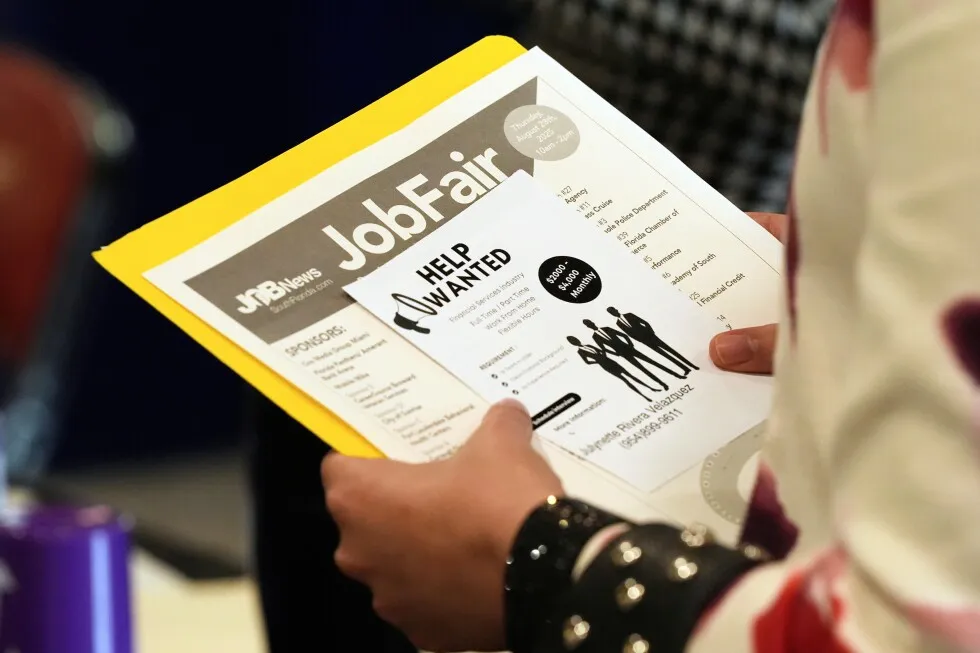
A job seeker waits to talk to a recruiter at a job fair Aug. 28, 2025, in Sunrise, Fla. (AP Photo/Marta Lavandier, File) Updated [hour]:[minute] [AMPM] [timezone], [monthFull] [day], [year] WASHINGTON (AP) — The American job market has climbed out of a rut. But it’s still trudging along tepidly, frustrating young people and others out of work.The Labor Department is expected to report Friday that companies, non-profits and government agencies added 105,000 jobs last month, according to a survey of forecasters by the data firm FactSet. That would be solid by the labor market’s recent, diminished standards -- but down from 115,000 in April.Hiring has bounced back this year from a miserable 2025, showing unexpected resilience in the face of economic uncertainty and painfully high energy prices caused by the Iran-war" class="entity-link entity-event" data-entity-id="38748" data-entity-type="event">Iran war.Unemployment is expected to have remained at a low 4.3% in May, FactSet says. But despite the improvement from last year, job creation is way down from the boom that followed pandemic lockdowns.Workers, jobseekers and employers are stuck in an awkward “no-hire, no-fire’’ labor market. “Those who have jobs are clinging to them, while those without are left wanting,” Diane Swonk, chief economist at the tax and consulting firm KPMG, wrote in a commentary ahead of the jobs report. “The result is a sense of being frozen or left in a sort of labor market purgatory.’’ Many young people are finding it tough to break into a stagnant job market. And workers who have been laid off struggle to get back to work. More than a quarter of the unemployed in April had been jobless for more than six months, up from less than 20% two years ago. 2 MIN READ 4 MIN READ 1 MIN READ Seeing their prospects diminished, Americans are reluctant to leave their jobs and seek something better elsewhere. In April, the number of people who quit dropped to the lowest level since the frightening days of August 2020, when the COVID-19 was running rampant. Last year, employers added 9,700 jobs a month, fewest outside a recession since 2002. This year, hiring has rebounded, averaging 76,000 new jobs a month from January through April. Big tax refunds — the product of President Donald Trump’s 2025 tax cuts — have given the economy a lift, offsetting the impact of higher energy prices since the United States and Israel attacked Iran in late February. But the refunds have mostly been pocketed, and gasoline prices remain above $4 per gallon. Healthcare companies have been propping up the job market. Over the past year, they’ve added more than 456,000 jobs; all other U.S. employers have collectively cut 205,000. Martha Gimbel and Ryan Nunn of Yale University’s Budget Lab note that strong healthcare hiring isn’t surprising as Americans age and need more prescriptions and trips to the doctor. In fact, the industry’s job growth is in line with Labor Department predictions from a decade ago. “The question is not why healthcare has kept hiring—it is why other industries have not,’' they wrote in a report published Tuesday, suggesting that one explanation might be an immigration crackdown that has reduced the supply of foreign-born workers.At least the United States doesn’t need as many new jobs as it used to. The drop in immigrants and rising Baby Boomer retirements mean that fewer people are competing for work. As a result, the so-called break-even point — the number of new jobs required to keep the unemployment rate stable — has likely dropped to near zero, from the 155,000 new jobs per month that was typical two or three years ago, according to a Federal Reserve report.
SRCAssociated Press (AP)
LANGEN
LEANCenter
WORDS603
ENT12
FRI · 2026-06-05 · 06:23 GMTBRIEF NSR-2026-0605-81913
NSR-2026-0605-81913News Report·EN·Economic Impact
US employers likely added 105,000 jobs in May with labor market stable despite costly Iran war
The U.S. job market is showing resilience, with employers expected to add 105,000 jobs in May, a slight decrease from April's 115,000.
By
PAUL WISEMANAssociated Press (AP)Filed 2026-06-05 · 06:23 GMTLean · CenterRead · 3 min
Associated Press (AP)FIG 01
Reading time
3min
Word count
603words
Sources cited
4cited
Entities identified
12entities
Quality score
100%
§ 01
Briefing Summary
AI-generatedNEWSAR · AI
The U.S. job market is showing resilience, with employers expected to add 105,000 jobs in May, a slight decrease from April's 115,000. Unemployment is projected to remain low at 4.3%. This stable, albeit tepid, hiring environment is occurring despite economic uncertainty and high energy prices stemming from the Iran war. Job creation is significantly lower than the post-pandemic boom, leading to a "no-hire, no-fire" market where those employed are hesitant to leave and the unemployed struggle to find work, particularly young people. Healthcare is a key driver of job growth, adding over 456,000 jobs in the past year, while other sectors have seen cuts. The need for new jobs to maintain stable unemployment has decreased due to lower immigration and increased retirements.
Confidence 0.90Sources 4Claims 5Entities 12
§ 02
Article analysis
Model · rule-basedFraming
Economic Impact
Human Interest
Tone
Measured
AI-assessed
CalmNeutralAlarmist
Factuality
0.70 / 1.00
Factual
LowHigh
Sources cited
4
Well sourced
FewMany
§ 03
Key claims
5 extracted01
Healthcare companies have added over 456,000 jobs in the past year, while all other U.S. employers have cut 205,000.
factual
Confidence
0.90
02
The number of people who quit their jobs dropped to the lowest level since August 2020.
factual
Confidence
0.90
03
Unemployment is expected to have remained at a low 4.3% in May.
predictionFactSet
Confidence
0.80
04
US employers are expected to have added 105,000 jobs in May.
predictionFactSet survey of forecasters
Confidence
0.80
05
Hiring has bounced back this year from a miserable 2025, showing resilience despite economic uncertainty and high energy prices from the Iran war.
factual
Confidence
0.70
§ 04
Full report
3 min read · 603 words§ 05
Entities
12 identifiedKey playerOppositionContextPositiveNeutralNegative
Locations4
§ 06
Keywords & salience
8 termslabor market
1.00
job creation
0.90
unemployment rate
0.80
iran war
0.70
energy prices
0.60
job seekers
0.50
tax refunds
0.40
healthcare companies
0.40
§ 07
Topic connections
Interactive graph No topic relationship data available yet. This graph will appear once topic relationships have been computed.