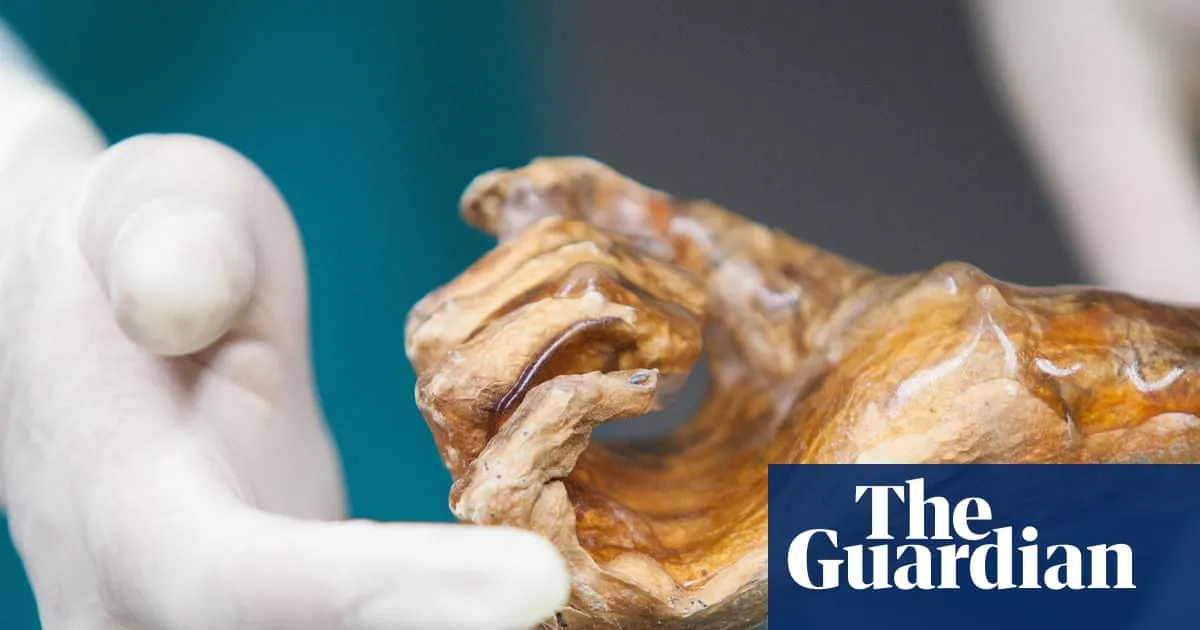
Scientists have baked a sourdough loaf of bread using Yeast strains harvested from a 5,000-year-old mummy and now plan to see if they can use them to brew beer too.The Yeast came from Ötzi the Iceman, a famous corpse remarkably preserved by being frozen in Alpine ice near the Italy-Austria border until he was discovered in 1991. Ötzi has been the subject of intense study since he was found and has shed much light on pre-historic European people and their way of life.Scientists have been recently studying the Microorganisms preserved in and on Ötzi’s remains. One unexpected result of that work was that researchers extracted Yeast and then used it to make Sourdough bread.“Eventually, we obtained a completely normal dough that rose within 24 hours − basically just like with ordinary Yeast. We made some really good dough with it,” microbiologist Mohamed Sarhan said in statements posted to the website of Eurac Research where he works for the Institute for Mummy Studies.“I’ve never baked bread before – and it showed. So the result definitely had room for improvement. But as I said, these were our very first experiments,” Sarhan added.Now, homemade beer could also be on the menu.“We want to pursue this further and involve specialized research teams from the food sector in the process. Bread is currently one of the obvious applications we’re considering; another is beer – we’ve already discussed this with experts from [German brewer] Weihenstephan,” he said.The harvested yeasts only live in cold conditions so are believed to have entered Ötzi’s body at some point after he died. Genetic analysis suggested they entered his body relatively soon after death.Ötzi has long been the focus of fascination. His body preserves the oldest tattoos ever discovered with a total of 61 markings. There is also huge interest in how he died high up in the mountains in an icy wilderness about 5,300 years ago. He appears to have been shot in the back by an arrow in what is often described as one of the world’s oldest cold-case murders.
SRCThe Guardian - World News
LANGEN
LEANCenter-Left
WORDS341
ENT12
FRI · 2026-06-05 · 15:00 GMTBRIEF NSR-2026-0605-82046
NSR-2026-0605-82046News Report·EN·Human Interest
Scientists make sourdough bread using yeast found in 5,000-year-old mummy
Scientists have successfully baked sourdough bread using yeast strains extracted from Ötzi the Iceman, a 5,000-year-old mummy discovered frozen in Alpine ice. Researchers at Eurac Research's Institute for Mummy Studies harvested these microorganisms from Ötzi's remains, which have been a subject of extensive study.
Guardian staffThe Guardian - World NewsFiled 2026-06-05 · 15:00 GMTLean · Center-LeftRead · 2 min
The Guardian - World NewsFIG 01
Reading time
2min
Word count
341words
Sources cited
2cited
Entities identified
12entities
Quality score
100%
§ 01
Briefing Summary
AI-generatedNEWSAR · AI
Scientists have successfully baked sourdough bread using yeast strains extracted from Ötzi the Iceman, a 5,000-year-old mummy discovered frozen in Alpine ice. Researchers at Eurac Research's Institute for Mummy Studies harvested these microorganisms from Ötzi's remains, which have been a subject of extensive study. The extracted yeast proved capable of fermenting dough, producing a loaf that rose within 24 hours. Building on this success, the team now plans to collaborate with food sector experts, including those from Weihenstephan, to explore the possibility of brewing beer using these ancient yeast strains. The yeast is believed to have entered Ötzi's body after his death, as it thrives in cold conditions.
Confidence 0.90Sources 2Claims 5Entities 12
§ 02
Article analysis
Model · rule-basedFraming
Human Interest
Technology
Tone
Mixed Tone
AI-assessed
CalmNeutralAlarmist
Factuality
0.80 / 1.00
Factual
LowHigh
Sources cited
2
Limited
FewMany
§ 03
Key claims
5 extracted01
Microbiologist Mohamed Sarhan stated, 'Eventually, we obtained a completely normal dough that rose within 24 hours − basically just like with ordinary yeast.'
quoteMohamed Sarhan
Confidence
1.00
02
The yeast was extracted from Ötzi the Iceman, a mummy discovered in Alpine ice in 1991.
factualarticle
Confidence
1.00
03
Scientists have successfully baked sourdough bread using yeast strains harvested from a 5,000-year-old mummy.
factualarticle
Confidence
1.00
04
The harvested yeasts only live in cold conditions and are believed to have entered Ötzi's body after death.
factualarticle
Confidence
0.90
05
Researchers plan to explore using these ancient yeast strains to brew beer.
predictionarticle
Confidence
0.90
§ 04
Full report
2 min read · 341 words§ 05
Entities
12 identifiedKey playerOppositionContextPositiveNeutralNegative
Organizations4
§ 06
Keywords & salience
8 termssourdough bread
1.00
ancient yeast
0.90
ötzi the iceman
0.90
mummy microorganisms
0.80
historical brewing
0.70
paleontology
0.60
archaeology
0.50
food science
0.40
§ 07
Topic connections
Interactive graph No topic relationship data available yet. This graph will appear once topic relationships have been computed.