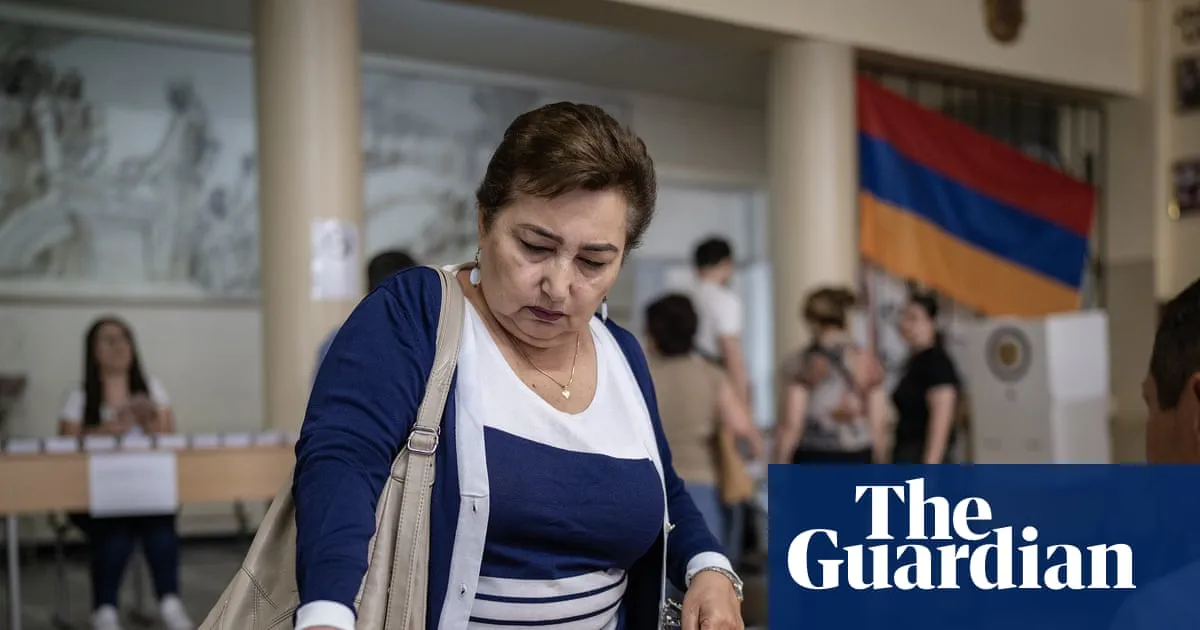
Armenians are going to the polls in an election that could cement the country’s shift towards Europe and away from its traditional alliance with Russia.Prime minister Nikol Pashinyan’s Civil Contract party enters the vote as the favourite, ahead of three opposition candidates who advocate for closer ties with Moscow. Pashinyan’s main challenger, Samvel Karapetyan, a Russian-Armenian billionaire who built much of his fortune in Russia, has been forced to campaign from house arrest at his mansion outside Yerevan.Much is at stake for the South Caucasus nation of 3 million people, with Moscow, Brussels and Washington all closely watching the vote.A Karapetyan victory could set Armenia on a trajectory similar to neighbouring Georgia, where a billionaire with Russian-made wealth has spent years dismantling pro-western reforms and pulling the country back towards Moscow.A strong majority for Pashinyan would give him a mandate to pursue his signature and politically sensitive goal: a peace agreement with Armenia’s longtime enemy Azerbaijan and the normalisation of relations with Turkey.Nikol Pashinyan after casting his ballot in Yerevan. Photograph: Karen Minasyan/AFP/Getty ImagesA former journalist who swept to power during the 2018 Velvet Revolution, Pashinyan has campaigned on a platform of peace, arguing that ending Armenia’s decades-long confrontation with its neighbours would unlock economic opportunities, improve security and reduce its dependence on Russia.The prime minister, known for his populist and often emotional rhetoric, has sought closer ties with Europe, signalling that Armenia’s future lies in deeper integration with the west and expressing hope that the country could one day join the European Union.Pashinyan has received an endorsement from Donald Trump, who described him as “a great friend and leader”. The US has taken on an increasingly prominent role in efforts to broker a peace agreement between Armenia and Azerbaijan.Sunday’s vote is the first national election since Armenia’s loss of Nagorno-Karabakh to Azerbaijan in 2023, a traumatic defeat that ended more than three decades of Armenian control over the disputed region.The opposition has sought to portray the loss as evidence of Pashinyan’s failures, accusing him of surrendering historical Armenian lands to its enemies.Yet Pashinyan has tried to turn the issue into a political asset. Arguing that Armenia’s pursuit of Karabakh helped trap the country in perpetual conflict and dependence on Russia, he has presented the painful chapter as the necessary starting point for a more secure and prosperous future.Anahit Sarkisyan, a lawyer from Yerevan, said after casting her vote on Sunday: “Pashinyan has a vision for the future, the rest are stuck in the past. We can’t be in endless wars with our neighbours. It’s time to move forward”Pashinyan’s course has put him in the crosshairs of Moscow, which has long projected influence over Armenian politics and the economy.Samvel Karapetyan casts his ballot. Photograph: Hayk Baghdasaryan/ReutersMany Armenians became disillusioned with Russia after Moscow failed to come to their aid when Azerbaijan seized Nagorno-Karabakh despite the presence of Russian peacekeepers in the region. The fallout prompted Pashinyan to suspend Armenia’s participation in the Collective Security Treaty Organization (CSTO) of six post-Soviet states, including Russia, marking the most dramatic rupture in relations with Moscow since the country’s independence.In the run-up to the election, the Russian president, Vladimir Putin, said Armenia, which has not formally applied for EU membership, was heading down the same path as Ukraine.“And where did it start?” Putin said, referring to Armenia’s EU push. “With Ukraine seeking to join the European Union.”Armenian officials and analysts have accused Russia of attempting to influence the election through disinformation campaigns in favour of pro-Russian candidates, and efforts to fly Armenians living in Russia back home to vote against Pashinyan.In recent weeks, Moscow has adopted a more overt approach, imposing a series of trade restrictions affecting everything from flowers and fish to fruit and Armenian brandy.But these last-ditch measures have so far failed to put a dent in Armenia’s economy.Buoyed up by strong economic growth following the influx of Russian businesses and capital after the invasion of Ukraine, Pashinyan has invested heavily in Armenia’s regions, where his support remains strongest.Yet observers have also pointed to his increasingly personalised style of politics, and what critics describe as growing authoritarian tendencies in Armenia, a country that remains a rare democratic outlier in a region largely governed by strongmen.In the run-up to the elections, Armenian authorities arrested opposition figures, including members of Karapetyan’s party, on accusations ranging from vote-buying and financial crimes to calls to overthrow the government. Karapetyan himself was detained in June and charged with calling for the seizure of power, leading him to campaign from house arrest.Pashinyan has at times appeared erratic, engaging in ugly public disputes with refugees from Nagorno-Karabakh, whom he accused of having “run away” from the region rather than staying to fight.The EU, meanwhile, has largely brushed aside criticism of Pashinyan, making little secret of its support for Armenia’s shift away from Moscow. Brussels this week announced an initial €50m support package to help Armenia withstand Russian economic pressure.Karen Grigoryan, a doctor, who voted for Karapetyan on Sunday, said: “Pashinyan is not the man he was when he came to power.”Referring to the Ottoman-era mass killings of Armenians that Yerevan and many western countries recognise as genocide, he added: “We can’t just be friendly with Turkey and pretend the past is erased.”Observers say many voters continue to back Pashinyan largely because the opposition remains deeply discredited and closely linked to Russia.Tatul Hakobyan, a popular Armenian commentator, saidL “People are choosing the lesser of two evils. The alternatives to Pashinyan are much worse.”
SRCThe Guardian - World News
LANGEN
LEANCenter-Left
WORDS913
ENT12
SUN · 2026-06-07 · 09:56 GMTBRIEF NSR-2026-0607-82408
NSR-2026-0607-82408News Report·EN·Political Strategy
‘It’s time to move forward’: Armenians vote in election closely watched by Russia and EU
Armenians are voting in an election that could solidify the country's pivot towards Europe and away from Russia. Prime Minister Nikol Pashinyan's Civil Contract party is favored against opposition candidates advocating for closer ties with Moscow.
Pjotr Sauer in YerevanThe Guardian - World NewsFiled 2026-06-07 · 09:56 GMTLean · Center-LeftRead · 4 min
The Guardian - World NewsFIG 01
Reading time
4min
Word count
913words
Sources cited
2cited
Entities identified
12entities
Quality score
100%
§ 01
Briefing Summary
AI-generatedNEWSAR · AI
Armenians are voting in an election that could solidify the country's pivot towards Europe and away from Russia. Prime Minister Nikol Pashinyan's Civil Contract party is favored against opposition candidates advocating for closer ties with Moscow. The election follows Armenia's loss of Nagorno-Karabakh to Azerbaijan, a defeat that has fueled disillusionment with Russia's lack of support. Pashinyan argues that ending regional conflicts and reducing dependence on Russia will lead to a more prosperous future and closer integration with the West. Russia has expressed concern over Armenia's pro-Western stance, while Armenian officials accuse Moscow of attempting to influence the vote. The outcome is closely watched by Russia, the EU, and the US, with a Pashinyan victory expected to empower his pursuit of peace agreements with Azerbaijan and Turkey.
Confidence 0.90Sources 2Claims 5Entities 12
§ 02
Article analysis
Model · rule-basedFraming
Political Strategy
Diplomatic
Tone
Measured
AI-assessed
CalmNeutralAlarmist
Factuality
0.70 / 1.00
Factual
LowHigh
Sources cited
2
Limited
FewMany
§ 03
Key claims
5 extracted01
Anahit Sarkisyan, a lawyer from Yerevan, stated, 'Pashinyan has a vision for the future, the rest are stuck in the past. We can’t be in endless wars with our neighbours. It’s time to move forward'.
quoteAnahit Sarkisyan
Confidence
1.00
02
The election is the first national vote since Armenia's loss of Nagorno-Karabakh to Azerbaijan in 2023.
factual
Confidence
1.00
03
A victory for Pashinyan would give him a mandate to pursue a peace agreement with Azerbaijan and normalize relations with Turkey.
factual
Confidence
1.00
04
Prime Minister Nikol Pashinyan's Civil Contract party is the favorite, while opposition candidates advocate for closer ties with Moscow.
factual
Confidence
1.00
05
Armenians are voting in an election closely watched by Russia and the EU, potentially shifting the country's alignment.
factual
Confidence
1.00
§ 04
Full report
4 min read · 913 words§ 05
Entities
12 identifiedKey playerOppositionContextPositiveNeutralNegative
Locations7
§ 06
Keywords & salience
10 termsarmenian election
1.00
russia-eu relations
0.90
nikol pashinyan
0.80
nagorno-karabakh
0.70
peace agreement
0.60
azerbaijan
0.50
velvet revolution
0.40
south caucasus
0.40
european union
0.40
turkey
0.40
§ 07
Topic connections
Interactive graph Network visualization showing 14 related topics
View Full Graph Person Organization Location Event|Click node to navigate|Edge numbers = shared articles