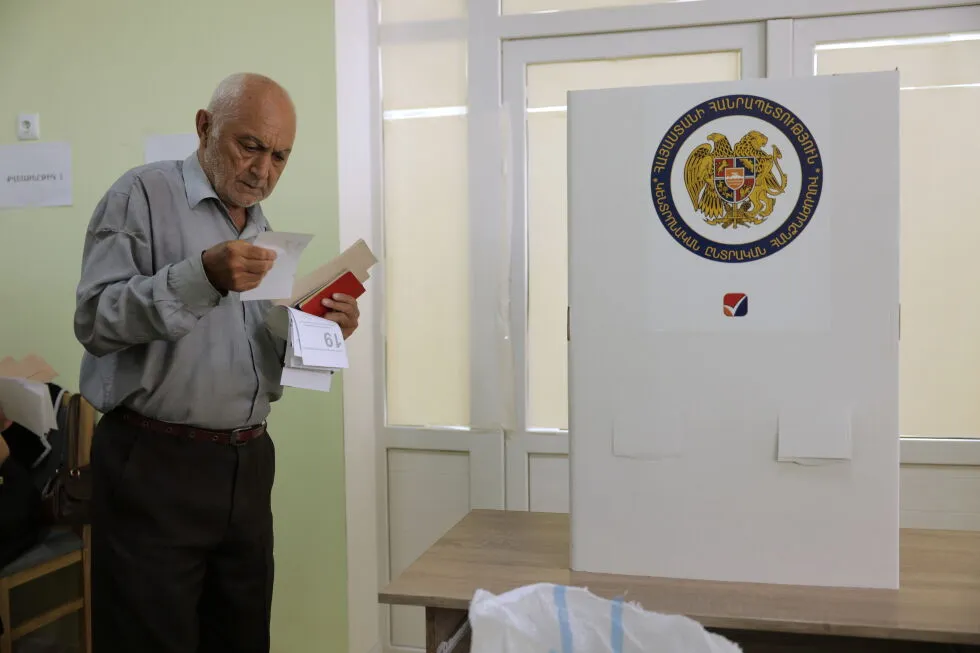
Armenians go to the polls under Russian pressure aimed at preventing a drift toward West 1 of 4 | Armenian Prime Minister Nikol Pashinyan, center, casts his ballot at a polling station during the parliamentary election in Yerevan, Armenia, Sunday, June 7, 2026. (AP Photo/Anthony Pizzoferrato) 2 of 4 | Voters gather to get their ballots at a polling station during the parliamentary election in Yerevan, Armenia, Sunday, June 7, 2026. (AP Photo/Anthony Pizzoferrato) 3 of 4 | Armenian Prime Minister Nikol Pashinyan poses for a selfie photo with a supporter as he walks on Northern Avenue in Yerevan, Armenia, Monday, June 1, 2026, during public celebrations marking International Children’s Day. (AP Photo/Anthony Pizzoferrato) 4 of 4 | Russian President Vladimir Putin, right, and Armenian Prime Minister Nikol Pashinyan meet at the Kremlin in Moscow, Russia, on April 1, 2026. (AP Photo/Pavel Bednyakov, Pool, File) By AVET DEMOURIAN Updated 8:33 AM MESZ, June 7, 2026 Leer en español Add AP News on Google Add AP News as your preferred source to see more of our stories on Google. Share Share Facebook Copy Link copied Print Email X LinkedIn Bluesky Flipboard Pinterest Reddit Yerevan, Armenia (AP) — Armenians will vote Sunday in parliamentary elections as the incumbent government, under mounting Russian pressure, seeks to loosen ties with Moscow and deepen cooperation with the West. Prime Minister Nikol Pashinyan and his ruling Civil Contract party are looking for a strong mandate for a new geopolitical course. The opposition they face includes some parties that are vocally pro-Russian. Russian officials have hit Armenian exports with a barrage of restrictions in recent weeks, while high-ranking officials, including President Vladimir Putin, have made thinly veiled threats comparing Armenia’s path to that already taken by Ukraine. Armenian investigators said they issued six arrest warrants for members of the opposition Armenia" class="entity-link entity-organization" data-entity-id="141693" data-entity-type="organization">Strong Armenia party the day before the vote, accusing them of buying votes. The nation’s Central Election Committee confirmed Saturday that the party could run after a member of another opposition party, Republic, appealed for Armenia" class="entity-link entity-organization" data-entity-id="141693" data-entity-type="organization">Strong Armenia to be barred over corruption allegations. Armenia’s Parliament, the National Assembly, must consist of at least 101 members who are elected for five-year terms. Parties must win at least 4% of the vote to take a seat, while blocs made up of three or more parties must hit 8%. Two political blocs and 17 parties are taking part in Sunday’s election. Most pollsters and experts have predicted Pashinyan, who came to power in 2018 following sweeping street protests, will come out ahead. “I think Armenians expect, first of all, a peaceful, independent and prosperous Armenia from this election, as we have today,” said Hripsime Grigoryan, a Civil Contract member of the outgoing Parliament. Armenia prepares for an election that could reshape ties with Moscow and the West Armenia hosts a historic European Union summit as the country charts a course away from Russia Moscow-led economic grouping threatens to suspend Armenia over its EU bid Pashinyan has spoken on several occasions about the need for a balanced foreign policy ensuring Armenia maintains good relations with the United States, Europe and Russia, as well as regional powers such as Turkey and Iran. Despite this, Pashinyan has attracted far more enthusiasm in the West than in Moscow. He has been endorsed by several European leaders, as well as U.S. President Donald Trump. “Prime Minister Nikol Pashinyan, of Armenia, a great friend and Leader, is making his Country strong, wealthy, and very secure,” Trump wrote on social media, urging Armenians to “Make (Armenia) Great Again.” This has displeased the Kremlin. Speaking to journalists after Russia’s Victory Day parade on May 9, Putin said if the Armenian people saw benefits in joining the European Union then “we will certainly have nothing to say against it.” Yet he also reminded reporters, “We are currently living through everything that is happening in respect of Ukraine. And how did it start? It started with Ukraine’s joining or attempting to join the EU.” Unlike the Civil Contract party, most of Armenia’s opposition supports building stronger relations with Moscow. The Armenia" class="entity-link entity-organization" data-entity-id="141693" data-entity-type="organization">Strong Armenia party seeks to develop business ties with Russia and has accused Pashinyan of attempting to start a war with Moscow. Party leader Samvel Karapetyan is on trial for allegedly advocating for the government’s overthrow, which the Armenian-Russian billionaire has rejected as a politically motivated case. He has coordinated the party’s campaign while under house arrest, aided by his nephew Narek Karapetyan. Other potential contenders include former President Robert Kocharyan, who leads the Hayastan bloc and has accused Pashinyan of “seriously undermining” relations with Russia, and the Prosperous Armenia Party led by pro-Russian business owner Gagik Tsarukyan. These parties also have strongly criticized Pashinyan for attempting to normalize relations with neighboring Azerbaijan. The Armenian leader and Azerbaijani President Ilham Aliyev initialed a document on moving toward a peace deal at the White House alongside U.S. President Donald Trump in August. The two countries were locked in a decades-long conflict over the fate of Karabakh, a breakaway region that had been controlled for decades by ethnic Armenian forces backed by Armenia. Azerbaijan took control of the entire Karabakh region during a rapid offensive in 2023. “I want this government to change because the condition of our country is getting worse,” Sahakyan Elina, a supporter of the Prosperous Armenia Party, told The Associated Press at a rally Thursday. “I don’t want to live with my enemies in unity.” Russian officials have slapped new restrictions on Armenian produce in the run-up to the parliamentary vote, banning the import of Armenian flowers, certain types of cognac and wine, eggplants, potatoes, dried fruits, fish and more. Russia says the bans are related to violations of agricultural import rules. The European Commission on Thursday described the move as “nothing short of economic coercion.” “By extending export restrictions on Armenian products, Moscow is weaponizing economic relations for political pressure. We know this playbook all too well,” the commission said in a statement. Moscow also controls a significant portion of Armenia’s energy and infrastructure and supplies it with cheap gas, which is a point that Putin has been quick to drive home in his meetings with Pashinyan. Putin also has stressed that Armenia cannot join the EU and remain within the Eurasian Economic Union, a Russian-led customs bloc. “Being in a customs union with the European Union and the Eurasian Economic Union is impossible,” Putin said. “It’s simply impossible by definition.” Katie Marie Davies in Manchester, England. and Sam McNeil in Brussels contributed to this report.
SRCAssociated Press (AP)
LANGEN
LEANCenter
WORDS1 089
ENT12
SUN · 2026-06-07 · 06:23 GMTBRIEF NSR-2026-0607-82356
NSR-2026-0607-82356News Report·EN·Political Strategy
Armenians go to the polls under Russian pressure aimed at preventing a drift toward West
Armenians are voting in parliamentary elections amid mounting pressure from Russia, which seeks to prevent the country from strengthening ties with the West. Prime Minister Nikol Pashinyan and his Civil Contract party are campaigning for a mandate to pursue a new geopolitical direction, while the opposition includes pro-Russian parties.
Associated Press (AP)Filed 2026-06-07 · 06:23 GMTLean · CenterRead · 5 min
Associated Press (AP)FIG 01
Reading time
5min
Word count
1 089words
Sources cited
3cited
Entities identified
12entities
Quality score
100%
§ 01
Briefing Summary
AI-generatedNEWSAR · AI
Armenians are voting in parliamentary elections amid mounting pressure from Russia, which seeks to prevent the country from strengthening ties with the West. Prime Minister Nikol Pashinyan and his Civil Contract party are campaigning for a mandate to pursue a new geopolitical direction, while the opposition includes pro-Russian parties. Russia has imposed restrictions on Armenian exports and issued veiled threats, drawing criticism from the European Commission as "economic coercion." Opposition parties advocate for closer ties with Moscow and have criticized Pashinyan's efforts to normalize relations with Azerbaijan. Despite Russian pressure, Pashinyan has received endorsements from Western leaders and U.S. President Donald Trump.
Confidence 0.90Sources 3Claims 5Entities 12
§ 02
Article analysis
Model · rule-basedFraming
Political Strategy
Diplomatic
Tone
Measured
AI-assessed
CalmNeutralAlarmist
Factuality
0.70 / 1.00
Factual
LowHigh
Sources cited
3
Well sourced
FewMany
§ 03
Key claims
5 extracted01
Prime Minister Nikol Pashinyan and his ruling Civil Contract party seek a strong mandate for a new geopolitical course, facing pro-Russian opposition parties.
factual
Confidence
0.90
02
Armenians are voting in parliamentary elections under mounting Russian pressure aimed at preventing a drift toward the West.
factual
Confidence
0.90
03
Armenian investigators issued arrest warrants for members of the opposition Strong Armenia party for alleged vote buying.
factualArmenian investigators
Confidence
0.80
04
Russian officials have imposed restrictions on Armenian exports and made veiled threats comparing Armenia's path to Ukraine's.
factual
Confidence
0.80
05
Most pollsters and experts predict Prime Minister Pashinyan will win the election.
predictionpollsters and experts
Confidence
0.70
§ 04
Full report
5 min read · 1 089 words§ 05
Entities
12 identifiedKey playerOppositionContextPositiveNeutralNegative
Organizations3
Locations6
§ 06
Keywords & salience
10 termsrussian pressure
1.00
parliamentary elections
1.00
geopolitical course
0.90
drift toward west
0.90
pro-russian opposition
0.80
nikol pashinyan
0.70
vladimir putin
0.60
election restrictions
0.50
vote buying allegations
0.40
ukraine comparison
0.40
§ 07
Topic connections
Interactive graph Network visualization showing 14 related topics
View Full Graph Person Organization Location Event|Click node to navigate|Edge numbers = shared articles