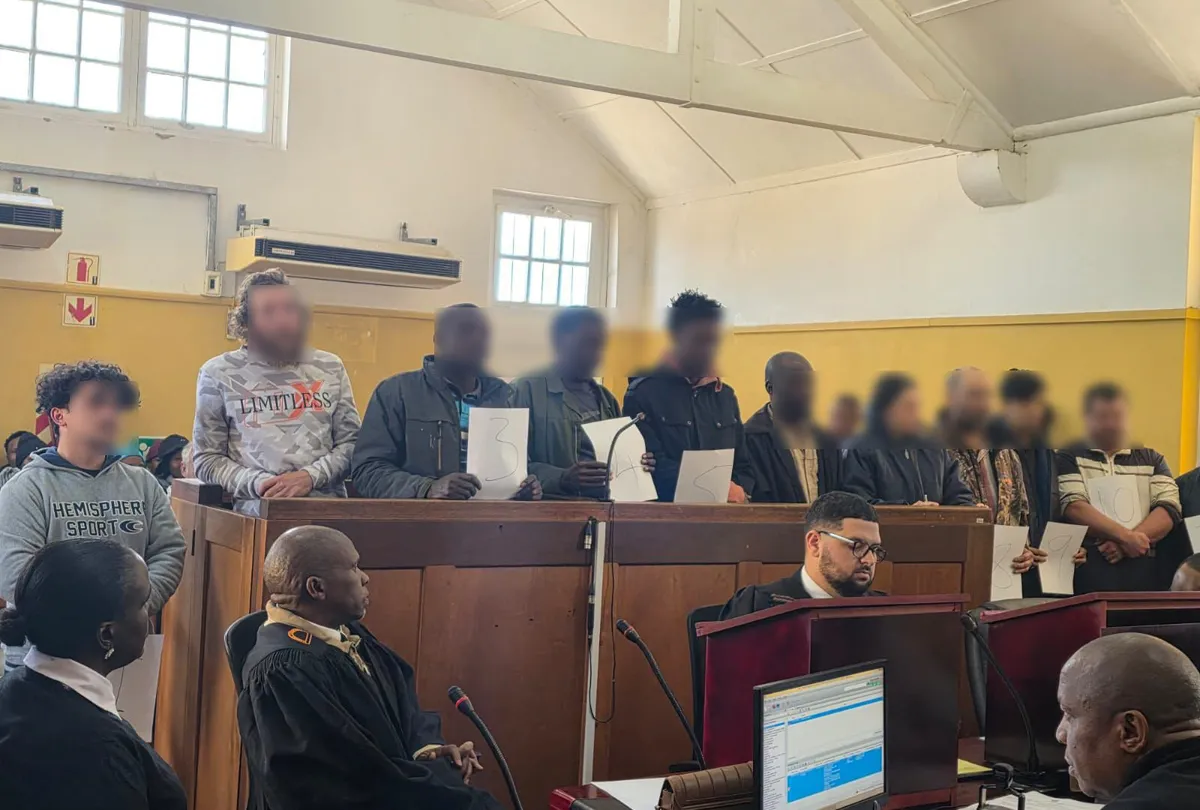
Raids on South African farms have uncovered meth labs linked to Mexican networks, signalling a new cartel phase.11 suspects appeared in Swartruggens Magistrate’s Court facing charges including drug manufacturing, illegal possession of hazardous materials and violations of the Immigration Act.[Handout/SA Police Service]Published On 8 Jun 2026Johannesburg, South Africa – In the quiet mining town of Swartruggens, a small courthouse is preparing to decide whether five Mexicans accused of a major illegal drug operation will be granted bail or remain in custody.Their arrests followed a raid on a remote farm in North West province, where police said they uncovered a large methamphetamine laboratory worth about one billion rand ($60m).The case is one of several pointing to a pattern taking shape in South Africa’s rural interior.The Swartruggens laboratory was not an isolated discovery.It was one of four major meth sites linked to Mexican criminals uncovered in South Africa in just two years, a pattern that has unsettled investigators and organised crime experts.In 2024, police dismantled a large meth facility worth about $105–110 million on a farm near Groblersdal in Limpopo. Later that year, another laboratory worth roughly $5–6 million was discovered near Tshwane, followed by arrests last year in Mpumalanga.Then came Swartruggens.When police moved in on the North West farm in May, they found 481 kilos of methamphetamine, containers of chemicals and firearms. Among those arrested were Mexican nationals Fabian Astorga, Jesus Alonso Medina Astorga, Luis Alberto Ramirez Rios, Jose Andres Medina and Jacquelin Lopez Madrid, alongside co-accused South Africans.All the sites followed the same pattern: remote farmland, long distances from towns and enough isolation for criminal activity to go undetected.The new cartel footprintFor investigators, the pattern is becoming harder to ignore.Mexicans are increasingly being found working alongside local collaborators in rural production sites, suggesting a shift from trafficking meth into Africa to producing it there.Organised crime researcher Julian Rademeyer told Al Jazeera the model reflects a deliberate strategy.“It’s quite a unique development where you have members of Mexican drug cartels franchising, moving chemists into remote rural areas and farms,” he said.The approach has been building for more than a decade, he added.The logic is straightforward: produce closer to consumers, cut transport costs and reduce exposure to border and maritime enforcement.How it spreadMexican-linked networks in Africa did not begin in South Africa.Researchers trace early activity back to Nigeria, where local groups were producing meth with Mexican involvement by around 2016.From there, the networks spread through East Africa, then south through Mozambique and Botswana, before reaching South Africa more recently.For years, users on the streets spoke of “Mexican meth”, often assumed to be imported. That supply chain has now shifted inward.“Now, basically, the cartel chemists are being sent here,” Rademeyer told Al Jazeera.Analysts say multiple supply routes now feed the South African market, but the most significant change is the rise of local production.Who looks the other wayMethamphetamine dominates parts of South Africa’s illicit drug market because cheaper drugs such as cocaine and heroin remain out of reach for many users, creating steady demand for a cheaper, highly addictive stimulant.Crime expert Willem Els says demand is only part of the story.“The main reason why manufacturing locally is lucrative to cartels is the local conditions that exist, where there is protection from corrupt police and politicians,” he told Al Jazeera.“It is very lucrative. The cartels can make a lot of money because South African conditions result in undetected and protected operations.”A separate commission of inquiry into law enforcement has heard testimony alleging deep corruption within policing structures, including missing drug consignments and suspected inside involvement in major cases.One case under scrutiny involves 541 kilos of cocaine seized in 2021 and later stolen from a police facility, in what investigators believe was an inside job.Former Interpol ambassador Andy Mashiale told Al Jazeera the problem is visible on the ground.“There is no way in which police don’t know those labs,” he said. “So corruption plays a role.”He said officers deployed to rural areas were often aware of suspicious activity but failed to act.“What inspires the drug manufacturers or the drug cartels is the willingness of the police to enable the drug trade from happening,” he said.South Africa’s elite Hawks unit says recent raids show progress in disrupting networks, while international partners, including the US Drug Enforcement Administration, have provided intelligence linking some suspects to the Sinaloa Cartel.But investigators warn that the system behind the labs is resilient.A frontier that keeps movingUS Africa Command officials have warned that Mexican cartels are now not only moving drugs through Africa, but also producing them on the continent.For South Africa, the challenge is no longer just border control, it is institutional capacity, intelligence and corruption within the system meant to contain it.Without deeper reform, analysts warn, the pattern is likely to continue: new farms, new labs, new chemists arriving quietly in rural provinces.For the five men in Swartruggens, the question is immediate, whether they will be released.For South Africa, the question is larger and more difficult: how to contain a trade that is no longer arriving at its borders, but taking root in the country.Rademeyer says the structure is built to absorb disruption.“It’s a game of whack-a-mole,” he told Al Jazeera. “You seize a meth lab here, you seize a meth lab there. They’ll spring up elsewhere.”
SRCAl Jazeera
LANGEN
LEANCenter
WORDS877
ENT12
MON · 2026-06-08 · 01:30 GMTBRIEF NSR-2026-0608-82558
NSR-2026-0608-82558News Report·EN·National Security
How Mexican cartels turned South African farms into meth production hubs
Mexican drug cartels are establishing methamphetamine production hubs on remote South African farms, a new phase in their operations. Recent raids have uncovered multiple large meth labs, with the latest in Swartruggens leading to the arrest of five Mexican nationals and co-accused South Africans.
Qaanitah HunterAl JazeeraFiled 2026-06-08 · 01:30 GMTLean · CenterRead · 4 min
Al JazeeraFIG 01
Reading time
4min
Word count
877words
Sources cited
1cited
Entities identified
12entities
Quality score
100%
§ 01
Briefing Summary
AI-generatedNEWSAR · AI
Mexican drug cartels are establishing methamphetamine production hubs on remote South African farms, a new phase in their operations. Recent raids have uncovered multiple large meth labs, with the latest in Swartruggens leading to the arrest of five Mexican nationals and co-accused South Africans. This pattern, observed across different provinces since 2024, suggests a shift from trafficking to local manufacturing, driven by reduced transport costs and proximity to consumers. Experts believe this expansion is facilitated by corruption within South African law enforcement, allowing for undetected operations. These networks have spread across Africa, with early activity traced to Nigeria around 2016.
Confidence 0.90Sources 1Claims 5Entities 12
§ 02
Article analysis
Model · rule-basedFraming
National Security
Legal & Judicial
Tone
Mixed Tone
AI-assessed
CalmNeutralAlarmist
Factuality
0.70 / 1.00
Factual
LowHigh
Sources cited
1
Limited
FewMany
§ 03
Key claims
5 extracted01
Five Mexicans accused of a major illegal drug operation appeared in Swartruggens Magistrate’s Court.
factual
Confidence
0.95
02
Mexican drug cartels are franchising and moving chemists into remote rural areas and farms in South Africa.
quoteJulian Rademeyer
Confidence
0.90
03
One large methamphetamine laboratory worth about one billion rand ($60m) was uncovered on a remote farm in North West province.
statisticSA Police Service
Confidence
0.90
04
Raids on South African farms have uncovered meth labs linked to Mexican networks, signaling a new cartel phase.
factual
Confidence
0.90
05
Four major meth sites linked to Mexican criminals have been uncovered in South Africa in the past two years.
factual
Confidence
0.85
§ 04
Full report
4 min read · 877 words§ 05
Entities
12 identifiedKey playerOppositionContextPositiveNeutralNegative
People4
Organizations2
§ 06
Keywords & salience
9 termsmeth production
1.00
mexican cartels
1.00
south african farms
0.90
drug manufacturing
0.80
organised crime
0.70
methamphetamine
0.60
rural areas
0.60
cartel phase
0.50
trafficking
0.40
§ 07
Topic connections
Interactive graph Network visualization showing 51 related topics
View Full Graph Person Organization Location Event|Click node to navigate|Edge numbers = shared articles